
Bak Kut Teh in Singapore: the 6 MICHELIN Guide shops, the 3 styles of broth, and what a bowl really costs
| Shops in the guide | Of the 307 establishments in the MICHELIN Guide Singapore 2026 selection, 6 serve bak kut teh. |
|---|---|
| Stars | None of the 6 holds a star; 3 carry a Bib Gourmand and 3 are listed as Selected. |
| Styles | The National Library Board describes 3 traditional styles, Hokkien, Cantonese and Teochew, and they do not taste alike. |
| Easiest to reach | Song Fa on New Bridge Road and Sin Heng on Joo Chiat Road are the 2 that sit near an ordinary sightseeing route. |
| Price | Founder publishes 10.20 Singapore dollars for its house bowl on its own ordering site, and 5 of the 6 guide-listed shops carry the cheapest price band. |
| Morning opening | Only 2 of the 16 Song Fa outlets in Singapore open before 10:00, at Jewel Changi Airport and on New Bridge Road. |
1. One dish name, several different bowls
2. Hokkien, Cantonese and Teochew: the 3 traditional styles
3. The 6 shops in the MICHELIN Guide Singapore selection
4. Half the list is in Jurong, and two of those are one block apart
5. The 2 you can reach without rearranging the trip
6. Song Fa has 16 outlets in Singapore and 2 of them open in the morning
7. Well-known shops the guide does not list
8. What a bowl costs, and why the official figures do not answer the question
9. What arrives alongside the bowl
10. The tea the dish is named after
11. Versions made without pork, and what halal means here
12. Dry bak kut teh, and where it sits
13. The argument with Malaysia over where the dish came from
14. When to go, and the days these places are shut
15. Where a bowl fits in a short Singapore trip
1. One dish name, several different bowls
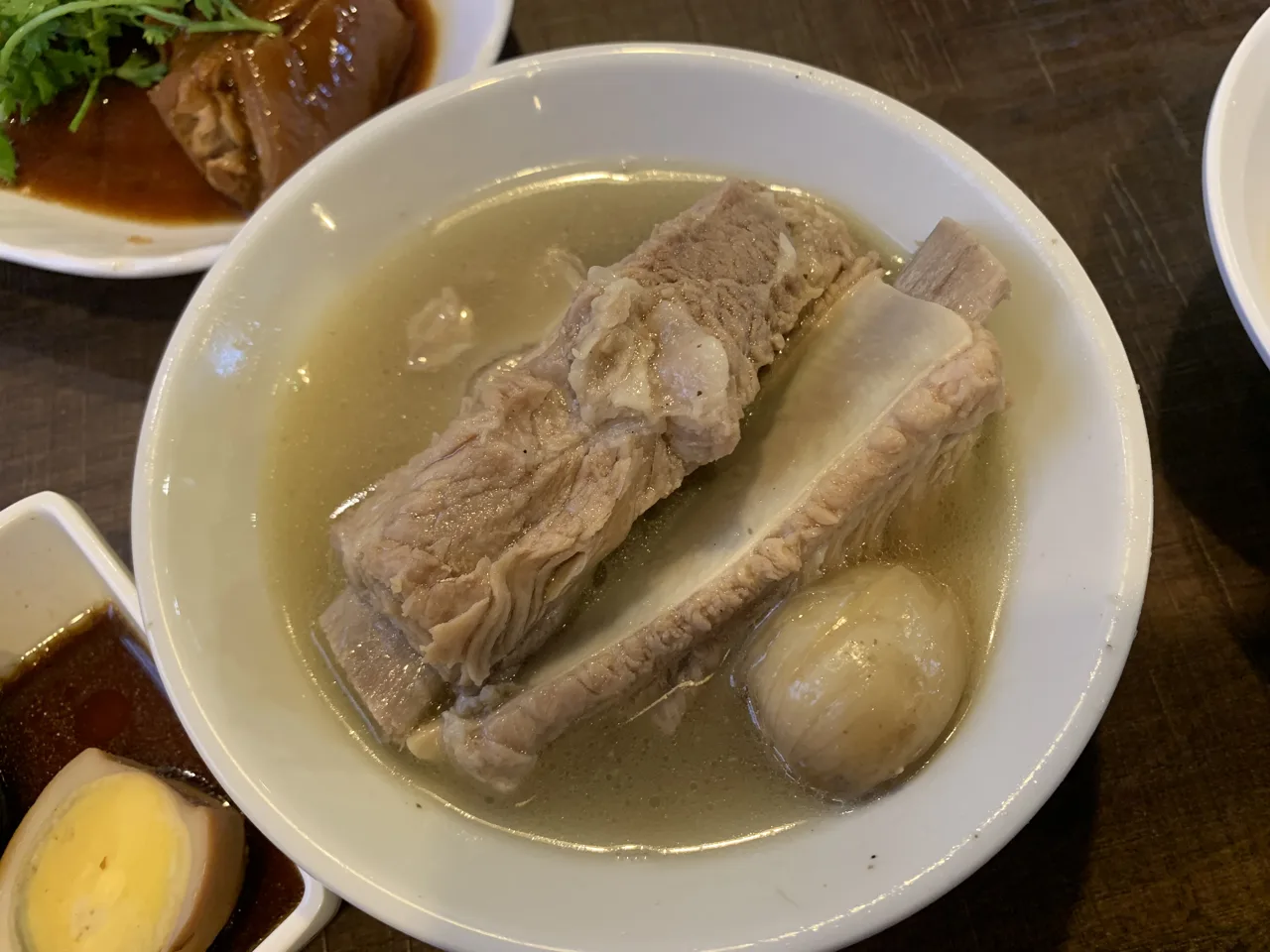
Bak kut teh is pork ribs in soup, and that is where the agreement stops. One shop sends out a pale broth that tastes of white pepper and garlic. Another sends out something dark brown, thick and heavy with Chinese medicinal herbs. Both are correct, both have been sold under the same three words for well over a century, and neither is a variation on the other.
What the name actually says
The National Library Board lists the dish under three names: bak kut teh in Hokkien, rou gu cha in Mandarin, and the written form 肉骨茶. Read character by character, those are meat, bone and tea. The first two describe what is in front of you.
The third character is not in the bowl
The National Heritage Board puts the point directly on its Roots portal. The name carries the word tea, but the food contains no tea at all. What the word refers to is the Chinese tea poured alongside, a habit with a long commercial history of its own in this city, and one that has its own section further down this page.
What goes into the pot
The heritage board lists the spices as star anise, cinnamon, cloves, fennel seed and garlic, simmered with the pork for several hours. Nothing on that list is rare and nothing is expensive. The distance between one shop and the next comes from the proportions, from how long the pot runs, and from what else is allowed in.
Garlic goes in as whole cloves rather than chopped. Over several hours of simmering the cloves soften completely, and they come up in the ladle with the ribs. Pepper carries the lighter versions, and at least one of the shops named on this page roasts its own in the kitchen rather than buying it ground.
What a plain order looks like
A basic order is one bowl of ribs in broth, one bowl of white rice, and a saucer of dark soy sauce for dipping the meat. Everything else costs extra and is ordered separately, which is why two people at the same table can pay quite different amounts. Reading a bill here is easier if you already know how a hawker centre stall prices its plates, because four of the six shops in the guide are stalls rather than restaurants.
The dish began as a working breakfast. The library board records that Hokkien immigrants brought it from Fujian province in China during the 19th century, and that it spread here as food for coolies, eaten early and before a shift. That detail becomes awkward later on, because most of the shops selling it now are shut at breakfast time, and planning a short Singapore trip around a bowl of it takes more care than planning around chicken rice.
2. Hokkien, Cantonese and Teochew: the 3 traditional styles
The National Library Board separates bak kut teh into 3 traditional styles, and the dividing line is dialect group rather than neighbourhood. Knowing which one a shop cooks tells you the colour of the broth before it arrives and roughly how salty it will be.
Hokkien: thick, dark, salty
This is the version boiled with rock sugar and a long list of Chinese medicinal herbs. A generous quantity of dark soy sauce goes in as well, and that is what produces the deep brown colour. The library board records it as the saltier of the styles. Visitors who were told to expect a clear soup and get this one instead tend to assume something has gone wrong with the order. Nothing has.
Cantonese: the most herbal of the three
By the library board’s account the Cantonese version uses more herbs than the Hokkien one while being less salty, which makes it the least aggressive of the three on the palate and the most medicinal on the nose. Button mushrooms, cabbage and dried beancurd are part of the recipe rather than paid extras, so the bowl arrives with more solid material in it than ribs alone.
Teochew: clear, and all pepper and garlic
Seasoning here is limited to garlic, soy sauce and pepper. The pot is skimmed while it boils, which is why the finished liquid is a clear brown rather than a cloudy one. The heritage board makes the same comparison from the opposite direction and notes that Teochew broth is lighter in colour than Hokkien broth. What you taste is garlic and a heavy dose of pepper, with very little sweetness behind it.
| Style | Colour and body | Salt | Herbs | Other ingredients |
|---|---|---|---|---|
| Hokkien | Thick, cloudy, dark brown | The saltiest of the three | Many Chinese medicinal herbs | Rock sugar, a large amount of dark soy sauce |
| Cantonese | Herbal, darker than Teochew | Less salty than Hokkien | More herbs than the Hokkien version | Button mushrooms, cabbage, dried beancurd |
| Teochew | Clear and light, clear brown | Seasoned rather than salted | None in the seasoning | Garlic, soy sauce, pepper; the pot is skimmed |
you want to taste the pork and the pepper, you are eating early, or you have someone at the table who dislikes the smell of Chinese herbs.
you want the darker, sweeter, saltier bowl, and you plan to eat it with a lot of rice rather than on its own.
you actively want the herbal character, and you would rather have mushrooms, cabbage and beancurd in the bowl than order sides separately.
Teochew is the style most short-stay visitors meet, because the better known shops near the city centre cook it. Ng Ah SioMap describes itself on its own website as Aromatic Teochew Style. Song FaMap was started by a man from a Teochew family, and the Roots portal describes the broth at Kai Juan on Balestier Road as clear and peppery, which is the Teochew profile exactly.
Shops do not usually print the style on the signboard. Where there is no label, the colour of the broth answers the question in a second, and the menu answers the rest: a shop listing mushrooms and cabbage in the soup is not cooking the pepper version.
This split has no parallel in the other dishes a first-time visitor is told to eat. Hainanese chicken rice varies by stall in the way any cooked dish varies by stall, but nobody is serving you a different recipe under the same name. With bak kut teh they are.
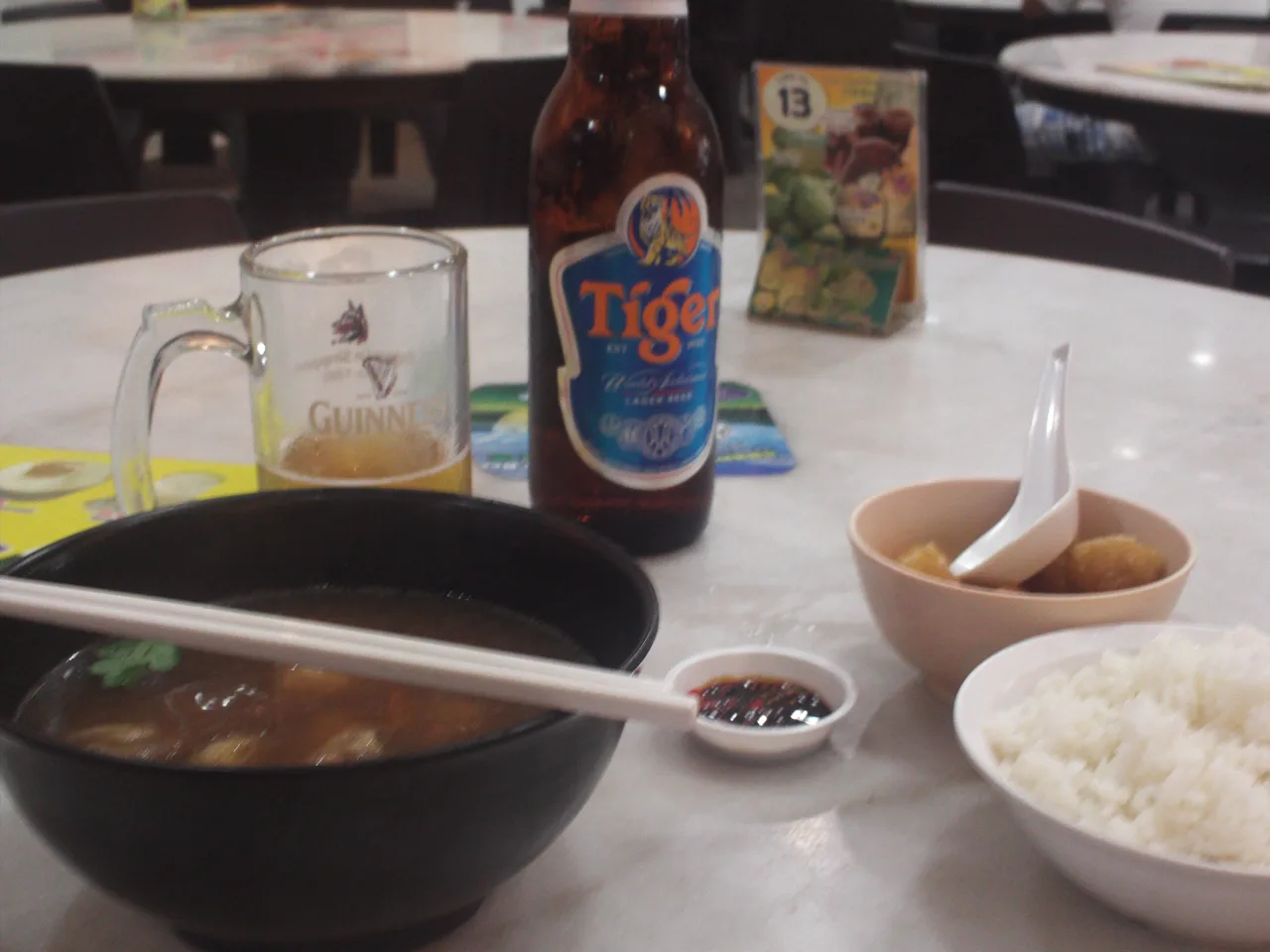
3. The 6 shops in the MICHELIN Guide Singapore selection
The MICHELIN Guide Singapore 2026 selection runs to 307 establishments across every price level in the country. Six of them serve bak kut teh. That is the entire population and not a shortlist, which means the table below is the complete answer to the question of which bak kut teh the guide keeps in its book.
| Shop | Award | Area | Price band |
|---|---|---|---|
| Song Fa Bak Kut TehMap (New Bridge Road) | Bib Gourmand | New Bridge Road, at the edge of Chinatown | $ |
| Sin Heng Claypot Bak Koot TehMap | Bib Gourmand | Joo ChiatMap Road, Katong | $$ |
| Joo Siah Bak Koot TehMap | Bib Gourmand | Jurong EastMap Avenue 1 | $ |
| Hua Xing Bak Kut TehMap | Selected | Yuhua Market and Hawker CentreMap, Jurong East Avenue 1 | $ |
| Yong Kee Claypot Bak Kut TehMap | Selected | Taman Jurong Market and Food CentreMap, Yung Sheng Road | $ |
| Leon Kee Claypot Pork Rib SoupMap | Selected | Alexandra Village Food CentreMap, Bukit Merah | $ |
No stars at all
Not one of the 6 holds a star. Three hold a Bib Gourmand, which the guide awards for good cooking at a moderate price, and three are listed as Selected, meaning inspectors visited, kept the shop in the book, and attached no symbol to it. Anyone working through the starred restaurants in Singapore will not meet this dish there.
One dish, two cuisine labels
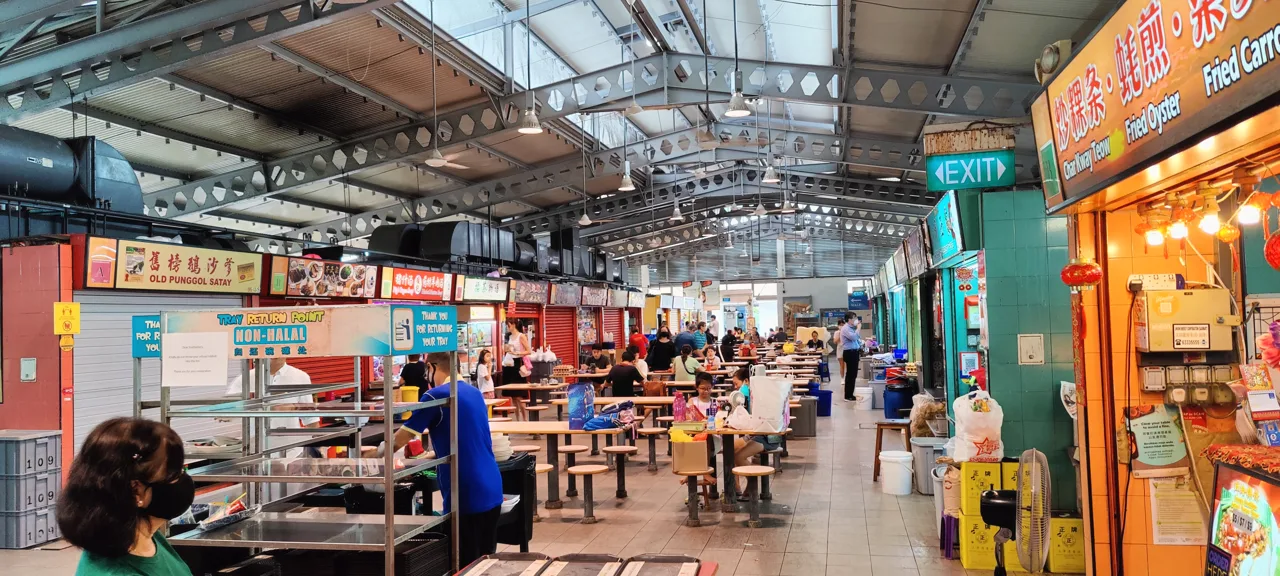
The guide files Song Fa and Sin Heng under Singaporean cuisine and the other four under Street Food. The split tracks the premises rather than the recipe: the first two are shopfront restaurants with their own doors, and the other four are stalls inside public markets and food centres. It is a useful signal for anyone deciding where to take a group, because a stall means communal seating and a tray return point.
One of them does not have the dish in its name
Leon Kee Claypot Pork Rib Soup at Alexandra Village Food Centre is the outlier. Pork rib soup is a plain English rendering of the first two characters of 肉骨茶, so the name is accurate, but it will not turn up for anyone searching the three familiar words. The inspectors note that the house dish there is pork rib soup cooked with Chinese herbs, and that the stall also sells pig tail soup, sesame oil chicken and claypot pork liver.
Three of the six put claypot in the name
Sin Heng, Yong Kee and Leon Kee all carry the word, written 砂锅 in Chinese. It describes how the soup reaches the table: heated in an earthenware pot and served in the same pot, still moving. Yong Kee is described by the guide as serving pork rib soup in a claypot with peppercorns alongside, and its herbal version is noted as balanced rather than overpowering.
No bookings, and only 2 telephone numbers
None of the 6 accepts a reservation. Only 2 publish a telephone number in the guide, Song Fa on +65 6533 6128 and Sin Heng on +65 6345 8754. The remaining four publish none at all, which is ordinary for a hawker stall and means there is no way to check in advance whether the day’s pot has run out.
The inspectors’ notes are short but they do separate the shops. Hua Xing is described as strong and peppery, with rice, pork organs, pork trotter or vegetable soup available to fill out the meal. Joo Siah is also a pepper bowl, with soft rib meat and a chilli soy sauce, and the guide flags that it closes earlier on Sundays. Sin Heng is recorded as a simple shop of more than 40 years, now run by the second generation, with pepper and garlic in a claypot as its speciality.
4. Half the list is in Jurong, and two of those are one block apart
Three of the 6 sit in Jurong, in the west of the island. That is not where a three to five day itinerary goes. Marina Bay, Chinatown and SentosaMap are all in the south, and Jurong is a deliberate journey out and a deliberate journey back, taken for the food and for nothing else nearby.
Two addresses on the same street
Joo Siah Bak Koot Teh is at Block 349, Jurong East Avenue 1. Hua Xing Bak Kut Teh is at Block 347, on the same avenue, inside Yuhua Market and Hawker Centre. The coordinates the guide publishes for the two put them about 80 metres apart, which is one block of public housing. A Bib Gourmand and a Selected listing for the same dish, almost within sight of each other, and both in the cheapest price band.
That pairing is the single best reason to make the trip. Two bowls of pepper broth from two different cooks, tasted within an hour, tells you more about the dish than a week of reading. Joo Siah sends out soft rib meat with a chilli soy sauce on the side. Hua Xing sends out something the inspectors call strong and peppery, and sells pork organs, pork trotter and vegetable soup to build the meal out.
The third one is a short ride further
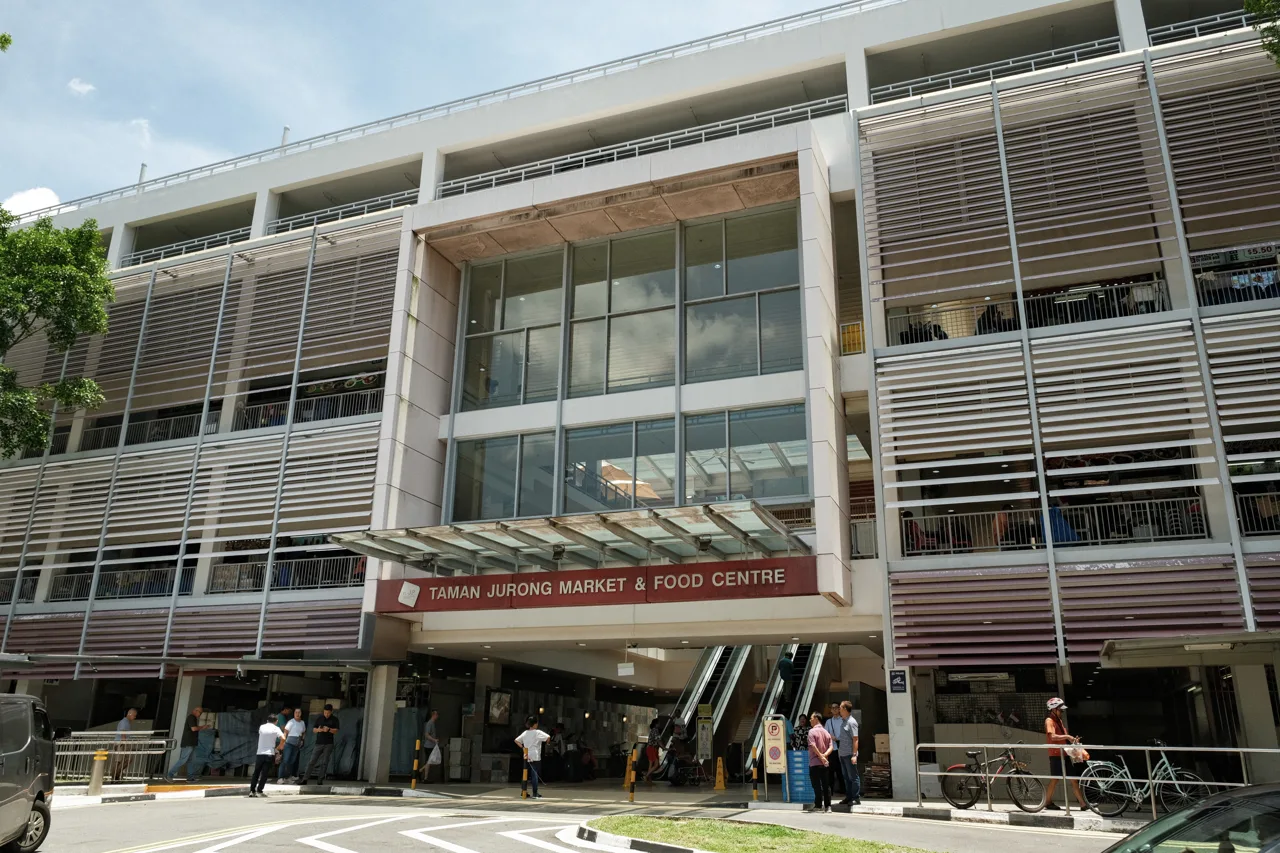
Yong Kee Claypot Bak Kut Teh is at stall 02-78 inside Taman Jurong Market and Food Centre on Yung Sheng Road. The stall number matters: the cooked food is on the second level, above the wet market, and the escalators on the front of the building take you up. The claypot arrives with peppercorns served alongside rather than only cooked into the broth.
Cheap food, expensive hours
The money is small and the time is not. All three Jurong shops are in the cheapest guide price band, so the bowls themselves are the least expensive part of the day. The cost is the crossing of the island in both directions, which is worth weighing against everything else competing for the same hours. Anyone tracking what a day in Singapore costs will find the meal cheap and the half day around it far less so.
There is a second reason to think about the west, and it has nothing to do with the guide. Song Fa has an outlet at Jem, the shopping centre above Jurong East station, which means a traveller already in the area has a fourth bak kut teh option within a few minutes’ walk of the train. It holds no award, but it is open in the evening when the stalls have long closed.
5. The 2 you can reach without rearranging the trip
Two of the six sit where ordinary sightseeing already takes people. They are also the two the guide files as restaurants rather than stalls, and the two with a published telephone number, so they are the realistic answer for most short visits.
Song Fa Bak Kut Teh, 11 New Bridge Road
The shop is at unit 01-01, 11 New Bridge Road, at the northern edge of the Chinatown area and within walking distance of the Singapore River. It holds a Bib Gourmand in the 2026 selection, and the company states on its own website that this is the tenth consecutive year the New Bridge Road shop has held one. The award belongs to this address only. None of the other Song Fa outlets carries it.
The shop takes no booking, so the queue is the queue. It also opens at 09:30 every day, which makes it one of only 2 Song Fa outlets in the country trading in the morning. That makes it the easiest place in the city centre to eat the dish at something close to the hour it was originally eaten, which fits neatly into a morning in Chinatown before the temples fill up.
One oddity is worth flagging because it will bite anyone navigating by postcode. The guide lists the shop under postcode 059386 and Song Fa’s own website gives 059383 for the same address. The street number, 11 New Bridge Road, is identical in both, so use the street address rather than the postcode.
Sin Heng Claypot Bak Koot Teh, 439 Joo Chiat Road
Sin Heng is at unit 01-01, 439 Joo Chiat Road, in the middle of the shophouse stretch that runs through Katong and Joo Chiat. The guide describes it as a simple shop that has been going for more than 40 years and is now run by the second generation owner, with pepper and garlic bak kut teh served in a claypot as its speciality.
It is the only one of the 6 in the second price band rather than the cheapest, which is consistent with it being a sit-down shop in a district where rents are not hawker rents. The guide publishes no opening hours for it, and the shop should be treated as a lunch and dinner proposition rather than a breakfast one unless you have confirmed otherwise.
The pairing of these two is useful in a different way. Both cook the clear peppery style, so a traveller who tries one and then the other is comparing two versions of the same idea rather than two different dishes. Anyone who wants the dark herbal bowl for contrast needs to look outside the guide list entirely.
6. Song Fa has 16 outlets in Singapore and 2 of them open in the morning
Song Fa is the name most English-speaking visitors arrive already knowing, and it is now a chain of some size. The company lists 16 outlets in Singapore and 24 more abroad, in Indonesia, Bangkok, Shanghai and Taipei, for a total of 40. The guide’s Bib Gourmand attaches to exactly one of the 40.
Where the 16 are
The Singapore outlets are spread across shopping centres and transport hubs: 111 Somerset, Punggol Coast Mall, VivoCityMap, 11 New Bridge Road, Bukit Panjang Plaza, Chinatown Point, ESR BizPark at Changi, Jem, Jewel ChangiMap AirportMap, Mandai Wildlife East, Northpoint City, Suntec City, The Centrepoint, The Seletar Mall, Velocity at Novena Square and Waterway Point. Two of those are places a visitor is likely to pass without planning to: the Jewel complex at Changi Airport, and the Mandai wildlife parks, where the outlet stands in the area you can enter without a park ticket.
Two of them open in the morning
Jewel Changi Airport runs 09:00 to 21:30 daily. New Bridge Road runs 09:30 to 21:30 daily. The other 14 outlets open at 11:00 from Monday to Friday and at 10:30 on Saturdays, Sundays and public holidays.
Set that against the origin of the dish and the arithmetic is uncomfortable. Bak kut teh spread in Singapore as a breakfast for dock and warehouse labourers, eaten before work. The largest operator of it in the country now opens most of its doors closer to lunch than to breakfast, because a mall tenancy sets the opening hour and a pushcart did not. If eating it early matters to you, the choice is Jewel, New Bridge Road, or a hawker stall, and the rest of an early morning in Singapore has to be built around that.
From a pushcart to 40 shops
Yeo Eng Song, the second of 9 siblings in a Teochew family, learned to cook at a zichar stall at 19 and opened his own stall at 21.
In 1969 he began selling bak kut teh from a pushcart on Johor Road. His customers were taxi drivers and families.
In 1975 the business moved indoors, into a coffee shop on Victoria Street beside the site where Raffles Hospital now stands. The logo and the pink uniforms date from then.
The second generation runs it today: three siblings, Diana, Hart Pong and Zhi Yong.
The guide’s own note on the shop makes the same point in one line, observing that much has changed since Mr Yeo started selling from a pushcart on Johor Road in the late 1960s, and that the family’s second generation now runs the business.
What is actually on the menu
The website lists 8 soups, 8 braised dishes and 12 sides, and puts no price against any of them. It also lists 7 teas, among them Bu Zhi Xiang, Tie Guanyin, Osmanthus Oolong and aged puer, and 8 retail products including white and black pepper in whole and ground form, a bak kut teh spice mix and a braising spice mix. Pepper is roasted on the premises, and the company states that it uses Sarawak pepper.
That last detail is the one worth carrying into the bowl. In a Teochew-style soup, pepper is not a garnish but one of only three seasonings, so where it comes from and how recently it was roasted is close to the whole flavour.
7. Well-known shops the guide does not list
Absence from the selection is not a verdict. Three of the names that come up most often in English-language writing about this dish are not in the 2026 guide at all, and each is worth understanding on its own terms before deciding where to spend a meal.
Ng Ah Sio
Ng Ah Sio dates itself to 1955 and is now owned by the JUMBO Group, the restaurant company that also runs a large chilli crab operation. It describes its own cooking on its website as Aromatic Teochew Style, which places it in the clear peppery camp rather than the herbal one.
There are 3 outlets in Singapore, at Tai Seng, Rangoon Road and Clarke QuayMap Central, plus 2 in China. The Tai Seng shop at 26 Tai Seng Street, unit 01-05, publishes its hours as 11:00 to 22:00 from Monday to Friday and on the eve of a public holiday, and 10:00 to 22:00 at weekends and on public holidays, with last orders at 21:30 in both cases. Its telephone number is +65 6027 2756.
Each outlet has its own menu on the company site, but they are published as image files, so the prices cannot be read as text or compared quickly. The company also sets out its own version of where the dish comes from: coolies working the godowns along the Singapore River who could not afford meat and made soup from pork bones instead.
Founder
Founder, written 發起人肉骨茶, describes itself as more than 40 years old and gives its own name in both readings, Rou Gu Cha in Mandarin and Bak Kut Teh in Hokkien and Teochew. Its outlet page lists two shops: Balestier, at 347 Balestier Road, open 11:45 to midnight and closed on Tuesdays, on +65 6352 6192; and Hotel Boss at 500 Jalan Sultan, unit 01-19, open 11:00 to 21:30 daily. Abroad it has one outlet each in Hangzhou, Jakarta, Taipei and Ho Chi Minh City.
There is a discrepancy on its own website worth knowing about. The ordering system carries a third Singapore outlet, at Bedok Marketplace, 348 Bedok Road, that the outlet page does not list. The Bedok shop is shown with special hours of 10:00 to 21:30 from Tuesday to Friday. Where a company’s own two pages disagree, treat the ordering system as the one being maintained and the outlet page as the one that has not been updated.
Kai Juan
Kai Juan Bak Kut TehMap at 395 Balestier Road is the only bak kut teh stop among the 11 sites on the National Heritage Board’s Balestier Food Trail. The board describes it as about 50 years old, with a broth that is clear and peppery, which makes it a textbook Teochew bowl. Boon Tong Kee Chicken Rice is on the same trail, so the two can be done in one walk.
The trail page carries opening hours, but the heritage board last updated it in 2020, which is old enough that the hours should be confirmed with the shop rather than relied on. Balestier Road is also where Founder’s original branch sits, a few hundred metres away, so this one street holds two bak kut teh shops of long standing and neither of them is in the guide.
The library board names three places where bak kut teh stalls have historically clustered: the central business district, Balestier Road and GeylangMap Road. Only the first of those is on a normal tourist route, which goes some way to explaining why the same two or three shop names circulate in English while the dish itself is sold all over the island.
8. What a bowl costs, and why the official figures do not answer the question
Very few bak kut teh shops publish prices. Song Fa lists 8 soups on its website with no figure beside any of them. Ng Ah Sio publishes menus as images. The one operator that puts numbers in readable form is Founder, through its own ordering system, and those figures are the most solid published prices available for the dish.
Founder’s published prices
| Item | Price (Singapore dollars) |
|---|---|
| Premium Loin Ribs | 7.20 |
| Popularity Bak Kut Teh | 8.20 |
| Premium Short Ribs | 10.20 |
| Founder Bak Kut TehMap | 10.20 |
| Classic Bak Kut Teh | 12.10 |
| Claypot Sliced Lean Meat | 11.20 |
| Claypot Popularity | 13.20 |
| Sliced lean meat, pig stomach, liver, intestine, mixed organ, pork ball or pig tail (each) | 8.10 |
| Braised pig trotter | 8.10 |
| Braised large intestines | 13.10 |
| Seaweed | 4.30 |
| Mushroom | 5.30 |
| Lettuce or choy sum | 5.80 |
| Tang o | 6.80 |
The house bowl, listed as Founder Bak Kut Teh, is 10.20 Singapore dollars. The cheapest rib soup on the list, Premium Loin Ribs, is 7.20. The gap between them is the cut of rib rather than the size of the bowl, which is the main thing that moves the price inside a single shop’s menu.
Sides are not small money. A plate of greens runs from 4.30 to 6.80 Singapore dollars, so a table that orders two soups, rice and two vegetables has roughly doubled the cost of the soups. This is the mechanism by which a cheap dish becomes a moderately priced meal, and it is the same mechanism at a hawker stall as at a restaurant.
The statistics office counts the bones, not the bowl
Singapore’s statistics office maintains a retail price basket of 78 items. Nineteen of those are cooked food and drink sold by the plate, bowl, piece or cup, and the list includes chicken rice, char kway teow, char siew rice, duck rice, economical rice, wanton noodles, fishball noodles, sliced fish bee hoon, mee rebus, mee siam, fried carrot cake and roti prata.
Bak kut teh is not among the 19. What the office tracks instead is the raw material: chilled pork rib bones by the kilogram, and frozen pork rib bones in 500 gram packs. So the published series follows the cost of the bones going into the pot rather than the price of the soup coming out of it.
| Year | Pork rib bones, chilled (S$ per kg) | Lean pork, chilled (S$ per kg) | Chicken rice, one plate (S$) |
|---|---|---|---|
| 2015 | 16.72 | 13.32 | 3.21 |
| 2019 | 16.91 | 13.97 | 3.40 |
| 2021 | 18.03 | 15.31 | 3.54 |
| 2022 | 19.34 | 15.95 | 3.86 |
| 2023 | 20.28 | 16.51 | 4.15 |
| 2024 | 18.32 | 15.72 | 4.08 |
| 2025 | 18.43 | 15.56 | 4.14 |
Rib bones cost more than lean pork, every year
In all 11 years the office has published, a kilogram of chilled pork rib bones cost more than a kilogram of chilled lean pork. That is the opposite of the usual assumption, which treats bones as the cheap part of the animal and lean meat as the expensive part. Demand explains it: the bone is the point of this dish and of several other soups, so the cut it competes for is not the offcut market.
Inside the older basket, the direction is clear. A kilogram of chilled rib bones was 16.72 Singapore dollars in 2015 and 20.28 in 2023. Over the same span a plate of chicken rice went from 3.21 to 4.15, which is the closest thing to a like-for-like cooked dish in the basket, since chicken rice is counted and bak kut teh is not.
For a traveller the practical conclusion is short. There is no official price for a bowl of bak kut teh in Singapore, the one operator that publishes figures asks 10.20 Singapore dollars for its house version, and 5 of the 6 guide-listed shops carry the cheapest price band. That is enough to plan a daily food budget around without pretending to more precision than exists.
9. What arrives alongside the bowl
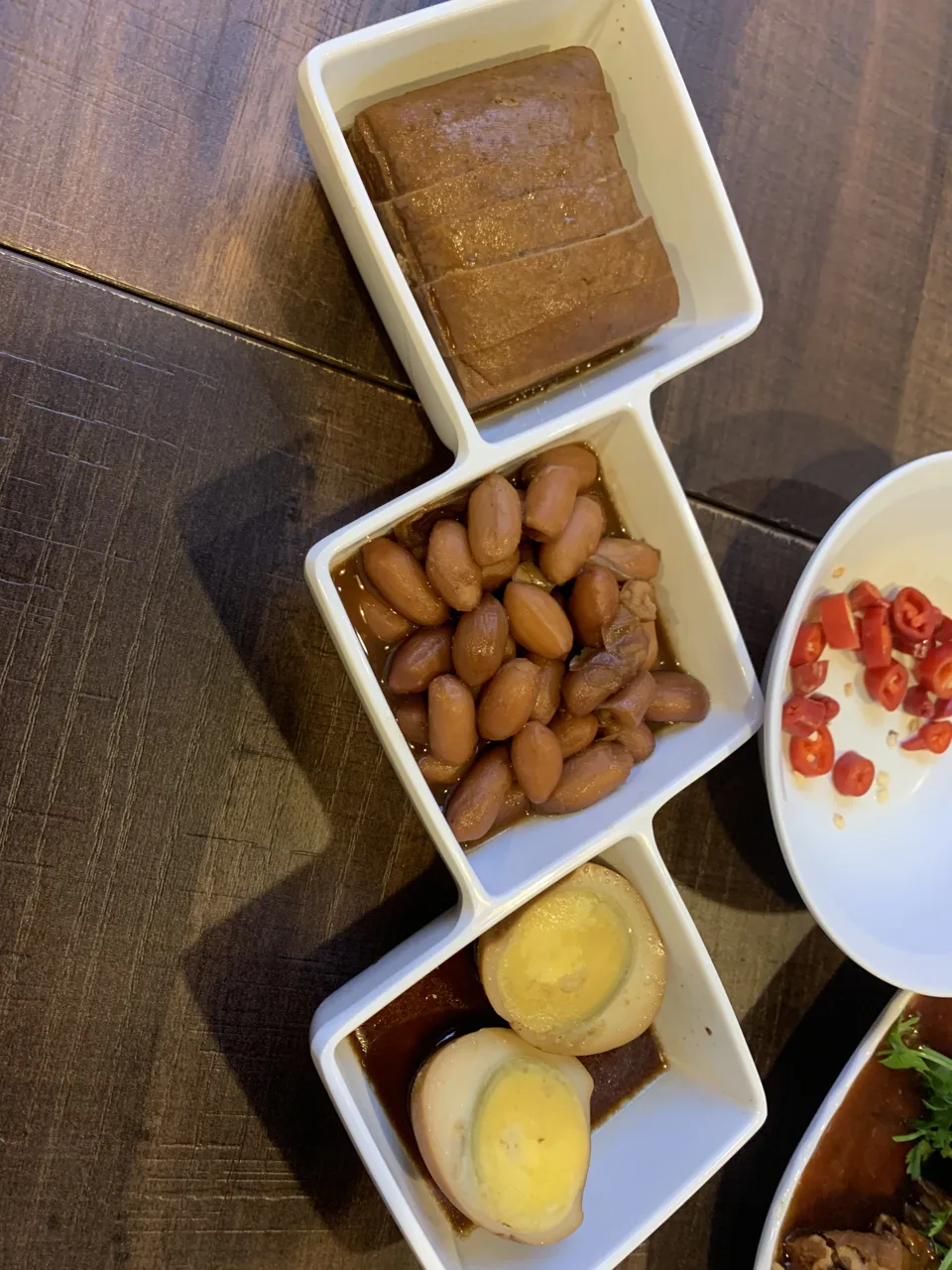
The soup is the smaller half of the order. The National Library Board lists the standard accompaniments as white rice, you tiao, offal, preserved vegetables and braised beancurd skin, and a table of four will usually have most of those on it at once.
You tiao
A length of deep-fried dough, cut into short pieces before it reaches the table. It is not eaten dry. The pieces go into the broth for a few seconds and are lifted out once they have taken up the liquid without collapsing, which is a matter of timing that anyone can get right on the second attempt.
The dip
Dark soy sauce in a saucer, for the rib meat. The library board records that sliced chilli, minced garlic or chilli padi are commonly added to it, and at most shops those sit in a communal container on the table or at a counter for customers to take. Chilli padi is small and considerably hotter than the sliced red chilli it sits next to, so it is worth telling the difference before building the sauce.
Preserved vegetables and braised beancurd skin
Salted preserved vegetables give the meal an acid, salty counterweight to a broth that is otherwise all pork and pepper. Braised beancurd skin is the soft, layered sheet that takes up braising liquid and holds it. Neither is expensive and both are usually ordered by the small plate rather than by the portion.
Offal
This is not a sideshow. Founder lists pig stomach, pig liver, pig intestine, mixed organ, pork ball and pig tail separately, each at 8.10 Singapore dollars, which is more than the cheapest rib soup on the same menu. Leon Kee at Alexandra Village Food Centre is recorded by the guide as selling pig tail soup, sesame oil chicken and claypot pork liver alongside its main dish. Hua Xing sells pork organs and pork trotter as add-ons to build out a meal.
Refills
Topping up the broth is a common courtesy at bak kut teh shops, but none of the six operators in the guide publishes a policy on it, and neither Song Fa nor Founder mentions it in writing. Treat it as something to ask about at the counter rather than to assume, particularly at a stall where the queue behind you sets the pace.
Ordering strategy for two people is simple enough: one soup each, one bowl of rice each, one plate of greens and one plate of beancurd skin or preserved vegetables for the table. Add offal only if someone actually wants it, because at 8.10 Singapore dollars a plate it is priced as a dish rather than as a garnish.
10. The tea the dish is named after
The third character in 肉骨茶 has a commercial history that is older than most of the shops selling the soup. BiblioAsia, the National Library Board’s journal, sets it out in its issue for the third quarter of 2026, and the story runs through two family tea firms that are still trading.
Two tea shops from the 1920s
Pek Sin ChoonMap, written 白新春茶庄, and Guan Chong Bee, written 源崇美茶庄, were both founded in the 1920s by Fujianese merchants and both are still in business. That is an unusual survival rate for a trade that has otherwise mostly disappeared into supermarkets.
The tea was free, and that is why it is in the name
Bak kut teh was traditionally served with tea at no charge, brewed from lower-grade leaves. A free cup of cheap tea is exactly the sort of thing that attaches itself to a dish and ends up in its name, and it also explains why nobody thought the name was strange at the time: the tea was on the table, just not in the bowl. Pek Sin Choon later developed a blend intended specifically to be drunk with the soup, which turned an afterthought into a product.
Bu Zhi Xiang
The blend is called Bu Zhi Xiang, written 不知香, and Pek Sin Choon supplies it exclusively. It appears on Song Fa’s tea list, which runs to 7 teas in all, alongside Xiang Ji JiMap, Tie Guanyin, Osmanthus Oolong, King’s Garden Tea, Xiang Pian and aged puer. Ordering it is the closest a visitor gets to drinking the thing the dish is named after rather than whatever the shop happens to pour.
Why the paper is pink
Pek Sin Choon wraps its tea in pink paper, and the reason is wartime supply. During the Japanese Occupation, paper ran short and the shop sourced what it could from Chinese medicine halls, which used pink. The colour stayed after the war and became the firm’s mark. The packets are still wrapped by hand in the shop.
There is a practical reason to drink it as well as a historical one. The library board records the belief that Chinese tea washes down the oil and fat of the soup, which is a plain enough claim about a broth that has been simmering bones for several hours. Whether or not it does anything, a pot of hot tea between two people costs a fraction of what the soup costs and changes the pace of the meal, which matters at a shop where nobody can book a table and the queue is visible from your seat. It also gives a solo traveller something to do while the pot cools, which is not nothing on a first trip through the city.
11. Versions made without pork, and what halal means here
Pork is not incidental to bak kut teh. The name says bone, the dish is a pork rib soup, and all 6 of the shops in the guide cook pork. Anyone who does not eat pork is not looking at a menu substitution but at a different product, and it is worth knowing what has actually been made and what has not.
Mutton, beef and ostrich
The National Library Board records versions made with mutton, beef and ostrich. It ties their appearance to Muslim customers, and separately to the Nipah virus outbreak of the late 1990s, which hit pig farming in this region and pushed operators towards other meats. Ostrich is the surprising one on that list and reflects a period when it was being promoted as a lean red meat.
None of the guide-listed shops is a candidate
The six shops in the selection are pork shops. Three of them are stalls inside public food centres, and food centres in Singapore separate halal and non-halal operations physically, down to the tray return points, which are signed for one or the other. A stall selling pork rib soup sits on the non-halal side of that line by definition.
For Muslim travellers the sensible approach is to treat bak kut teh as a dish to read about rather than to chase, and to spend the meal on something with a wide certified supply instead. The practicalities of that are covered in the guide to eating and travelling in Singapore as a Muslim visitor, which deals with certification marks and with which food centres have certified stalls.
What the separation looks like on the ground
Inside a food centre the division is unmissable once you know to look. Signboards carry certification marks where they apply, and the tray return points are labelled. Alexandra Village Food Centre, where Leon Kee trades, has a return point signed as non-halal, which tells you the section you are standing in without having to read a single stall board.
One further note for mixed groups. Because certified and non-certified stalls can sit under the same roof in a public food centre, a group that splits its order can still eat at the same table, and that is often the workable compromise. The constraint is not the building; it is the individual stall.
12. Dry bak kut teh, and where it sits
Dry bak kut teh turns up on menus and in conversation often enough that it needs placing. It is the same meat cooked down until almost no liquid is left, finished in a claypot, and eaten as a dish rather than as a soup.
What the heritage sources say about it
Nothing. The National Library Board describes 3 traditional styles, Hokkien, Cantonese and Teochew, and all three are soups. The National Heritage Board’s account of the dish describes spices simmered with pork for hours and says nothing about a dry preparation. Whatever dry bak kut teh is, it is not one of the styles those two institutions treat as traditional.
Where you can actually order it
Founder carries one on its ordering system, listed as Claypot Dry Bak Kut Teh and written 砂锅肉干骨茶, at 14.19 Singapore dollars for the set. That is the most expensive item on the part of its menu covering soups and claypots, which is consistent with a dish that takes longer to reduce and produces less volume for the same weight of meat.
None of the 6 shops in the guide is recorded as serving a dry version. The inspectors’ notes describe soups at all six, including the three that carry the word claypot in their names, and a claypot in those cases refers to the vessel the soup arrives in rather than to a dry preparation.
How to think about ordering it
If you have one bak kut teh meal in the trip, the soup is the dish the guide, the library board and the heritage board are all describing, and the dry version is a menu item at particular shops. If you have two meals, the dry one is a genuine contrast rather than a repeat, because the seasoning concentrates as the liquid goes and the result tastes considerably stronger than the same shop’s soup.
One caution about the word claypot. Sin Heng, Yong Kee and Leon Kee all carry it in their names and all three serve soup. A shop advertising claypot is telling you about the pot, not about how wet the contents will be, and the two meanings sit side by side on the same menus.
13. The argument with Malaysia over where the dish came from
This one comes up quickly in any conversation about bak kut teh, and it has a specific origin with a date attached rather than being a vague rivalry.
What was claimed, and by whom
In September 2009 the Malaysian tourism minister, Ng Yen Yen, described bak kut teh as a Malaysian dish, created by a Chinese physician in Klang in the 1930s. The claim was made in public and about a named place and a named decade, which is what made it quotable and what keeps it circulating.
What the National Library Board says about that claim
The library board records the claim in its own entry on the dish and follows it with a single sentence: the claim has not yet been proven. That is the whole of the official Singapore position on it, and it is a statement about evidence rather than a counter-claim.
The account the library board gives instead
Its own entry traces the dish to Fujian province in China and credits Hokkien immigrants with bringing it to this region in the 19th century, where it spread as a breakfast for coolies. That account is a century earlier than the Klang story and puts the origin outside both countries, which is the part usually lost when the argument is summarised as Singapore against Malaysia.
Individual shops keep their own versions. Ng Ah Sio states on its website that the dish came from coolies working the godowns along the Singapore River, who could not afford meat and made soup from pork bones instead. That is a local origin story rather than a national claim, and it describes the same social setting the library board does: men doing heavy work, eating early, buying the cheapest thing that would hold them.
What to do with the argument
Not much, if you are here to eat. One source says the dish was created in Klang in the 1930s. Another traces it to Fujian in the 19th century and says the first claim is unproven. Both versions agree on the essential point for a traveller, which is that the dish arrived with Hokkien and Teochew migrants and developed on both sides of the strait, so a Singapore itinerary can include it without settling anything.
14. When to go, and the days these places are shut
Opening hours are the single largest practical obstacle with this dish. The guide publishes hours for only 1 of the 6 shops, three of the six are stalls in buildings that close for cleaning several times a year, and one of the best-known shops outside the guide closes on a weekday.
The one published set of hours
Hua Xing Bak Kut Teh runs 08:30 to 14:00 from Tuesday to Sunday and closes on Mondays. That is the only bak kut teh entry in the selection with hours attached, and it is also the only one on the list that keeps something like the original breakfast timing. Joo Siah, one block away, is flagged by the inspectors as closing earlier on Sundays, though no times are given.
Quarterly cleaning closures
Public food centres in Singapore close for scheduled spring cleaning four times a year, and the dates are published by the environment agency for all 123 buildings on its list. Three of the six guide-listed shops are inside buildings that appear on it.
| Building | 1st quarter | 2nd quarter | 3rd quarter | 4th quarter |
|---|---|---|---|---|
| Yuhua Market and Hawker Centre (Hua Xing) | 9 and 10 March | 8 to 11 June | 14 and 15 September | 14 and 15 December |
| Taman Jurong Market and Food Centre (Yong Kee) | 9 and 10 March | 1 and 2 June | 31 August to 2 September | 30 November and 1 December |
| Alexandra Village Food Centre (Leon Kee) | 2 March | 22 June | 14 September | 21 December |
Every one of those closures starts on a Monday. That is deliberate scheduling on the agency’s part and it softens the blow, since a Monday is already the quietest trading day and Hua Xing closes on Mondays anyway. The closures that run past Monday do cost trading days, and the longest of them takes out most of a working week.
Weekday closings outside the guide
Founder closes its Balestier shop on Tuesdays and otherwise runs 11:45 to midnight, which is the latest finish among any of the shops named on this page. Its Hotel Boss outlet on Jalan Sultan runs 11:00 to 21:30 every day, so the two together cover a Tuesday between them. Ng Ah Sio at Tai Seng opens at 11:00 on weekdays and at 10:00 at weekends and on public holidays, closing at 22:00 with last orders half an hour earlier.
The breakfast problem, stated plainly
A dish that began as a labourer’s breakfast is now, at most of its best-known addresses, a lunch and dinner dish. Three addresses break that pattern: Hua Xing from 08:30, Jewel Changi Airport from 09:00 and Song Fa on New Bridge Road from 09:30. Anyone building an early start in Singapore around a bowl of it has those three and very little else.
15. Where a bowl fits in a short Singapore trip
Three to five days does not leave room for a food pilgrimage across the island, so the question is where one bowl can be inserted without displacing anything. Two answers hold up.
The Chinatown morning
Song Fa on New Bridge Road opens at 09:30 and stands at the edge of the Chinatown district, which is a normal half day on any first visit. Eating there at opening and walking into the temples and shophouse streets afterwards costs nothing in itinerary time, because the meal replaces a hotel breakfast rather than a sightseeing block.
The Katong afternoon
Sin Heng on Joo Chiat Road sits inside the Katong and Joo Chiat walk, which is already on a lot of second-day plans for the shophouse architecture and the Peranakan food. A lunch there fits the same way, and the claypot arriving at the table is a different experience from a restaurant bowl in the centre of town.
The trips that only work if you already have a reason
Jurong is a long way west, and the three shops there justify the ride only for someone who wants to taste two cooks’ versions of the same pepper broth an hour apart. The Jewel outlet at Changi is a different case entirely, because a long check-in gap at Changi Airport and Jewel is dead time you already have, and the outlet there opens at 09:00, earlier than anywhere else in the chain.
Who this dish suits and who it does not
A bowl of pork rib soup with a plate of rice is a full meal for one person at a modest price, which makes it one of the easier things to order on a solo trip, where sharing plates is not an option and a lot of Singaporean food assumes a table of four. It also works well for older travellers: soft meat, a warm broth, no chilli in the dish itself, and seating with a back to it at both of the restaurants.
It works less well for anyone who cannot eat pork, for reasons set out above, and it is not the right choice for a single celebratory dinner, since none of the six shops is a restaurant in that sense and the starred restaurants are a different exercise altogether.
Fitting it among the other dishes
The three dishes most first-time visitors are pointed at are chicken rice, chilli crab and bak kut teh, and they do not compete for the same slot. Chicken rice is a cheap lunch. Chilli crab is an evening meal for a group with a bill to match. Bak kut teh is a breakfast or an early lunch for one or two people, which is precisely the slot the other two leave empty, and the Bib Gourmand stalls scattered across the food centres fill the rest.
One bowl is enough to understand the dish. Two bowls, from different shops in different styles, is enough to understand why one name covers both, and that is the only reason to spend a second meal on it.
🎡Things to Do53
🍜Food5
🏨Where to Stay10
🚇Getting Around4
🧭Travel Tips20
Frequently asked questions
It is pork ribs simmered in a seasoned broth, served with white rice and a saucer of dark soy sauce for dipping. The National Heritage Board lists the pot spices as star anise, cinnamon, cloves, fennel seed and garlic, cooked with the pork for several hours.
The broth can be almost clear or deep brown depending on which of the 3 traditional styles the shop follows. Both are the same dish under the same name.
No. The National Heritage Board states that the name carries the word tea but the food contains none. The written form is 肉骨茶, which reads character by character as meat, bone, tea.
The tea in the name is the Chinese tea poured at the same table. BiblioAsia records that bak kut teh was traditionally served with free tea brewed from lower-grade leaves, which is why the drink attached itself to the dish name in the first place.
None of them. Six bak kut teh shops appear in the MICHELIN Guide Singapore 2026 selection of 307 establishments, and the guide gives no star to any of them.
Three hold a Bib Gourmand: Song Fa Bak Kut Teh on New Bridge Road, Sin Heng Claypot Bak Koot Teh on Joo Chiat Road and Joo Siah Bak Koot Teh in Jurong East. The other three, Hua Xing, Yong Kee and Leon Kee, are listed as Selected.
Teochew broth is clear, light and seasoned with garlic, soy sauce and pepper; Hokkien broth is thick, dark brown and cooked with rock sugar and Chinese herbs. The National Library Board describes both as traditional.
The Hokkien version takes a large amount of dark soy sauce, which is what gives it the colour, and the library board records it as the saltier of the two. The Teochew pot is skimmed while it boils, so what reaches the bowl is a clear brown liquid that tastes of pepper.
Founder publishes 10.20 Singapore dollars for its house bowl and 7.20 for the cheapest rib soup on its own ordering site. Those are the clearest published figures available, because most bak kut teh shops do not put prices online at all.
Five of the 6 shops in the guide carry the cheapest of the guide price bands, and the sixth, Sin Heng, carries the band above it. Song Fa lists 8 soups on its website without a single price beside them.
Song Fa Bak Kut Teh at 11 New Bridge Road holds a Bib Gourmand and stands at the northern edge of the Chinatown area. It takes no reservations, so arriving outside the middle of the lunch hour is the only real tactic.
The company also runs an outlet at Chinatown Point, but the Bib Gourmand belongs to the New Bridge Road shop alone, and that shop is also one of only 2 Song Fa outlets that open in the morning.
Rarely, and that is the strangest thing about the dish today. The National Library Board records that it spread in Singapore as a coolie breakfast, eaten before a shift.
Only 2 of the 16 Song Fa outlets in Singapore open before 10:00: Jewel Changi Airport from 09:00 and New Bridge Road from 09:30. Hua Xing in Jurong East opens at 08:30 and closes at 14:00, which is the closest thing on the guide list to the original timing.
Not among the 6 shops in the guide, all of which cook pork. The dish is built on pork ribs and pork bones in every style the National Library Board describes as traditional.
Versions made with mutton, beef and ostrich do exist. The library board links their appearance to Muslim customers and to the Nipah virus outbreak of the late 1990s. Halal certification is granted to individual premises, so it has to be checked at the shop rather than assumed from the meat.
The claim that it was invented in Malaysia has not been proven. In September 2009 the Malaysian tourism minister, Ng Yen Yen, described bak kut teh as a Malaysian dish created by a Chinese physician in Klang in the 1930s.
The National Library Board records that claim and adds, in its own words, that it has not yet been proven. The same entry traces the dish to Fujian province in China and to Hokkien immigrants who brought it to this region in the 19th century, which is a different account with a much earlier date.
It is the same meat cooked down until there is almost no liquid left, served in a claypot rather than as a soup. Founder sells one as Claypot Dry Bak Kut Teh, written 砂锅肉干骨茶, at 14.19 Singapore dollars for the set on its ordering site.
Neither the National Library Board nor the National Heritage Board describes a dry version among the traditional styles. All 3 of those are soups, so a dry bowl is best treated as a menu item at particular shops rather than a fourth regional style.
You cannot. The guide records all 6 bak kut teh shops as taking no reservations. Two of them publish a telephone number, Song Fa on +65 6533 6128 and Sin Heng on +65 6345 8754, and the other four publish none.
The only lever you have is timing. Arriving before noon or after 14:00 is the difference between walking in and standing outside.
White rice, you tiao, preserved vegetables, braised beancurd skin and offal, with dark soy sauce for dipping. That list comes from the National Library Board entry on the dish.
The dip is often built up at the table with sliced chilli, minced garlic or chilli padi. Offal is a full part of the menu rather than a curiosity: Founder lists pig stomach, liver, intestine and tail separately, each at 8.10 Singapore dollars.