
Solo Travel in Singapore: What to Book Ahead and What to Leave Open
Singapore asks very little of a solo traveller in advance. The two best-known evening shows are free and take no booking, and hawker centres sell food one plate at a time. Three things are worth settling early: a bed, an entry slot at Night Safari, and how you get back after midnight.
| Capsules and dorms | S$30 to S$70 a night. Clustered in Chinatown, Kampong Glam and Little India |
|---|---|
| Minimum age | Capsule hotels in the CUBE group check in guests aged 18 and over only |
| Free every evening | Garden Rhapsody at 7.45pm and 8.45pm, Spectra at 8pm and 9pm. No tickets |
| Night Safari | Sold by entry slot. Last entry 11.15pm, park closes around midnight |
| After midnight | Trains stop around midnight and the night buses were withdrawn in 2022 |
| A day on your own | About S$90 to S$130 with a capsule bed and hawker meals |
1. Book the bed, the Night Safari slot and the ride home
2. What you can decide on the morning
3. Two free shows, at 7.45pm and 8pm
4. Night Safari is sold by entry slot
5. There is no public transport after midnight
6. How to hold a table at a hawker centre alone
7. Start with the dishes that arrive as one bowl
8. One crab is not a portion for one person
9. Afternoon tea and bar counters take one
10. Capsules and dorms, by name
11. Female-only floors and rooms exist here
12. Where to leave your bags between check-out and check-in
13. What the police crime figures say
14. Things go missing while you are away from the table
15. Fares are counted per tap
16. Where to go when the afternoon turns
17. Things you can join as one person
18. Sentosa and Universal on your own
19. The three heritage quarters have no gate
20. Two versions of three days
21. What a day costs at three levels
22. Before you fly
1. Book the bed, the Night Safari slot and the ride home
Where you sleep, which Night SafariMap slot you hold and how you get back once the trains stop are worth deciding before you land. The rest of a Singapore itinerary survives being decided on the morning of the day.
Two travellers have a different problem. They need seats next to each other, a room that sleeps two, and two tickets in the same timed slot, so their calendar fills up in advance. A single traveller has none of those constraints. A slot showing one last seat is still open to you, which changes the order in which things get booked.
So instead of drawing a full itinerary and filling it with reservations, deal with the three items below and leave the rest blank. Afternoon storms are frequent here, and blank afternoons are what let you move indoors without losing anything.
What the three are
| Book ahead | Why it will not wait | By when |
|---|---|---|
| The bed | Well-placed capsules and dorms fill early, and Singapore has very little genuinely cheap accommodation | Two weeks out |
| Night Safari entry slot | Sold by timed slot, earliest first | The day before |
| The ride home after midnight | Trains stop and there is no night bus network | That evening |
What can wait
The two evening light shows take no booking at all. Hawker centres work on claim a seat and join a queue. Trains charge per tap. The Marina Bay waterfront promenade, the Botanic Gardens and the three heritage quarters have no admission. That is already more than half of a typical day.
Leave the first evening empty
Long-haul flights into Changi tend to land in the evening. A reservation on that first night turns immigration queues and a train ride into a deadline. Put the free shows on night one and start the booked items on day two.
From the airport, the MRT takes 30 to 45 minutes for about S$2, with a cross-platform change at Tanah MerahMap. A taxi or ride-hail car takes 20 to 30 minutes for S$25 to S$40. Arriving tired and alone, that gap matters more for energy than for time.
2. What you can decide on the morning
More than half of a Singapore day needs no advance booking. A lot of the best of it is free, and the paid attractions still sell at the door.
Alone, that flexibility is worth more. There is no second opinion to reconcile, so you can look at the sky over breakfast and reorder the day. Rain means indoors, clear means the waterfront.
Places with no ticket
| Place | Hours | On your own |
|---|---|---|
| Singapore Botanic GardensMap | 5am to midnight | Free. Only the National Orchid GardenMap charges |
| Marina Bay waterfront promenade | Always open | This is where you stand for Spectra |
| Jewel ChangiMap Rain VortexMap | Airport hours | Free, and useful on a departure day |
| Chinatown, Little IndiaMap, Kampong GlamMap | Varies by shop | Walking, so group size is irrelevant |
| SentosaMap beaches | Always open | Only getting onto the island costs anything |
Paid places still sell at the gate
Most ticketed attractions run a box office. Buying online is usually slightly cheaper and lets you pick an entry time, so booking the evening before on your phone is enough. There is rarely a reason to lock these in weeks ahead.
Certain dates are the exception. Chinese New Year, the Formula One weekend and the last week of December push accommodation to two or three times the usual rate and clear out the early slots at popular attractions. If your dates overlap one of those, plan the whole trip in advance rather than three items.
One person can take the last remaining seat
A slot with one seat left, one stool at a counter, one empty bench on a tram: none of those are usable by a pair. They are usable by you. On days when the popular times look sold out, single seats are often still there.
Restaurants behave the same way. A fully booked evening usually still has counter seating, because counters are filled seat by seat rather than by party. If the booking page shows nothing, it is worth asking about the bar.
3. Two free shows, at 7.45pm and 8pm
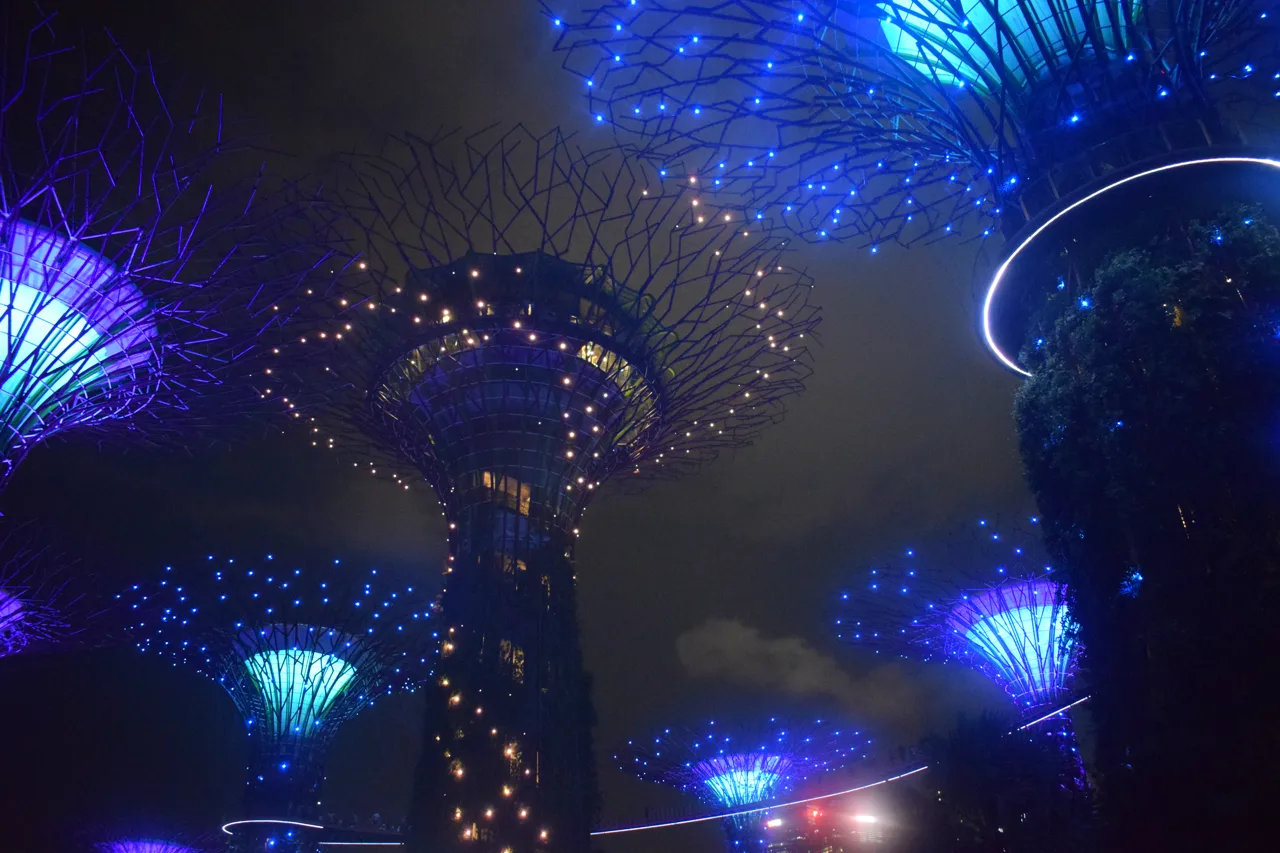
The two most photographed evening shows in Singapore are free and unbookable. Garden Rhapsody runs at 7.45pm and 8.45pm, Spectra at 8pm and 9pm.
For a solo traveller those two carry the evening. Nothing to reserve, nothing to collect, nobody checking a ticket. You stand in the right place at the right time.
Times and places
| Show | Where | Times | Length |
|---|---|---|---|
| Garden Rhapsody | Supertree GroveMap, Gardens by the Bay | Nightly 7.45pm and 8.45pm | About 15 minutes |
| Spectra | Event Plaza, Marina Bay Sands | Nightly 8pm and 9pm, plus 10pm on Friday and Saturday | 15 minutes |
Fitting both into one evening
- Be under the Supertrees by 7.30pm. The grass between the trunks is the comfortable spot, because the show is directly overhead.
- Watch the 7.45pm show. It takes about a quarter of an hour.
- Walk across to Marina Bay SandsMap. Allow 20 minutes.
- Watch Spectra at 9pm from the waterside at Event Plaza.
The reverse order also works, taking Spectra at 8pm and Garden Rhapsody at 8.45pm, but 20 minutes of walking makes it tight the first time you do it. The order above has slack in it.
When it rains
Both shows are outdoors. Light rain does not stop them; lightning does. Tropical evening storms usually pass inside half an hour, so the practical answer is to step inside and take the later showing. The two conservatories at Gardens by the BayMap and the mall at Marina Bay Sands are the shelter on either side.
What sits either side of the shows
The ticketed conservatories at Gardens by the Bay stay open into the evening, so seeing them first and walking straight out to the lawn is a natural sequence. On the Marina Bay side the promenade runs continuously, and you can walk to an MRT station when the show ends.
Dinner does not fit between the two. The gap is around an hour, which is not enough to sit down properly. Eating after 9.30pm works better, and several hawker centres are still serving then.
4. Night Safari is sold by entry slot
Night Safari puts a time on your ticket. Slots are sold at 7.15pm, 8.15pm, 9.15pm and 10.15pm, and the earliest one goes first.
One detail here favours a solo visitor. The tram has no allocated seats, so boarding is in queue order. A pair has to find two together; you take whatever is free. The outer edge seats give the best view of the animals, and you only need one of them to be empty.
What the ticket covers
| Item | Detail |
|---|---|
| Non-resident adult | Around S$58. Children 3 to 12 around S$41, under 3 free |
| Included | One Safari Adventurer tram loop, four walking trails, the evening show |
| Tram | 30 to 40 minutes per loop. No allocated seating |
| Hours | 7.15pm to around midnight. Last entry 11.15pm |
| Getting there | Mandai shuttle from KhatibMap station, about S$3, 20 minutes. 45 to 60 minutes from the city |
Which slot to take
The 7.15pm entry is better on several counts. You get the full evening, you catch the first show, the tram queue is short, and the animals have had fewer people past them. Later slots are perfectly workable, but do not push it to the 11.15pm last entry.
There is one extra calculation for a solo visitor. The park closes around midnight and it sits nearly an hour from the city. A late slot means walking out at exactly the time the last trains are going. The next section deals with that.
Not the same place as the daytime zoo
The daytime Singapore Zoo is next door in the same Mandai reserve, with a separate ticket and different hours, roughly 8.30am to 6pm. The names look similar and people book the wrong one.
There is a way to take both in one go: spend the afternoon at the zoo or River WondersMap, eat nearby, then enter Night Safari at 7.15pm. That makes the long trip out and back count once instead of twice. The trade is that nothing else fits into that day.
5. There is no public transport after midnight
Singapore has no night bus network. The six NightRider routes were discontinued on 30 June 2022, along with the Nite Owl services, and the MRT has never run overnight.
This matters more when you are on your own. A group splits the late fare and talks through the options; alone, you pay the whole thing and make the call yourself. Deciding the way back before you head out is the simplest fix.
When things stop
| Mode | Hours | On your own |
|---|---|---|
| MRT | Roughly 5.30am to midnight. Last trains from terminals 11.30pm to midnight | Varies by line and station, so check the one you will use |
| Buses | Route dependent, mostly finishing around midnight | They stop when the trains do |
| Night buses | Withdrawn 30 June 2022 | Not a fallback. They do not exist |
| Taxi and ride-hail | 24 hours | Midnight to 6am surcharge. S$10 to S$18 across town |
Using a car late
Grab is the common app and settles payment in-app. Street taxis are metered and add a midnight to 6am surcharge. Off-peak, a car arrives in five to seven minutes, but when a show finishes or the bars close, demand spikes and so does the fare.
One trick works well alone: do not order from the exit. Walk 10 or 15 minutes away from the crowd first. Prices often drop once you are out of the surge area, and you are not standing in a queue of people all opening the same app.
Staying somewhere you can walk back to
Clarke QuayMap, Boat QuayMap, Marina Bay and the Chinatown bar streets are all within walking distance of one another. Basing yourself near them cuts the number of late-night cars to almost none. When choosing where to stay alone, walkability home at night is a more useful filter than distance to the nearest station.
Deciding the way back before you go out is the whole of it. If late nights are rare on your trip, this barely applies: the free shows are finished by 9.30pm, which leaves plenty of margin on the last train.
6. How to hold a table at a hawker centre alone
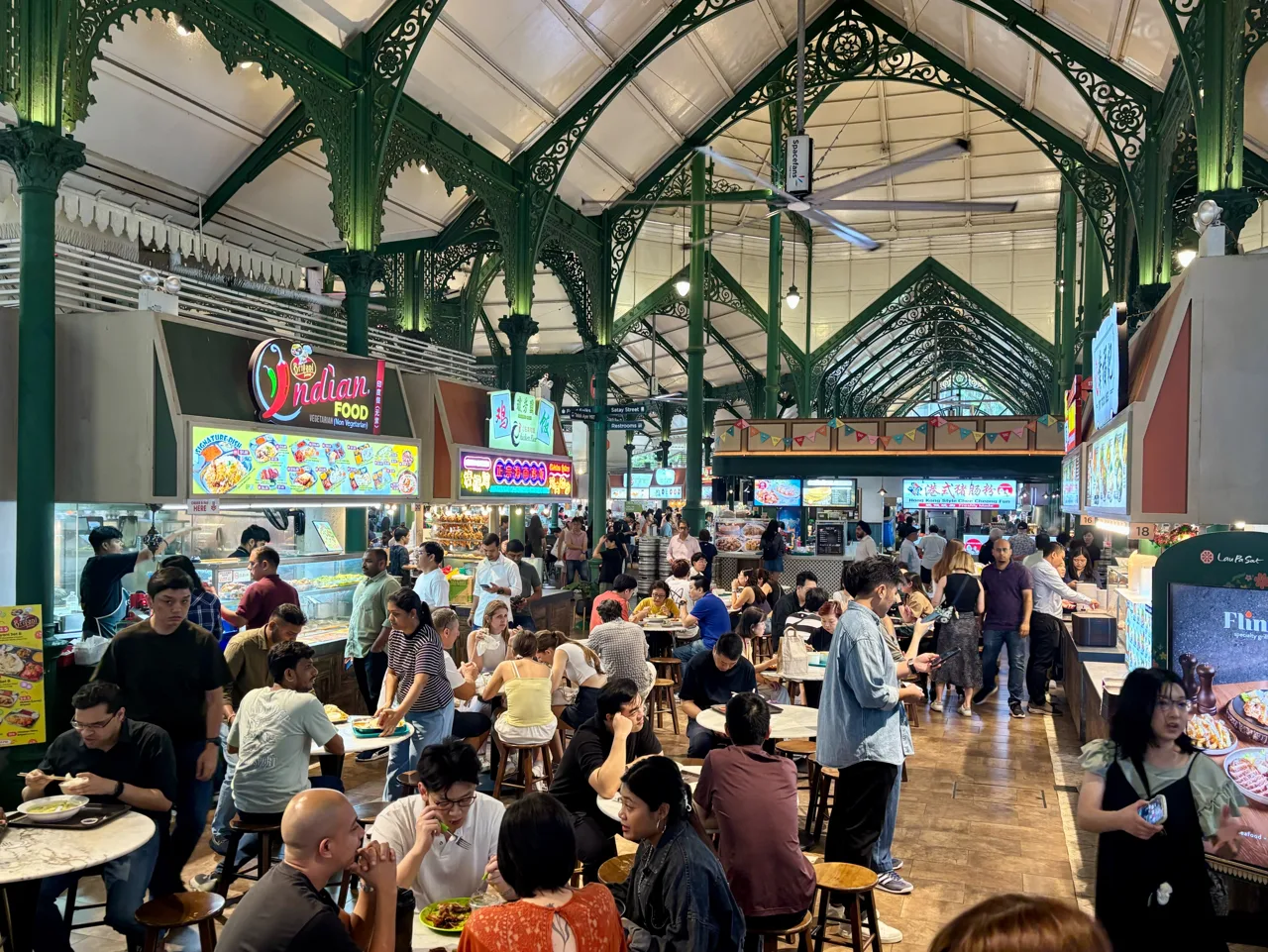
Hawker centres sell single plates, so a table for one is unremarkable. Sitting down at a table with strangers is equally normal.
There is an order to it though. Claim a seat, queue at each stall separately, then return the tray. Skip the first step and you end up holding a hot plate looking for somewhere to sit.
Chope, the seat-claiming custom
Leaving a packet of tissues or an umbrella on a chair marks that seat as taken. Locals call it choping and everybody honours it. You do this before you join any queue.
Alone, there is a catch. A pair leaves one person at the table; one person leaves the bag. Keep valuables on you while you queue, and mark the seat with something you would not mind losing, which is exactly why tissues became the standard.
- Find an empty seat and put a packet of tissues or an umbrella on the chair.
- Keep your passport, wallet and phone with you.
- Queue at each stall you want. Mixing stalls in one meal is normal.
- Most stalls take cards and QR payment, but carry small notes for the ones that do not.
- Take your tray and crockery to the return point when you finish.
Returning trays is enforceable
Since September 2021 leaving a tray behind can be fined, up to around S$300 for repeat offenders. Compliance went from 65 per cent in August 2021 to 93 per cent by 2024, so it is now simply what everyone does. Return points sit along the edges or in the middle of the hall.
Which hawker centre
| Hawker centre | Best at | On your own |
|---|---|---|
| Maxwell Food CentreMap | Lunch | Known for chicken rice. Busy in the middle of the day |
| Lau Pa SatMap | Evening | The satay street sets up outside at night. Right in the business district |
| Old Airport Road Food CentreMap | Lunch and early dinner | Where locals go. Less of a tourist crowd |
| Chinatown ComplexMap | Daytime | The largest of them. Enough stalls to browse properly |
Moving between several in a day is easier alone. One plate at a time means lunch in one place and dinner in another without ending up overfed. A pair tends to settle in one hall and order several dishes, which is a different way of eating.
7. Start with the dishes that arrive as one bowl
Singaporean food divides into dishes plated for one and dishes built for a table to share. The first list is long, which is what makes eating alone here straightforward.
Almost every hawker classic is a single portion: chicken rice, laksa, char kway teow, bak kut teh, nasi lemak, roti prata, Hokkien mee. Prices run S$4 to S$8 a plate.
Dishes that work for one
| Dish | What it is | Roughly |
|---|---|---|
| Hainanese chicken rice | Poached chicken with rice cooked in the stock | S$5 to S$8 |
| Laksa | Noodles in a spiced coconut broth | S$5 to S$8 |
| Char kway teow | Flat rice noodles fried hard and fast | S$5 to S$7 |
| Bak kut teh | Peppery pork rib soup | S$8 to S$12 |
| Kaya toast with kopi | Breakfast, served with soft-boiled eggs | S$4 to S$6 |
| Roti prata | Griddled flatbread with curry | S$2 to S$5 |
The Michelin-listed stalls
Several hawker stalls hold Michelin recognition. The Bib Gourmand stalls mostly sell single-plate food at prices close to their neighbours. Alone you can join a short queue, eat one plate and leave, which makes them easier to try than a restaurant with the same reputation.
Long queues thin out around the edges of lunchtime. Before 11am or after 2pm gets you the same food without the wait.
Food courts in the malls
Mall food courts run on the same model with air conditioning added, which matters in the middle of the day and during a downpour. Prices sit S$1 to S$3 above a hawker centre and seats are generally easier to find.
For one person, food courts are the softer landing. Many have counter seating and single seats, and the choping custom is less strictly needed because tables turn over faster. The character, though, is stronger in the hawker centres.
8. One crab is not a portion for one person
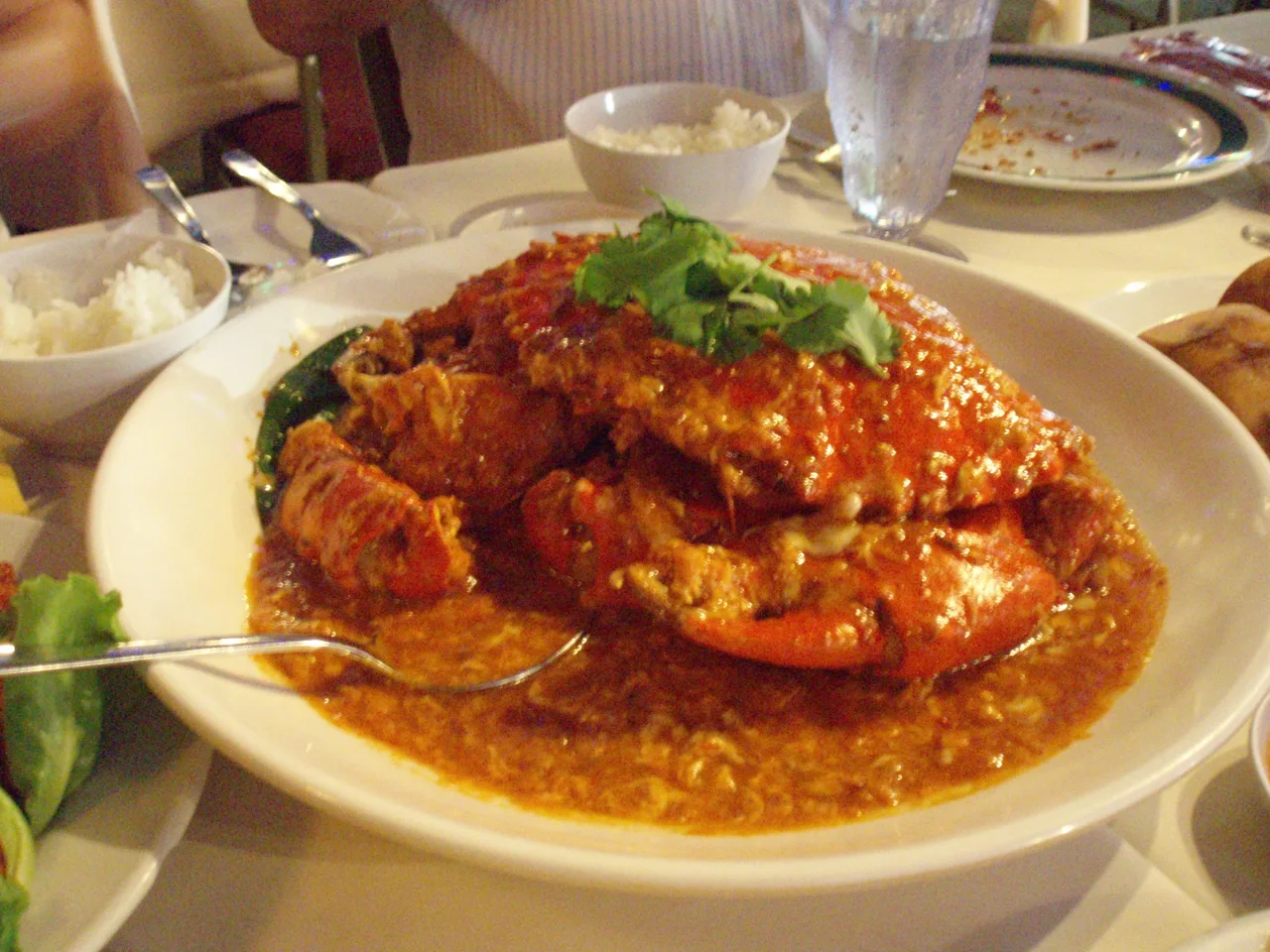
Chilli crab arrives as a whole crab of 700g to 1kg, which is more than one person gets through. The same kitchen makes crab bee hoon, which comes as a single bowl.
Crab is sold by weight at a rate that moves with the market, roughly S$50 to S$80 per kilogram. One crab lands between S$45 and S$80 before you add mantou buns and sides, so asking for both the rate and the weight before ordering is the standard move.
What one person can order
| Dish | Sold as | Workable alone |
|---|---|---|
| Chilli crab | A whole crab, 700g to 1kg | Too much food |
| Black pepper crab | A whole crab | Same problem |
| Crab bee hoon | One bowl | Yes |
| Cereal prawns, salted egg prawns | A plate | Usually yes, depending on size |
| Satay | By the stick | Yes, though many places start at ten |
What crab bee hoon actually is
Crab in a milky peppery broth with rice noodles. Less sauce-forward than chilli crab and served as one bowl, which is the version sized for a table of one. Neighbourhood branches and the East Coast seafood row both do it.
If the whole-crab experience is the point, there is another route. Group walking tours and hostel common rooms are where solo travellers find someone to split one with, and in a dorm that happens without much effort.
Whether the East Coast trip is worth it
The East Coast seafood row is about 20 minutes out of town by car, and alone you pay that fare twice. The city branches make more sense on the numbers. There are outlets at Jewel Changi, ION OrchardMap and Dempsey that slot into a day you were having anyway.
The Jewel branch also works on a departure day: leave your bag, eat inside the airport complex, then walk to the gate. Alone, the timing is simple because there is nobody else to coordinate.
9. Afternoon tea and bar counters take one
Afternoon tea at the Grand Lobby of Raffles HotelMap has no minimum party size. The official page sets out a dress code and says nothing about numbers. It runs daily from 12.30pm to 5.30pm.
Solo travellers often write these places off in advance, and mostly they should not. A handful of things are sold in pairs, but the great majority are priced per person.
Where the dress code bites
The Grand Lobby asks for Casual Chic. The official wording rules out slip-ons, flip-flops, rubber clogs, sandals and similar. Men are encouraged into collared shirts, trousers and proper shoes. Dress shorts are allowed at lunch.
Turning up in what you wore to Sentosa or the Botanic Gardens will not work. On a day with a booking like this, build in a stop at your accommodation to change. Capsule hotels hold bags and provide lockers, which makes that loop possible.
Bar counters fill seat by seat
Fully booked evenings often still have a bar counter free, because counters fill seat by seat rather than by party. A restaurant showing no availability online is frequently still able to seat one at the bar, so it is worth asking in person.
The bar districts cluster around Clarke Quay, Boat Quay and Ann Siang HillMap, all within walking distance of each other. Alone, moving between two or three places usually beats settling in at one for the night.
What is priced per person and what is not
| Item | Sold by |
|---|---|
| Afternoon tea | Per person. No minimum party size |
| Hawker centres and food courts | Per plate |
| MRT and buses | Per tap |
| Attraction tickets | Per person |
| Capsules and dorms | Per bed |
| Hotel rooms | Per room. One occupant pays the same as two |
| Cable car dining | Per cabin. From three people the per-head cost falls |
| Crab | Per crab |
Accommodation is the only line that costs more because you are one. That is why capsules and dorms change the arithmetic of a solo trip so sharply: they are the one bed sold on its own.
10. Capsules and dorms, by name
A bed sold on its own runs S$30 to S$70 a night in Singapore. They cluster in Chinatown, Kampong Glam and Little India, all of which sit on the train network.
Cheap rooms barely exist here. Mid-range hotels run S$150 to S$300 and luxury starts around S$350. Take a room alone and you pay the full rate for it, which is why the bed-by-bed category matters so much on a solo budget.
Properties worth knowing by name
| Property | Where | Notes |
|---|---|---|
| The POD at Beach RoadMap | 289 Beach Road, Level 3 | Over 100 pods. Ladies Floor. Check-in 3pm, check-out 11am |
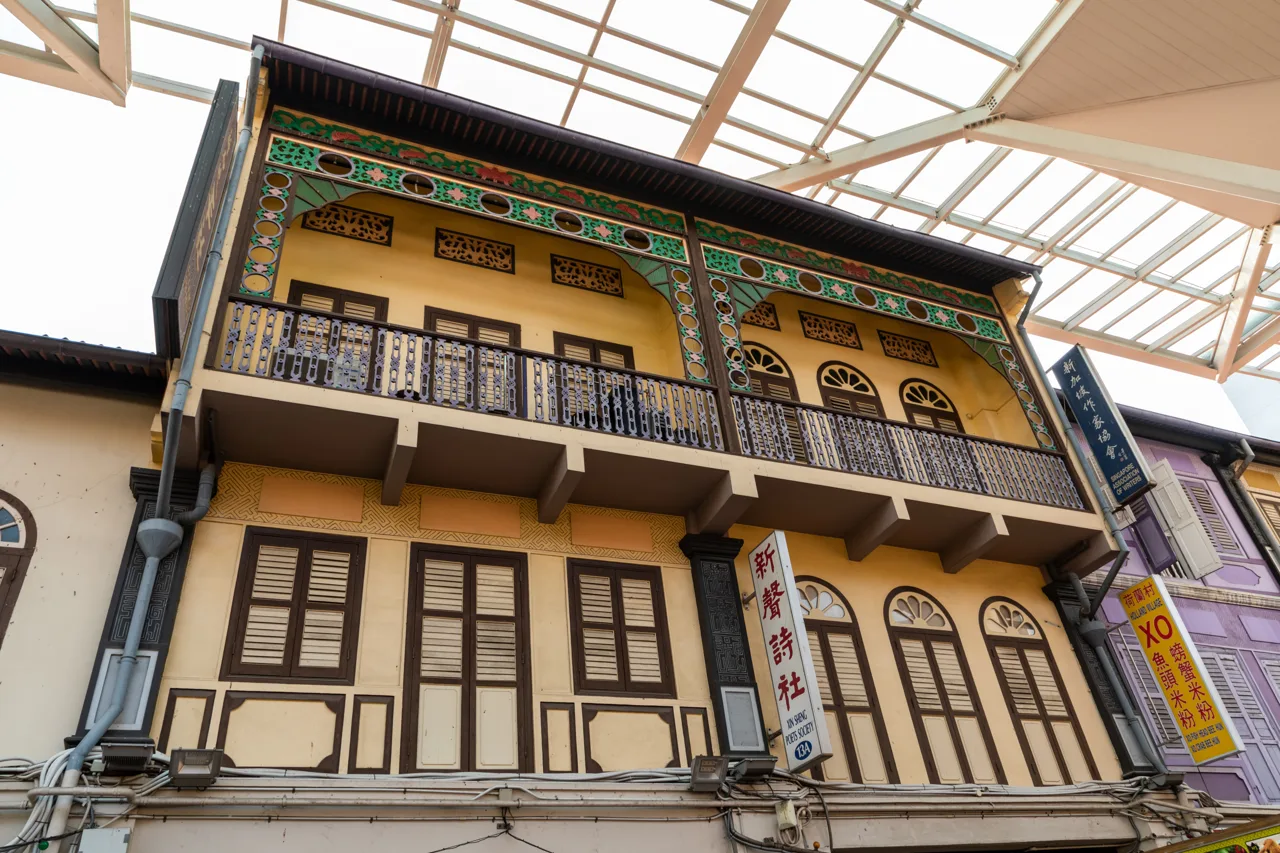
| CUBE Boutique Capsule Hotel ChinatownMap | 76A/B and 78A/B Smith StreetMap, Levels 2 and 3 | An 1800s shophouse. Female-only rooms. Breakfast 7.30am to 10.30am |
| CUBE Boutique Capsule Hotel Kampong Glam | Kampong Glam | Breakfast 8am to 10am |
| CUBE Social at Boat Quay | Boat Quay | On the river, beside the bar strip |
House rules across the CUBE properties
Check-in is 3pm and check-out is noon. Early check-in or late check-out costs S$10 an hour at the capsule properties and S$20 an hour at the family one, subject to space.
Guests must be 18 or over to check in on their own. Only the family property takes children, from age six, with a parent and an extra bed charge. If you are travelling alone under 20, check this before you pay.
Rates include towels, wifi, shampoo and body wash in the bathrooms, and a bottle of water at check-in. The capsule properties include breakfast; the family one does not. Each capsule has its own safe.
Choosing the neighbourhood
Chinatown and Tanjong Pagar suit a first visit: several train lines, hawker centres a short walk away. Kampong Glam and Bugis skew younger and get you a better room for the same money. Little India is the cheapest and the most crowded, which people either enjoy or do not.
Alone, add one more filter: can you walk home at night. All three sit inside the central area so none of them fail badly, but if your evenings run late, the river side is the easiest.
11. Female-only floors and rooms exist here
The POD at Beach Road runs a Ladies Floor as an entire floor. CUBE Boutique Capsule Hotel in Chinatown also has capsules in rooms shared by women only.
The room type says which it is on the booking screen, and you are allocated what you paid for. Asking to be moved on arrival works only if something is free, so this gets settled at payment.
Pod types at The POD
| Type | Sleeps | Female-only option |
|---|---|---|
| Single Pod Suite | 1 | On the Ladies Floor |
| Front Entry Single Pod | 1 | Mixed, male-only or female-only shared room |
| Side Entry Single Pod | 1 | Mixed or female-only shared room |
| Queen Pod | 2 | Mixed or female-only shared room |
| Queen Pod Suite | 2 | Separate category |
Front entry and side entry describe which end you climb in from. The side entry version means you are not shuffling in lengthways, which is marginally easier with a bag in hand.
How it differs from a mixed room
Because the split happens by floor or by room, bathrooms and washing areas split with it. In a mixed room everyone shares the same facilities; on a ladies floor they do not. The nightly difference in rate is small, so when a bed is available it is usually the one to take.
Living in a dorm without friction
Most capsule properties close each bed off with a curtain or a door, but sound still travels. If you plan a late night or an early start, pack your bag beforehand. A small torch or head-torch lets you move without switching the lights on.
Earplugs and an eye mask are rarely provided. Bringing even thin ones changes the first night substantially, especially with jet lag on top.
12. Where to leave your bags between check-out and check-in
Capsule hotels store luggage for up to 24 hours on the day you arrive and again on the day you leave. The CUBE properties state that as policy, and others operate similarly.
That rule shapes both ends of a solo trip. Check-in at 3pm leaves a morning arrival with hours to fill, and check-out at noon does the same on a late-flight departure. With bags stored, those hours become useful rather than awkward.
What to do with each gap
| Situation | Hours free | What fits |
|---|---|---|
| Morning arrival | 3 to 5 hours before check-in | Drop the bag, walk the nearest hawker centre and heritage quarter |
| Noon check-out, night flight | 8 to 10 hours | Store the bag, spend the day in town, collect it in the evening |
| Noon check-out, afternoon flight | 3 to 4 hours | Go out early and spend it at Jewel |
Lockers inside the room
The CUBE properties issue personal lockers in a range of sizes, big enough for cabin luggage. Each capsule additionally has its own safe, which is where a passport and a card belong while you sleep.
The split is deliberate. The locker sits in the shared area; the safe sits inside your own bed space. Big items go in the locker, anything you would hate to lose goes in the safe.
Time to fill at the airport
Changi and Jewel add up to half a day on their own. The Rain Vortex is free to look at and each terminal has its own gardens. The same approach used for a layover works on a last day.
Airports are one of the easier places to be alone, because the facilities there are sold by the person. Lounges and transit hotels are priced per traveller, so you can decide what to do with the remaining hours on the spot.
13. What the police crime figures say
The Singapore Police Force reported 20,857 physical crime cases for 2025 when it published its annual brief on 24 February 2026. That is 4.4 per cent above the 19,969 recorded in 2024, which the force described as a minor uptick.
The five-year line is close to flat: 19,343 in 2021, 20,193 in 2022, 19,966 in 2023, 19,969 in 2024 and 20,857 in 2025. For a city of this size those are low numbers and they are not moving much.
Up and down in 2025
| Category | 2025 | Change on 2024 |
|---|---|---|
| All physical crime | 20,857 cases | Up 4.4 per cent |
| Outrage of modesty | 1,531 cases | Up 7.3 per cent |
| Voyeurism | 486 cases | Down 6.4 per cent |
| Shop theft | 4,109 cases | Down 3.0 per cent |
Where these happen
Of the 1,531 outrage of modesty cases, the police stated that more than half involved offenders already known to the victim. The three leading locations were residential premises with 372 cases, the public transport network with 164, and public entertainment outlets with 115. Of those, the last two are the ones a visitor might plausibly encounter.
The 164 figure covers an entire year on a network carrying millions of journeys a day, which is not a reason to avoid the trains at night. The force asks people to stay alert in crowded places and to report anything they witness immediately, noting that prompt reporting is what lets them identify an offender who runs.
Voyeurism fell to 486 cases. The police credited design work done with the Restroom Association of Singapore, including cameras at toilet entrances, full-height partitions and better lighting. Locations were 146 in residential premises, 91 in shopping complexes and 48 on the transport network.
What the streets are actually like late
The bar districts and the waterfront promenades stay populated well into the night. Stations and malls connect through sheltered walkways, so you rarely have to cut through anywhere dark. Every sign is in English, so a wrong turn is easy to undo.
After the trains stop the picture changes, mainly because the crowds thin with them. Not ending up somewhere unfamiliar at that hour is the whole of the precaution.
14. Things go missing while you are away from the table
Theft in dwelling was one of the two crimes of concern the police highlighted for 2025. They said it happened mainly in premises left unsecured or unattended.
That description maps directly onto three solo moments: leaving your bag on a bunk while you shower, leaving it at a hawker table while you queue, and leaving it by the water while you swim. The force specifically asked people not to leave valuables unattended in common spaces and shared facilities.
The moments you have to leave things
| Situation | In a pair | Alone |
|---|---|---|
| Ordering at a hawker centre | One person stays at the table | The bag stays while you queue |
| Showering in a dorm | You watch each other | It goes in the locker or the safe |
| Beach or pool | You take turns | You need a dry bag or a paid locker |
| Toilets | Someone holds it | It comes in with you |
A routine that removes the problem
- Leave the passport and one card in the capsule safe. There is no reason to carry them daily.
- Take out only the cash and one card you will use that day.
- Lock the big bag in the locker. Bringing your own padlock settles it.
- At hawker centres, mark the seat with something you would not mind losing.
- Set up phone payment, which cuts down how often the wallet comes out at all.
Days that involve water
Decide the bag question before you head to a Sentosa beach or a waterpark. Most venues run paid lockers, and a waterproof pouch on a cord is the other common answer. Alone, there is no taking turns, so this actually needs deciding.
Leaving it at the accommodation is simplest. If the plan for the day is a beach, one card, a little cash and a phone will cover everything you need out there.
15. Fares are counted per tap
Singapore trains and buses charge per tap, regardless of how many people are travelling. A ride costs S$1 to S$2, and a contactless card works straight out of your wallet with no ticket to buy.
That is why transport does not weigh on a solo budget here. There is almost nothing sold by the vehicle rather than by the passenger, so a day comes in at S$6 to S$10.
When a pass pays
The Singapore Tourist Pass breaks even at around four rides a day. Below that, tapping a contactless card is cheaper and there is nothing to buy. Travelling alone you tend to take short frequent hops, so some days clear the threshold and some do not.
When to use a car instead
| Route | Train | Car |
|---|---|---|
| Changi to the city | 30 to 45 minutes, about S$2 | 20 to 30 minutes, S$25 to S$40 |
| Across the central area | 10 to 20 minutes, S$1 to S$2 | 10 to 15 minutes, S$10 to S$18 |
| City to Mandai | 45 to 60 minutes including the Khatib shuttle | 30 to 40 minutes, S$25 to S$35 |
A car fare falls entirely on you, so the sensible split is trains whenever they are running and cars only after midnight or when you are carrying luggage. Build a day on that rule and transport stays inside the budget.
The stretches you should walk
Much of the central area is connected by sheltered walkways, so you can cross it in a downpour without getting wet. Marina Bay, Orchard Road and the inner streets of Chinatown are all like this. Two stops on the map is often faster on foot.
Alone there is no walking pace to match, so this suits you more than it would a group. It does mean more distance covered in a day, and one pair of comfortable closed shoes earns its place in the bag.
16. Where to go when the afternoon turns
It is hot all year and it rains hard in the afternoons. Alone you can rearrange the day on the spot, so neither of those does much damage.
Storms usually clear within half an hour to an hour. Knowing where to sit them out keeps a day intact. The rainy day guide lists indoor options; a few of them are particularly easy on your own.
Indoors, alone
| Place | How long | On your own |
|---|---|---|
| The two conservatories | 2 to 3 hours | Held around 23C inside. No pace to match |
| National Gallery | 2 to 3 hours | Somewhere you can stay as long as you like |
| ArtScience Museum | 2 hours | A photography-heavy show, so no waiting around |
| Mall food courts | An hour | Many have single seats and counters |
| Jewel Changi | 3 to 4 hours | The free areas alone will fill the time |
Museums suit a solo visit
Galleries and museums make no demands on group size. You linger in the rooms you want and skip whole floors without negotiating. The result is that you see more in the same hours.
Most sell tickets at the door, which is what makes them a workable answer to a sudden downpour. There is no need to have booked.
Shaping a day around the heat
The middle of the day is the worst of it. Outdoors in the morning, indoors in the early afternoon, outdoors again in the evening is the pattern that leaves energy in the tank. Alone, you can actually stick to it, because you are only reading your own body.
Drink more than feels necessary. Bottled water is S$1 to S$2 and refill points are common, so on a full walking day carrying a bottle is better on both cost and stamina.
17. Things you can join as one person
Guided walks and cooking classes are sold per person, which makes them the simplest way to be around people for an afternoon.
Three kinds are easy to find in Singapore: walking tours of the heritage quarters, hawker centre food tours, and Peranakan cooking classes. All of them put individual bookings into a group.
What is on offer
| Programme | Length | Booking alone |
|---|---|---|
| Heritage quarter walking tour | 3 to 4 hours | Runs as a group walk |
| Hawker centre food tour | About 3 hours | Built around shared tasting portions |
| Peranakan cooking class | 3 to 4 hours | Each person cooks their own dish |
| Free Singapore Tour from Changi | 2.5 hours | Open to transit passengers with enough time |
The free tour that leaves from the airport
Changi runs a free city tour for transit passengers. There is no charge, you sign up inside the terminal, and a coach takes you on a loop through the city and back. You need a minimum amount of connecting time to qualify, so check the threshold. The layover guide sets out how to sign up.
If your itinerary has a long connection at either end, this fits neatly. Alone, the sign-up is quick and slotting into a single remaining seat is easy.
Common rooms
Dorms and capsule properties usually keep a lounge or shared kitchen. Most people in them arrived alone, so conversation happens without anyone forcing it. This is also where people find someone to split a whole crab with.
The reverse is equally available. Capsules close with a curtain or a door, and if you never go into the common room you will not run into anybody.
18. Sentosa and Universal on your own
Universal Studios Singapore is S$83 at the gate for an adult off-peak and S$86 at weekends and on public holidays. Tickets are per person and dated.
There is a place where being one saves time here. Rides have fixed capacity and single seats go unfilled, and one person can take them. It means being split from whoever you came with, which is why pairs rarely bother.
Getting onto the island
| Route | Cost | Note |
|---|---|---|
| Sentosa Express | Charged separately | Not covered by the tourist transport pass |
| Boardwalk on foot | Free stretch available | You walk over from VivoCityMap |
| Cable car | Charged separately | The view costs more than the alternatives |
Shaping the day
Sentosa works as a single zone: once you are on, the day fills itself. The three beaches are free and the paid attractions sit between them, so what you spend depends on how many of those you add.
A day built around Universal StudiosMap means arriving at opening and staying until close, and nothing else fits. A day built around the beaches and the walking trails can start in the afternoon and run into the evening.
Photographs, if you want them
Sentosa and Marina Bay are full of people taking pictures, and swapping the favour is normal. A small tripod removes the need to ask, and a phone timer covers most of it.
If photographs are not the point, skip them. There is no obligation to document a trip taken alone.
19. The three heritage quarters have no gate
Chinatown, Little India and Kampong Glam are places you walk into. There is nothing to book, group size is irrelevant, and you can reorder them on the day.
Each has its own MRT station. Two of them fit comfortably into a day, each taking roughly half of it. Alone, you can stand in front of a shopfront as long as you like or skip a whole street, which is what makes these three the easiest part of the trip.
What each one is
| Quarter | Station | On your own |
|---|---|---|
| Chinatown | Chinatown | A very large hawker complex. Good for trying several single plates |
| Little India | Little India | A 24-hour shopping complex, so it is walkable late |
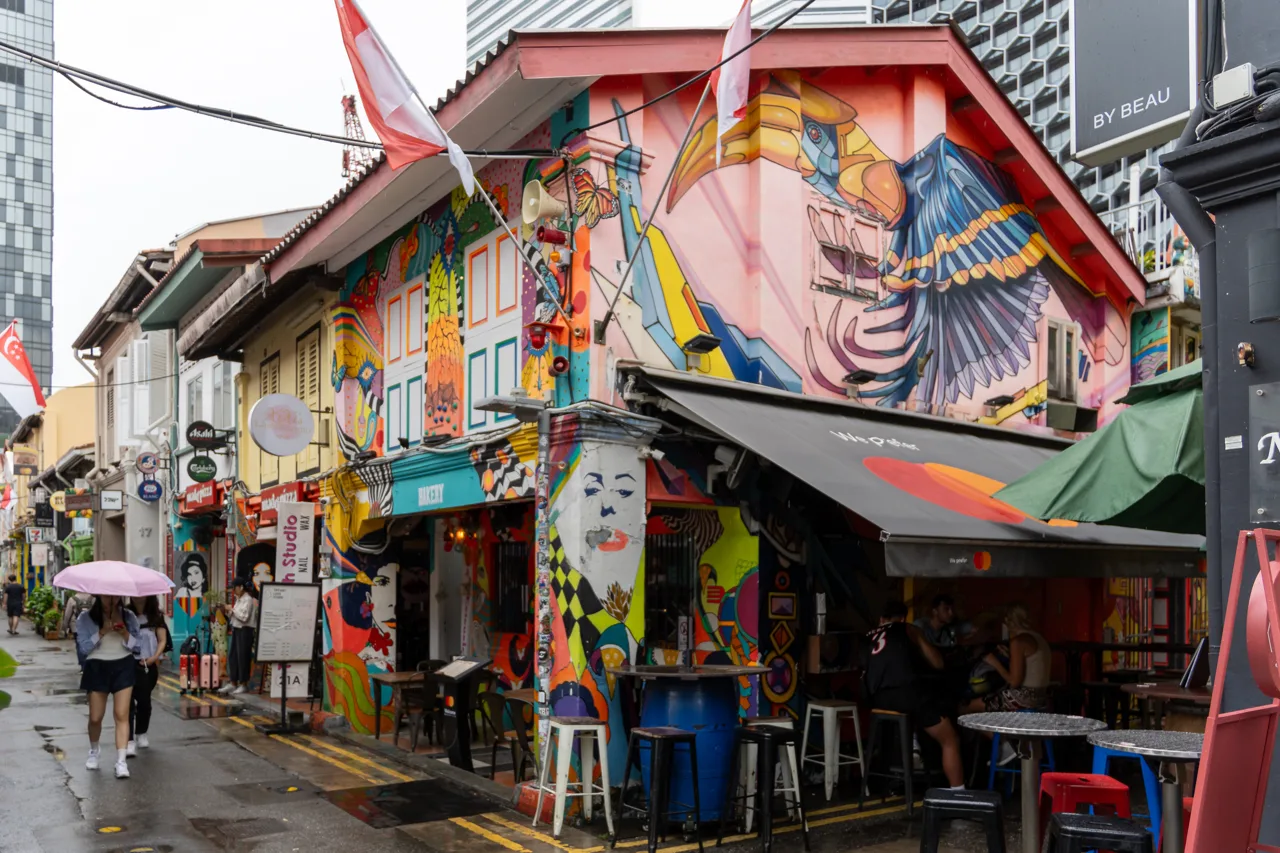
| Kampong Glam | Bugis | Narrow lanes and murals. Also where the capsule hotels cluster |
The cheap beds are in these same three areas
These same three neighbourhoods hold the cheap beds. Sleeping and wandering happen in the same place, so an evening can continue after you have already dropped your bag at the property.
That also cuts down late-night travel. Finish an evening in town, take one train, and you are at the door, which means fewer cars after the trains stop.
Temples and places of worship
All three have temples and mosques, most of them free to enter. Some require shoulders and knees covered, so a light layer or long trousers in the bag means you can walk in when you find one.
Where shoes come off, the question is what to do with your bag. There is normally a rack for shoes and bags can be carried in, so leaving the large one at your accommodation is all the preparation needed.
20. Two versions of three days
Alone, meals and transfers are quick, so two substantial places fit into a single day. Both itineraries below keep booked items to a minimum.
The first stays in the city. The second gives a day to Mandai. Both assume a capsule bed and hawker meals.
Three days in the city
| When | What | Booked |
|---|---|---|
| Day 1 afternoon | Arrive, store the bag, walk Chinatown | Nothing |
| Day 1 evening | Garden Rhapsody 7.45pm, walk over for Spectra at 9pm | Nothing |
| Day 2 daytime | Sentosa. Beaches plus one or two paid attractions | Sold at the gate |
| Day 2 evening | Dinner at Clarke Quay, walk the river | Nothing |
| Day 3 morning | Botanic Gardens or the conservatories | Only the conservatories charge |
| Day 3 afternoon | Little India and Kampong Glam | Nothing |
Three days with Mandai in them
- Day 1: arrive, walk the city, take both free shows in the evening.
- Day 2 daytime: head out to Mandai for the zoo or River Wonders. Travel alone eats nearly two hours return.
- Day 2 evening: eat nearby and enter Night Safari at 7.15pm. Settle the ride back before you go in.
- Day 3: Sentosa or the heritage quarters. On a night flight, store the bag and stay in town until evening.
The second version spends all of day two at Mandai. In exchange the long trip happens once and covers both a daytime park and Night Safari. Only the ride home that night needs deciding in advance.
The hours to leave blank
Keep 2pm to 5pm free. It is the hottest part of the day and the likeliest time for a storm, so a booking there ends up dragging you around. Use it for indoors or for going back to the property, and you will still have energy in the evening.
Alone, that adjustment is easy to make. Nobody has to agree to it.
21. What a day costs at three levels
With a capsule bed and hawker meals, a day runs S$90 to S$130. The bed accounts for S$30 to S$60 of that.
Food and transport here are inexpensive; accommodation is the exception. So the cost of a solo day is decided almost entirely by which bed you booked.
Three levels
| Level | Food | Transport | Attractions | Total before the bed |
|---|---|---|---|---|
| Lean | S$20 to S$30 | S$6 to S$10 | Mostly free | About S$40 to S$60 |
| Middle | S$40 to S$80 | S$10 to S$20 | S$40 to S$90 | About S$100 to S$180 |
| Generous | From S$120 | From S$40 | From S$100 | From about S$300 |
Then add the bed: S$30 to S$60 for a capsule or dorm, S$150 to S$300 for a mid-range hotel, S$400 and up at the top. Lean plus a capsule is where the S$90 to S$130 figure comes from.
Three and four day totals
Hostel bed, hawker food and mostly free attractions gives roughly S$350 to S$500 over three days and S$450 to S$650 over four. Broken down across four days that is S$120 to S$240 on beds, S$80 to S$120 on food, S$25 to S$35 on transport and S$50 to S$100 on one or two paid attractions.
A day with no paid attraction finishes around S$40 before the bed. There is enough free here that scheduling one of those does not leave the trip feeling thin.
What a lean day looks like
| When | What | Cost |
|---|---|---|
| Morning | Kaya toast and kopi at a hawker centre | About S$4 |
| Late morning | Botanic Gardens, train there | About S$2 |
| Lunch | A plate of chicken rice | About S$6 |
| Afternoon | Walking a heritage quarter | Free |
| Evening | Satay and char kway teow at Lau Pa Sat | About S$10 |
| Night | Spectra, then the train back | About S$2 |
That comes to about S$24 before the bed. Add a capsule at S$30 to S$60 and the day finishes under S$90. The budget guide breaks the individual line items down further.
22. Before you fly
The preparation list does not grow much beyond the three items at the top: the bed, the entry slot, the ride home.
Add a few things about documents and payment and you are done. With nobody to fall back on, keeping two of everything important is the sensible habit.
Checklist
| Item | What to check |
|---|---|
| Accommodation | Mixed or female-only, breakfast included or not, the 18 and over rule |
| Entry | The electronic arrival card is submitted from three days before you land |
| Payment | Two cards kept in different places, plus some small cash |
| Connectivity | A local SIM or eSIM. Buying at the airport can mean a queue |
| Shoes | One pair of closed shoes, for the places with a dress code |
| Luggage | A padlock. Most of these properties issue lockers |
Rules that carry fines
Eating or drinking in an MRT carriage is fined, water included. Not returning a hawker tray can be fined up to about S$300 for repeat offences. Smoking outside a designated area is a fine. The rules and fines guide lists the amounts.
Alone there is nobody to point these out as you go, so reading them once beforehand is worth the five minutes. Most are common sense, but the sums are not small.
Where this leaves you
Singapore asks less of a solo traveller than most places. Food is sold by the plate, transport by the tap, and the best-known evening shows cost nothing. A slot with one seat left is a slot you can take, which is why so little of this has to be locked in early.
Three things stay on the list. Good beds go early, Night Safari is sold by timed slot, and there is no public transport once the trains stop. Handle those and the rest of the trip can be decided the morning it happens.
The same city changes shape with different company. What shifts when you bring children, parents or a partner is set out separately.
🎡Things to Do51
🍜Food4
🏨Where to Stay10
🚇Getting Around4
🧭Travel Tips16
Frequently asked questions
It asks less advance planning of a solo traveller than most cities. Food is sold by the plate, transport is charged by the tap, and the two best-known evening shows are free, so there is nothing to reserve.
The island is small enough that journeys are short, and every sign is in English, so you rarely need to ask directions. A few things do bite. Well-located capsule beds fill early, Night Safari is sold by timed entry slot, and there is no public transport after the trains stop. Settle those and the rest of the itinerary can move around the weather.
About S$90 to S$130 a day with a capsule bed and hawker meals. The bed is S$30 to S$60 of that.
Three hawker meals come to S$20 to S$30. Trains and buses run S$6 to S$10 a day. On a day with no paid attraction, that is the whole total. Add a big ticket such as Universal Studios and roughly S$80 goes on top. Swap the capsule for a mid-range hotel room and the daily figure nearly doubles, because a room costs the same whether one person sleeps in it or two.
They are the one category sold by the bed rather than by the room. The CUBE group checks in guests aged 18 and over only.
Each capsule has its own lockable safe, and guests get a separate personal locker large enough for cabin luggage. Breakfast is included at the capsule properties, served 7.30am to 10.30am in Chinatown and 8am to 10am in Kampong Glam. Check-in is 3pm and check-out is noon, with early or late hours available at S$10 an hour when there is space.
The police figures point at your belongings rather than at the streets. Singapore recorded 20,857 physical crime cases in 2025.
Outrage of modesty accounted for 1,531 of those, and the police stated that more than half involved offenders already known to the victim. The three most common locations were residential premises with 372 cases, the public transport network with 164, and public entertainment outlets with 115. Meanwhile theft in dwelling, one of the two crimes of concern that year, happened mainly in premises left unsecured or unattended, and the police asked people not to leave valuables in common areas and shared facilities. That is exactly the dorm shower run.
Yes. The POD at Beach Road runs a Ladies Floor as a whole floor.
Its Front Entry and Side Entry Single Pods can be booked in a mixed shared room or a female-only shared room, and the female-only rooms sit on that floor. CUBE Boutique Capsule Hotel in Chinatown also has capsules in female-only shared rooms. The room type states which it is on the booking screen, so it is settled at the point of payment rather than on arrival.
Hawker centres sell single plates, so a table for one is ordinary. Sharing a table with strangers is also normal.
The order of operations is: claim a seat, queue at each stall separately, then return your tray when you finish. Seats are claimed by leaving a packet of tissues or an umbrella on a chair. On your own you will be queueing while your bag sits at the table, so keep valuables with you. Returning trays has been enforceable since September 2021, with fines up to about S$300 for repeat offenders.
A crab weighs 700g to 1kg, which is more than one person finishes. Crab bee hoon comes as a single bowl instead.
Crab is sold by weight at a market rate, roughly S$50 to S$80 per kilogram depending on the day, which puts one crab at S$45 to S$80 before mantou buns and sides. Ask for the per-kilo rate and the weight of the specific crab before you order. Crab bee hoon uses the same crab in a peppery broth with rice noodles and is served as one bowl, which is the version that works for a table of one.
The tram has no allocated seating, so everyone boards in queue order. Only the entry slot needs choosing.
Slots are sold at 7.15pm, 8.15pm, 9.15pm and 10.15pm, and the earliest goes first. A non-resident adult ticket is around S$58 and includes one tram loop, the four walking trails and the show. Last entry is 11.15pm and the park closes around midnight. Sort out how you are getting back before you go: there is a shuttle to Khatib station, but a ride-hail car is the realistic answer late at night.
Trains stop around midnight, and there are no night buses. The six NightRider routes were discontinued on 30 June 2022.
The MRT runs roughly 5.30am to midnight, with last trains from terminal stations between 11.30pm and midnight. Times vary by line and station, so check the one you will actually use on a late night. After that it is a taxi or a ride-hail car, both with a midnight to 6am surcharge, and about S$10 to S$18 to cross the city.
Only if you have a day with three or more paid attractions in it. The transport pass breaks even at about four rides a day.
Travelling alone tends to raise the number of places you get through in a day, because there is nobody to wait for, so those days do happen. The deciding factor is Universal Studios: the gate price is S$83 for an adult off-peak and S$86 at weekends and on public holidays, which is large enough to swing the whole calculation. Note that the tourist transport pass excludes Sentosa Express, RWS8 and express or premium buses.
Three days covers the city and the island. Add Mandai and four is more comfortable.
On your own, meals and transfers are quick, so two substantial places fit into a day. Day one covers the civic district and Marina Bay, day two Sentosa, day three the heritage quarters and an evening show. The Mandai parks and Night Safari take close to two hours of travel there and back, so that pairing eats a whole day and belongs on a fourth.
Capsule hotels hold luggage for up to 24 hours on arrival day and again on departure day.
With check-in at 3pm and check-out at noon, both ends of a stay leave a gap, and the usual pattern is to drop the bag at reception and go into town. Inside the room you also get a personal locker sized for cabin luggage, plus a safe in the capsule itself. If your flight home is a late one, leave the bag, watch an evening show, then collect it on the way to the airport.