
Raffles Singapore and the Long Bar: the arcade entrance, the walk-in rule and the Singapore Sling
| Address | The bar sits at #02-01 Raffles Arcade, 328 North Bridge Road, and not behind the front door on Beach Road. |
|---|---|
| Booking | Walk-ins only, with parties of 10 to 20 people the single exception the hotel makes. |
| Quiet hours | The hotel names 11:00 to 11:30, 14:00 to 15:30 and after 21:00 on weekdays as the shortest waits. |
| Opening hours | Sunday to Wednesday 11:00 to 22:30, and Thursday to Saturday 11:00 to 23:30. |
| Afternoon tea | Served daily from 12:30 in the main building, 90 minutes a sitting, booked with a card guarantee. |
| Prices | No price is published for the cocktail or for afternoon tea, and every figure that is published carries ++. |
1. The front door on Beach Road is not the door you want
2. Eight rooms, two buildings, and the one the hotel leaves off its own list
3. Level 2, unit #02-01: the walk up from the street
4. Walk-ins only, and the single exception the hotel makes
5. The three quiet windows, and the hour that moves on Thursday
6. The peanut shells belong on the floor
7. A gin drink built to pass for fruit juice
8. The room you queue for has only stood there since 1991
9. The centenary gin, and a shaker that makes 18 at a time
10. 27 June, and the first 100 people carrying a pineapple
11. Afternoon tea downstairs runs on a 90 minute clock
12. The other rooms on the main building side
13. The arcade side is where the prices are actually printed
14. Dress codes, and the one room that sits a notch looser
15. What ++ does to a bill, and the prices that are not printed at all
16. Half a day here without booking a room
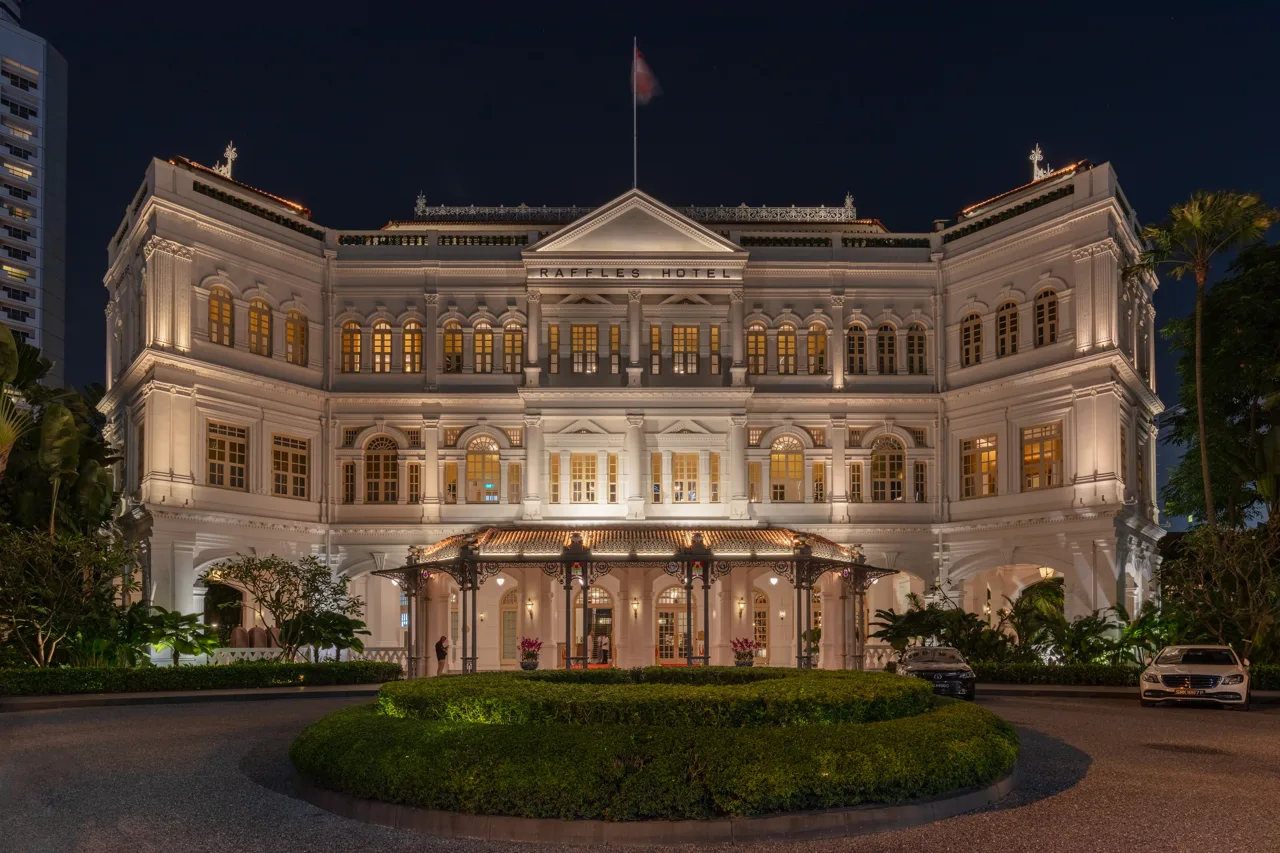
1. The front door on Beach Road is not the door you want
Two street addresses belong to the same hotel, and only one of them ends at a Singapore Sling. The main building stands at 1 Beach Road, behind the white front and the covered carriage porch that almost every photograph shows. Raffles ArcadeMap, the dining and shopping wing along the back of the site, carries its own number at 328 North Bridge Road. The Long BarMap is in the arcade, up on level 2, at unit #02-01.
Both addresses are written down by the hotel in plain language, on pages that sit a click apart. The Long Bar page gives the location as #02-01 Raffles Arcade, 328 North Bridge Rd, and then spells out that the room is reached through the North Bridge Road entrance. Every main building outlet carries a different sentence, saying the room is in the Main Building and reached through the main hotel entrance. Those two lines are the entire geography of a visit, and they are the difference between a short walk and a long one with a detour through a lobby where you have no business.
Why a map application can still point at the lawn
Part of the confusion is written into the page itself. The machine readable data attached to the Long Bar listing still gives 1 Beach Road, so a search engine or a mapping app reading that page can drop its pin on the front lawn while the visible text a few lines above says North Bridge Road. When the pin and the sentence disagree, follow the sentence. Typing 328 North Bridge Road, Singapore 188719 ends the walk at the right doorway.
The last two minutes are the only part of the journey that tends to go wrong. Everything before that is straightforward, whether you arrive on the train network or walk across from the shophouse streets on the Bugis and Kampong Glam side. Aim for the arcade frontage rather than the driveway and the visit proceeds without a correction.
One hotel, two buildings
1 Beach Road, Singapore 189673. Holds The Grand Lobby, Tiffin Room, Writers BarMap, 1887 by André and 藝 yì by Jereme Leung. Entered under the carriage porch on the driveway.
328 North Bridge Road, Singapore 188719. Holds the Long Bar at #02-01, Butcher’s Block at #02-02, Raffles Courtyard and the boutique on the Seah Street side. Entered from North Bridge Road.
The split is not an accident of planning. Raffles Arcade did not exist for the first hundred years of the hotel. It went up during the closure that began in 1989, when the whole site was rebuilt behind the old front and the back edge of the property gained a new frontage facing North Bridge Road. That single piece of late 1980s construction is the reason the most photographed room on the property is not in the building people photograph.
2. Eight rooms, two buildings, and the one the hotel leaves off its own list
The hotel runs 8 places to eat and drink across the two buildings. Its own frequently asked questions page names only 7 of them, because The Grand LobbyMap is missing from that list, and The Grand Lobby is exactly where afternoon tea is served. Anyone planning a day from that one page will plan it with a hole in the middle of the afternoon.
| Place | Building | Days and hours | Booking |
|---|---|---|---|
| Long Bar | Raffles Arcade, level 2, #02-01 | Sunday to Wednesday 11:00 to 22:30, Thursday to Saturday 11:00 to 23:30 | Walk-ins only, except parties of 10 to 20 |
| The Grand Lobby | Main Building | Breakfast Monday to Friday 07:00 to 10:30, afternoon tea daily 12:30 to 17:30 | Booked online, credit card guarantee |
| Tiffin Room | Main Building | Lunch daily 12:00 to 13:30, dinner daily 18:30 to 21:00 | Bookings taken |
| Writers Bar | Main Building | Sunday to Thursday 17:00 to 23:30, Friday and Saturday 17:00 to 24:00 | Over 18s only |
| 1887 by André | Main Building, lobby level | Lunch Tuesday to Saturday 11:30 to 13:30, dinner Tuesday to Saturday 18:00 to 20:30 | Booking advised, closed Sunday and Monday |
| 藝 yì by Jereme Leung | Main Building | Lunch daily 11:30 to 13:30, dinner daily 18:00 to 20:30 | Bookings taken, private room available |
| Butcher’s Block | Raffles Arcade, #02-02 | Lunch Wednesday to Saturday 12:00 to 14:00, dinner Tuesday to Saturday 18:00 to 21:30 | Bookings taken, private room available |
| Raffles Courtyard | Raffles Arcade | Daily 12:00 to 22:30, with lunch and dinner service inside those hours | Bookings taken, the only outlet that admits pets |
Read the second time in each row as the last seating rather than the moment the lights go out. A kitchen that stops seating at 13:30 will still let a table that sat down at 13:29 finish lunch in peace. The bar upstairs works on a different principle, because nothing there is seated to a schedule, so its closing time is simply the closing time.
The days that catch people out
1887 by André shuts on Sundays and Mondays, which takes the hotel’s starred restaurant out of exactly the two days that short visits most often keep free. Butcher’s Block is harder again to pin down, because its lunch and its dinner close on different days. No lunch is served on Sunday, Monday or Tuesday, and no dinner on Sunday or Monday, so a Tuesday visitor can eat there in the evening but not at midday.
Raffles Courtyard is the steady one. It opens every day of the week and keeps going through public holidays, which is why it is the sensible fallback when a plan built around one of the closed rooms falls apart at the last minute.
Rooms inside rooms
Two outlets keep a private dining room, Butcher’s Block and 藝 yì, for groups that want a door that closes. There is also the Chairman’s Room, which is not listed as an outlet of its own but can be served either afternoon tea or the Tiffin RoomMap menu. For a first visit the useful division is not by cuisine but by building, because the two halves are entered from different streets and, in practice, on different legs of a walk through this part of the city.
3. Level 2, unit #02-01: the walk up from the street
From the pavement on North Bridge Road the route is two moves long. Go into the arcade, then take the escalator or the lift to level 2. The hotel writes the instruction out on the Butcher’s BlockMap page, telling visitors to take the escalator or lift to level 2 and noting that the floor is reached through the North Bridge Road entrance. That same sentence serves the bar next door, because the two rooms share the landing at the top.
Stand on North Bridge Road at number 328, with the arcade frontage in front of you rather than the hotel driveway.
Go inside and find the escalator or the lift. Both reach level 2, and the hotel names either one as the way up.
At the top, #02-01 is the Long Bar and #02-02 is Butcher’s Block. They sit beside each other on the same landing.
Join the queue. There is no name to give and no booking to check, so the only question you will be asked is how many of you there are.
The signs take over once you are inside
The arcade walkway is signed for the bar. A bracket sign hangs from the ceiling of the walkway and one of the pillars carries a painted panel showing the drink itself, which makes the last stretch difficult to get wrong. The failure happens earlier, at street level, where a hotel driveway reads as the entrance to a famous hotel and an arcade frontage does not.
Everything from the pavement to the bar stool is under cover, which is worth knowing on the afternoons when the sky opens without warning. A visit here survives weather that ruins an outdoor plan, and it belongs on the short list of things that still work on a day rearranged around rain.
The two neighbours on the landing
Sharing a floor with Butcher’s Block is not a trivial detail of layout. It is the only officially described way of getting into the Long Bar without standing in line, which turns the restaurant next door into a working part of the plan rather than an alternative to it. That route is set out in full further down.
The lift matters for anyone with a pushchair, a suitcase or a knee that does not enjoy escalators. Both machines serve the same floor, and the hotel treats them as interchangeable in its own directions, so there is no wrong choice between them.
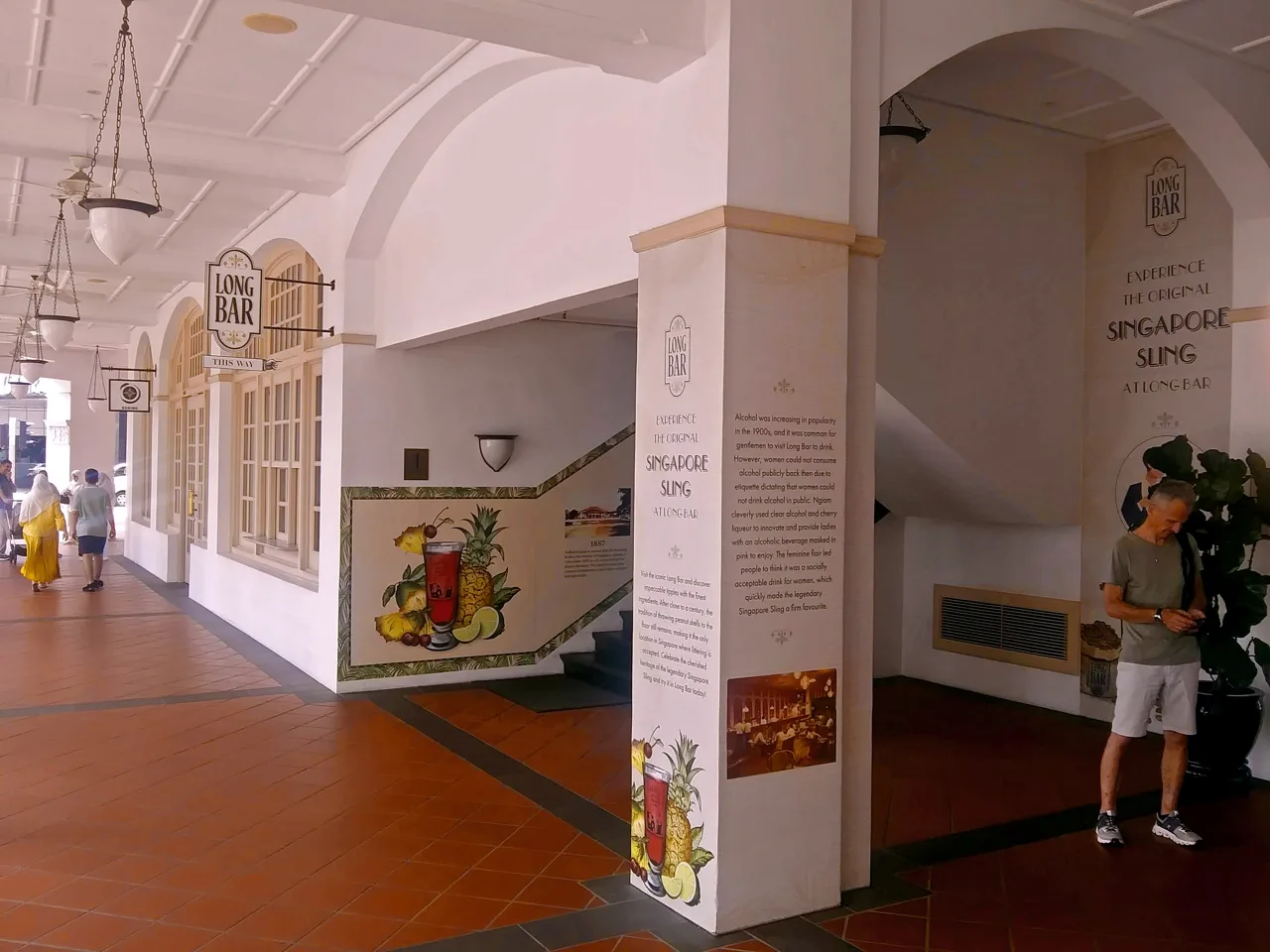
4. Walk-ins only, and the single exception the hotel makes
The rule is one sentence on the official page: the Long Bar is open to walk-ins only. There is no form, no online slot and no telephone number for a table, and below a party of 10 there is nothing to reserve at all. The hotel does not keep a discreet list for people who ask nicely, and it does not pretend otherwise on the page.
This is unusual for a room of this reputation, and it has a consequence worth stating plainly. Arriving at a busy hour with a group of 6 means waiting until 6 seats come free together, and that is a longer wait than the length of the queue suggests, because the queue does not move evenly.
Parties of 10 to 20
Above 10 people the position changes. A group of 10 to 20 can be arranged with the hotel in advance, which is a practical concession rather than a privilege, since a bar that seats people as they arrive cannot absorb 14 arrivals at once without notice. Anything larger than 20 falls outside what the room is willing to do.
The route through the room next door
The other exception is written into the Butcher’s Block material. Eat there and the restaurant team will help arrange a visit to the Long Bar after the meal. The two rooms are neighbours on the same landing, so the handover is short, and it converts an unpredictable wait into a known one.
For one person the walk-in rule is close to harmless. Single seats come free constantly in a bar where people finish a drink and leave, and a solo arrival can often be placed while a group of 4 is still waiting for a table to clear. That asymmetry is one of the few places where travelling alone in Singapore is straightforwardly easier rather than merely cheaper.
For everyone else the answer is timing, and the hotel has published the timing itself. Few businesses tell customers when not to come, and fewer still name three separate windows for it. The last of those windows, after 21:00 on weekdays, works better as a fixed point late in an evening built around bars than as the first stop of one.
5. The three quiet windows, and the hour that moves on Thursday
Most bars would rather not discuss their queue at all. This one publishes a short list of the times when the wait is shortest, labels each one, and leaves it on the page for anyone to read before setting out.
| Label | When | What the hotel says about it |
|---|---|---|
| Best | 11:00 to 11:30 | Minimal wait |
| Good | 14:00 to 15:30 | Off peak |
| Late night | After 21:00 | Weekdays only |
Why the first half hour works
The opening window is arithmetic rather than luck. Doors open at 11:00, the room starts empty, and nobody inside has yet had time to settle into a second round. Arrive inside that half hour and the hotel says the wait is close to nothing. Turn up at 12:15 and the same room is holding a full house with no particular reason to move.
The middle of the afternoon
The second window runs from 14:00 to 15:30, and it exists because two different crowds are out of the room at the same moment. Lunch has finished and left, and the evening arrivals, who mostly come after a day of sightseeing, have not started. At 90 minutes it is the longest of the three windows, which makes it the easiest to plan around when the morning is already spoken for.
Late, but only on a weekday
After 21:00 the room thins out again, and the hotel marks that window for weekdays. The qualification cuts directly against instinct, because Friday and Saturday are when most visitors would choose to go out. Weekend hours are longer, but the extra hour brings extra people with it, so the late window is not offered on the nights when the bar is open latest.
Closing time is the second thing to check before setting out, because it is not the same every night.
| Days | Hours |
|---|---|
| Sunday to Wednesday | 11:00 to 22:30 |
| Thursday to Saturday | 11:00 to 23:30 |
The difference is 1 hour, applied to the back half of the week. Opening never moves. If a late drink is the plan, Thursday is the first night of the week that supports one, and a Sunday arrival at 22:15 is walking into the last 15 minutes of service. Anyone with a very early start booked for the next day will find the 11:00 window far easier to keep than the late one.
6. The peanut shells belong on the floor
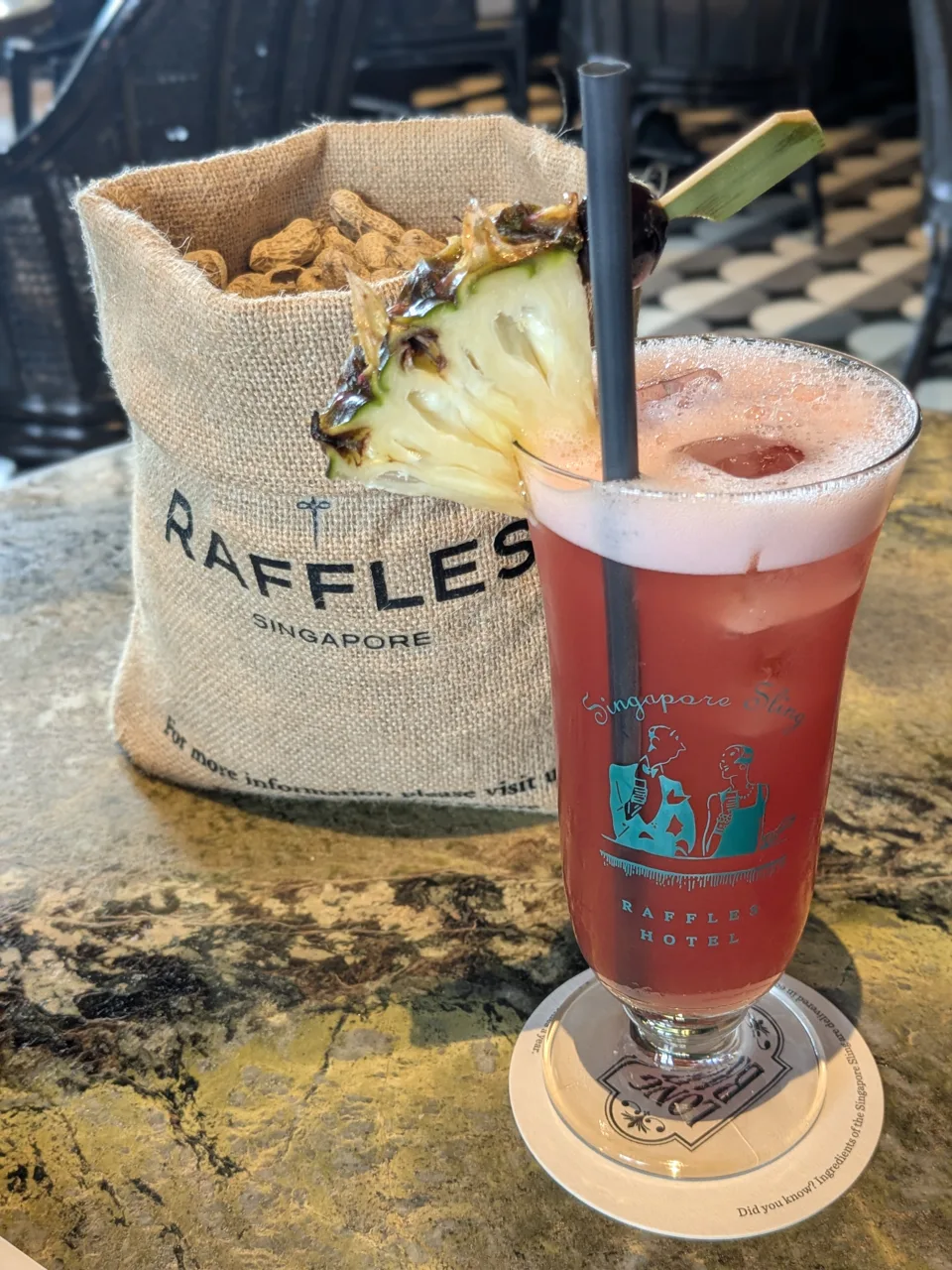
A sack of peanuts sits on the bar and the shells go on the floor. This is not a tolerated habit that staff quietly sweep up between customers. The hotel asks for it in writing, describing the room as close to the only place in Singapore where dropping something on the ground is encouraged.
The line works because of where it is being said. Cleanliness is enforced hard in this country, and visitors arrive braced to be told off for far less, so an instruction to make a mess lands differently here than the same instruction would anywhere else. It is also the one instruction the hotel prints that no other room in the city prints.
The practical version is short. Sweep the shells off the bar top rather than dropping them from shoulder height, and expect the floor to be well covered by the middle of the evening. Shoes you would rather not walk on shells in are the wrong shoes for this room.
A room built over two levels
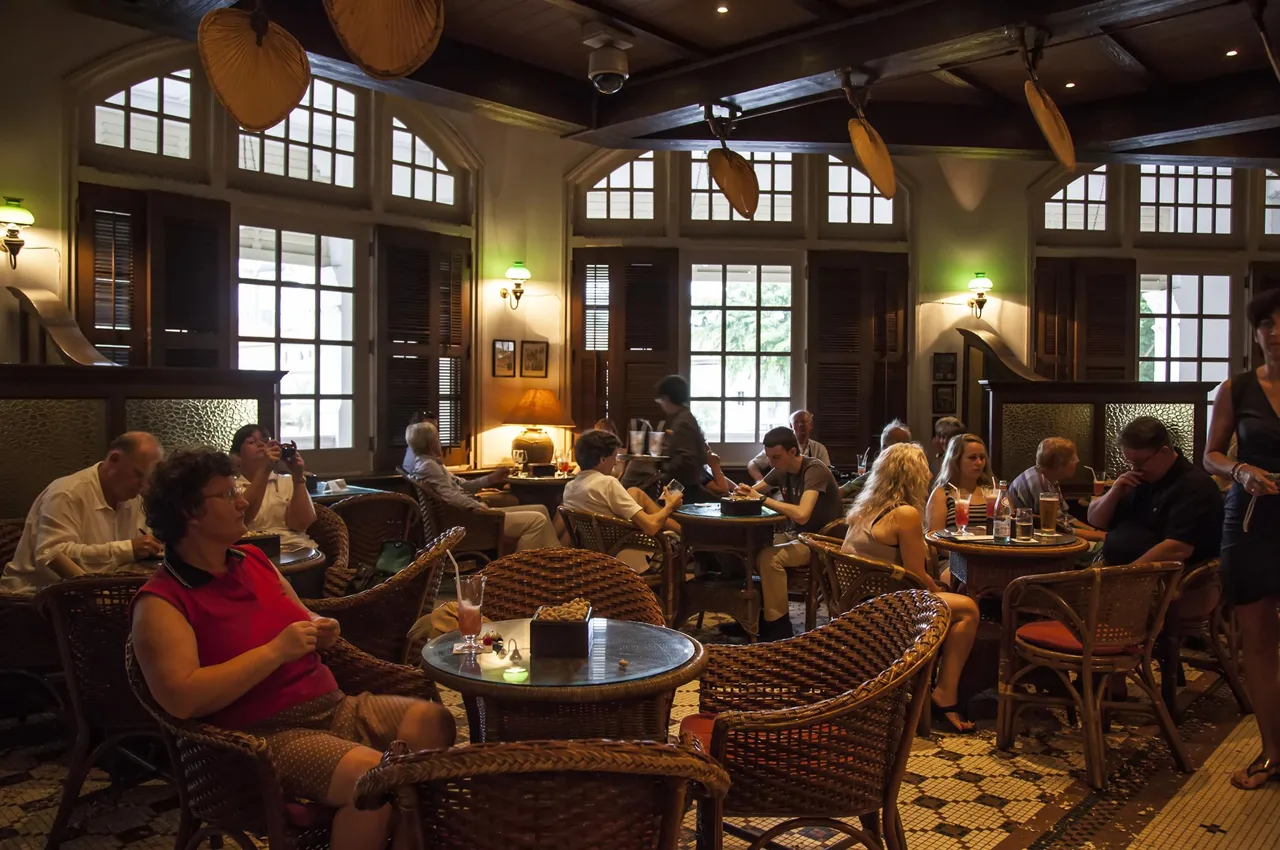
The bar is arranged on two floors, with woven fans hanging from the beams and rattan armchairs pulled around small round tables. Its decoration is drawn from Malayan life in the 1920s, which is a chosen period rather than a preserved interior, and that distinction explains why the room reads as older than the date it was actually built.
The peanuts arrive in sacks printed with the hotel’s name and are topped up through the day rather than portioned out per customer. Nothing about the arrangement is delicate, which is an odd note to strike in a property where the restaurant one floor down and one building across asks men to wear a collar.
7. A gin drink built to pass for fruit juice
The Singapore Sling was mixed here in 1915 by a bartender named Ngiam Tong Boon, who the hotel records as having come from Hainan. That year is the only date most visitors know about the drink, and it is also the one date that does not describe the room they are about to queue for.
Why the colour mattered
The pink was the whole point. At the time it was not considered proper for a woman to drink alcohol in a public room, so the bartender built a gin drink that would pass for fruit juice at a distance. The disguise is why the recipe leans on pineapple and grenadine rather than on anything that would give it away, and it is why the finished glass still arrives the colour it does.
The hotel tells the story without embroidery, and the social rule it worked around is worth taking seriously rather than treating as a marketing hook. A drink designed to be deniable says more about the room it was poured in than the recipe ever will.
What is in the glass now
Gin is still the base, and the gin is now Singapura Gin from Brass Lion, a distillery inside the city rather than an imported name on a shelf. Pineapple and lime carry the rest of it. A cherry and a wedge of pineapple sit on the rim, and the glass itself is printed with the hotel’s own design.
The hotel names him as Hainanese, which is the kind of detail its own pages keep and most retellings drop. Origins like that one sit behind a good deal of the naming across the island, a subject taken up in the languages Singapore actually speaks.
8. The room you queue for has only stood there since 1991
The hotel dates the cocktail to 1915 and every retelling repeats that year. The room is a separate matter. What stands in the arcade today, at #02-01, was put there when the hotel reopened after its first restoration, and the gap between those two facts is the most widely misunderstood thing about a visit.
Two official pages, two starting points
The hotel’s own material does not agree with itself on this. Its Long Bar page traces the bar back to the early 1900s at Cad’s Alley, where it was known as the rendezvous of planters and where its tables faced Bras Basah Road. The historical timeline on the same site says something different, putting the beginning of the Long Bar in the 1960s as a counter inside the Raffles Ballroom.
Both accounts converge on what happened afterwards. The hotel closed in March 1989 for its first full restoration, the arcade was built onto the North Bridge Road side during that work, and the property reopened on 16 September 1991 with the Long Bar installed upstairs in the new wing. Raffles CourtyardMap opened at the same time.
The dates that settle it
| Year | What happened |
|---|---|
| 1887 | The Sarkies brothers, an Armenian family, opened a hotel of 10 rooms on 1 December |
| 1915 | The Singapore Sling is mixed by Ngiam Tong Boon |
| 1987 | The hotel is declared a National Monument |
| 1989 | Closed in March for its first full restoration, with the arcade added on the North Bridge Road side |
| 1991 | Reopened on 16 September, the Long Bar taking a new place in the arcade |
| 2019 | Reopened in August after a second restoration |
Between those rows sit the episodes the hotel likes to tell. In 1902 a tiger was shot beneath the bar and billiard room, then a building raised on posts, and it was the last tiger caught in Singapore. The centenary was celebrated a year early to land inside a year of the tiger, and a live one was put on a billiard table for the photograph.
The war left a different mark. Under the occupation the hotel was renamed Syonan Ryokan, and the silver beef wagon was buried in the Palm Court to keep it from being taken, then dug up and put back into service afterwards. That episode belongs with the rest of the city’s wartime sites rather than with the cocktail.
National Monument status arrived in 1987, two years before the doors closed for the rebuilding, and that sequence is the reason the front of the building survived a restoration that replaced a great deal behind it. The same register covers other buildings in the civic district, among them the former Supreme Court, one half of the pair that now holds the National Gallery.
9. The centenary gin, and a shaker that makes 18 at a time
In 2015 the drink turned 100, and the hotel marked the anniversary by making a gin rather than a menu. Raffles 1915 Gin was produced with Sipsmith, and the year in the name refers to the original Sling rather than to the bottle.
Three years later the room came back from its own restoration and the drink was reset alongside it. That work was done by Jason Crawley, an Australian bartender, who built a cast iron hand cranked device for the bar and called it the Raffles Sling Shaker.
What the hotel records about the machine
The machine shakes 18 drinks in one go. The hotel names the man who built it, gives the material as cast iron and says it is turned by hand, and it stops there. No reason is published for the number itself, so read 18 as a description of the device rather than as a promise about how fast a round arrives.
The same entry places the shaker alongside the reopening rather than alongside the recipe. What the hotel says changed in 2018 is the Sling itself, reset when the room came back, and the machine is listed as part of that return.
Which gin is poured today
The house pour is Singapura Gin from Brass Lion, distilled in Singapore. Those two bottlings are separate things, and the hotel does not present the 1915 gin as the standard base of the drink served now. Anyone hoping to taste the anniversary edition should ask rather than assume.
10. 27 June, and the first 100 people carrying a pineapple
Singapore Sling Day falls on 27 June and is kept every year. The date was not chosen at random. It already belonged to International Pineapple Day, which is a reasonable thing to borrow when a wedge of pineapple sits on the rim of every glass the bar sends out.
The hotel’s part in it has a hard edge. Anyone who turns up carrying a whole pineapple is given a Sling, up to the first 100 people through the door. That number is a cap rather than a target, so the morning of the day is a race, and the opening window that normally guarantees a quiet room does exactly the opposite on that one date.
Nothing else about the day is unusual. The bar does not close for it, the hours are the ones printed for that day of the week, and anyone arriving without a pineapple joins the queue in the ordinary way.
The version without the gin
A zero proof Sling sits on the menu as Singapore Sling Zero. It is built on Tanqueray 0.0% with the hotel’s own grenadine, pineapple and lime juice and a spice mix, which makes it a reconstruction of the drink rather than a consolation handed to whoever is driving.
That matters more than it sounds. The room is a single stop for most visitors and the queue does not sort drinkers from non drinkers, so a table of 4 that includes someone who does not drink alcohol still has something to order that belongs to the same visit. It is one of the details that makes the bar workable with older parents in the group, alongside seating that does not require standing at a counter for an hour.
11. Afternoon tea downstairs runs on a 90 minute clock
The Grand Lobby serves afternoon tea every day, from 12:30, with the last seating at 17:30. A sitting lasts 90 minutes, and the limit is enforced rather than suggested. That single rule changes how the rest of an afternoon has to be planned, because the end of the sitting is fixed at the moment it begins.
Booking runs through the hotel’s online reservation system, and a credit card guarantee is required to hold the table. One booking covers up to 6 people.
| Rule | What applies |
|---|---|
| Where | The Grand Lobby, main building, entered from Beach Road |
| When | Daily from 12:30, last seating 17:30 |
| Length of a sitting | 90 minutes |
| How to book | Online reservation system, credit card guarantee required |
| Party size | Up to 6 people per booking |
| Cancellation | 24 hours ahead, or 7 days over Grand Prix week and 24, 25 and 31 December and 1 January |
| Late cancellation or no-show | S$108 per person, or the full value of the set booked |
| Closing days | None listed |
| Price | Not published |
The cancellation deadlines are not all the same
The standard deadline is 24 hours before the sitting. Over the Grand Prix week, and on the four dates around Christmas and New Year, the deadline moves out to 7 days instead. Those are the dates when the room fills furthest ahead, and anyone whose trip overlaps the race weekend should treat the tea as a fixed booking rather than a spare hour to fill.
Miss the deadline or fail to turn up and the charge is S$108 per person, or the full value of the set that was booked. That figure is the guarantee rather than the price of the tea, and the difference is worth holding on to, because the hotel publishes no price for the tea itself anywhere at all.
What arrives on the stand
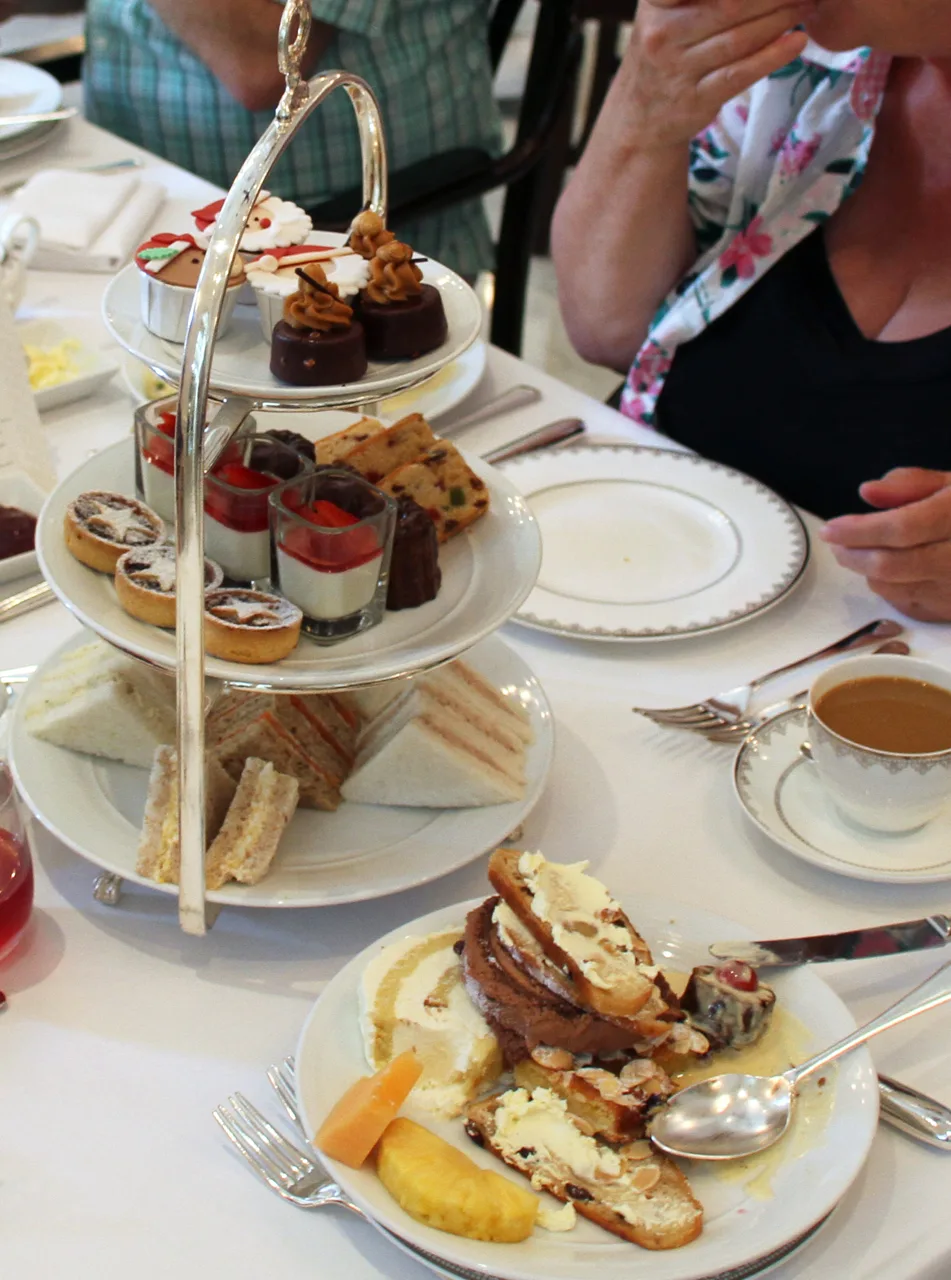
The tea comes on a three-tier silver stand: finger sandwiches, scones and small pastries, with a cup poured alongside. Leaves come from JING, single garden, and the selection is put together by a tea sommelier rather than left as a list of names on a card for guests to guess at.
There is no closing day. The sitting is listed as daily, it runs through public holidays, and the reservation system takes dates right through the coming months without a weekly gap. For two people with an afternoon to spend, it is the most reliable booking in either building, and it sits well inside a trip planned for two.
Champagne for Race Week
One limited version appears on the calendar. Champagne Afternoon Tea: Race Week is built around the Grand Prix, runs for 8 days and then stops, and the reservation page is where the current dates sit. It is the only seasonal variation the hotel lists for this room, which makes the rest of the year unusually predictable by the standards of hotel dining.
12. The other rooms on the main building side
Four more places sit inside the main building, and they have less in common with one another than a shared address suggests. One is a dining room from the beginning of the hotel, one opens only after work, one collected two stars before its first birthday and one runs seven days a week without fuss.
Tiffin Room
The north Indian dining room carries the oldest idea in the hotel. A tiffin curry has been served on the premises since 1910, and the restaurant took its present name in 1976, which is a late christening for something that had been on the table for 66 years by then. Lunch and dinner run every day, and the dress code is the standard casual chic.
The room also moved once, in a way that is easy to miss. It opened in 1892 at Commercial Square, the place now called Raffles Place, and only came into the hotel in 1910. The name followed the food rather than the other way around.
Writers Bar
The second bar opens in the evening only, from 17:00, and it is restricted to over 18s. Closing is 23:30 from Sunday to Thursday and midnight on Friday and Saturday. An aperitivo hour was added recently, running Tuesday to Thursday from 19:00 to 21:00, which gives the main building a reason to be visited before dinner rather than only after it.
1887 by André
The restaurant on the lobby level holds two MICHELIN stars in the 2026 Singapore guide, and it took them before its first year was out, which is rare enough to be worth stating on its own. Lunch and dinner run Tuesday to Saturday, and the room closes on Sunday and Monday. Booking is advised, and walk-ins are seated only when a table happens to be free. It is the only starred room on the property, and it appears on the city’s list of starred restaurants alongside the rest.
藝 yì by Jereme Leung
The Chinese restaurant works across regional cooking rather than a single province, and it runs lunch and dinner every day of the week with a private dining room attached. Of the four main building rooms it is the easiest to get into at short notice, because it neither closes for two days a week nor limits itself to the evening.
13. The arcade side is where the prices are actually printed
The hotel keeps most of its numbers off the page. That changes in the arcade, where Raffles Courtyard prints more figures than anywhere else on the property, which makes it the one part of the building you can budget for before arriving.
Set lunch at S$30++
The Courtyard runs a set lunch at S$30++. That buys one main course from a short list, dry laksa goreng, red curry duck confit or grilled chicken breast, plus a drink or a house made ice cream. It is the cheapest published way to eat inside the hotel, and it is served in the open courtyard rather than in a dining room.
The Courtyard opens daily from 12:00 to 22:30, with lunch and dinner service inside those hours, and it stays open on public holidays when other rooms take the day off. It is also the only outlet in either building that admits pets, which is an unusual line to find on a hotel dining page and a useful one for residents rather than visitors.
The nights with names
Tuesday is Grill Night, running from 17:00 to 21:00. A live grill works through grilled oysters, tiger prawn skewers, satay and Muar otak otak, and it is the one service on the property where the cooking happens in front of the table.
Wednesday brings wine by the glass at S$12++, and ordering a bottle gets a second bottle at no charge. The offer explains itself. A courtyard with a lot of seats needs a reason to fill them in the middle of the week, and the middle of the week is when the hotel’s other rooms are quietest.
Happy hour runs Monday to Friday from 17:00 to 20:00, which lines up with the end of the working day in the offices a few streets away. Anyone keeping an eye on what a day in Singapore costs will find this corner of the hotel much easier to justify than the rest of it, and the arithmetic behind that is set out in the piece on what a trip here actually costs.
Butcher’s Block
The restaurant at #02-02 cooks over fire and is run by chef Jordan Keao. A business lunch of 3 courses is listed at S$78++, served Wednesday to Friday, which is the only weekday set menu on the arcade side.
The tasting menus run longer and cost more. Lunch is 6 courses at S$178++ and dinner is 7 courses at S$238++. Those are the highest published figures anywhere on the hotel’s dining pages, which is worth noticing given that the room on the other side of the landing will not quote the price of a single drink.
Its closing days do not follow a clean pattern. Lunch is not served on Sunday, Monday or Tuesday. Dinner is not served on Sunday or Monday. That produces the odd result of a Tuesday on which dinner is available and lunch is not, and it is exactly the sort of detail that wrecks a plan built from a half remembered opening time.
14. Dress codes, and the one room that sits a notch looser
The main building rooms share a single line: casual chic. It is not a formal dress code and there is no jacket requirement, but it is written down on every outlet page and it is applied at the door rather than waved through.
For men that means a collared shirt, long trousers and proper shoes. Dress shorts are allowed at lunch, which is the one concession the hotel makes to the climate, and it does not extend into the evening service.
For women the wording is a dress, a skirt or long trousers, with shoes held to the same standard as the rest of the outfit.
What actually gets turned away
Footwear is the part that is genuinely enforced. The Grand Lobby names slip-ons, flip-flops, rubber clogs and sandals as unacceptable. Over at Tiffin Room the list is shorter, naming slip-ons and flip-flops. In a city where most visitors walk around in precisely those, this is the one thing worth checking before leaving whichever part of town you are staying in.
The bar asks for less, and says why
Smart casual is the standard upstairs, one step below the main building, and the hotel gives its reasoning on the page. It wants guests to be able to move comfortably around the whole property. The code was written so that a visitor can go from a drink in the arcade to dinner in the main building without going back to change.
In practice the gap between the two standards is small. A collared shirt and closed shoes clear every room in both buildings, which removes the question from the day entirely.
15. What ++ does to a bill, and the prices that are not printed at all
Two plus signs after a figure are not decoration. The first stands for a service charge of 10 per cent, added to the menu price. Behind the second sits the goods and services tax, which is then worked out on that larger total rather than on the original figure.
The order is what matters. Because the tax is applied after the service charge, the two do not simply add together, and the final line always sits above what a quick mental sum suggests. A set lunch printed at S$30++ is not S$30 at the till, and the gap is wider than the service charge on its own.
Where the hotel prints nothing
The Long Bar does not publish a drinks price. Its menu loads through an outside widget and no amounts appear on the page, so there is no official figure for a Singapore Sling to quote and nothing to check a bill against in advance. Any number seen elsewhere came from somewhere other than the hotel.
Afternoon tea is the same case with an extra layer. The booking system takes a card guarantee, states that displayed prices are per person and exclusive of a service charge of 10 per cent and prevailing taxes, and then displays no price. S$108 is the only figure the hotel attaches to the tea anywhere, and that is what is charged for missing the booking.
Budgeting without a number
The workable approach is to treat the visit as a fixed cost of unknown size and to set the rest of the day against it. An afternoon that includes this room is not an afternoon that also includes an expensive dinner, and the balance usually comes from eating the other meals at a hawker centre instead.
Payment itself is simple enough. Cards work everywhere in both buildings, the service charge is already on the bill so nothing further is expected on top, and the rules on tax refunds for departing visitors are set out in the piece on cards, cash and GST refunds.
16. Half a day here without booking a room
Everything described so far can be done by someone who is not staying in the hotel. The bar takes walk-ins, the tea takes a public booking, the restaurants take reservations, and the spa accepts outside guests. Only the bedrooms are closed to visitors, which is a narrower restriction than most hotels of this kind apply.
An order of play that works
Arrive at the arcade entrance at 11:00 for the first quiet window and order upstairs. Come down at about 12:20, cross to the main building, and take the 12:30 afternoon tea sitting. That sequence uses the only two time bound things on the property and puts them in the order the clock allows.
The reverse works less well. Sittings run 90 minutes and the last one starts at 17:30, so a tea that begins late in the afternoon finishes close to the hour when the bar queue is at its worst. Taking the morning version instead leaves the whole evening free for the waterfront after dark.
For a visitor with three or four days this is a half day rather than a full one, and it sits comfortably beside the civic district museums inside a three day plan. Trying to stretch it further usually means waiting in a queue that a different hour would have removed.
The hotel behind the bar
Every room here is a suite. There are 8 suite types, and a Raffles butler is attached to every one of them rather than to a top tier alone, which is the detail that separates this house from other hotels in the same price bracket.
The pool is on level 3 and opens daily from 07:00 to 19:00. A fitness room sits on the same floor and never closes. Neither is open to the public, which leaves the spa as the one facility a non guest can book, and the boutique on the Seah Street side as the one shop.
The building has been a National Monument since 1987, and it keeps a resident historian, Leslie Danker, who has worked here for more than 50 years. Taken together, the visit is a short one with a long history attached to it, and it slots into the wider Singapore guide as a fixed point in an afternoon rather than a day of its own.
🎡Things to Do52
🍜Food6
🏨Where to Stay10
🚇Getting Around4
🧭Travel Tips20
Questions people ask
It is at #02-01 Raffles Arcade, 328 North Bridge Road, on level 2, and not inside the main hotel building on Beach Road. The arcade has its own street entrance on the North Bridge Road side. Take the escalator or the lift up to level 2 and the bar is next door to Butcher’s Block at #02-02.
No, the bar takes walk-ins only. The one exception is a group of 10 to 20 people, which can be arranged with the hotel in advance. Booking a meal at Butcher’s Block next door is the other route in, because that team helps guests move across to the Long Bar afterwards.
The hotel names three windows: 11:00 to 11:30, 14:00 to 15:30, and after 21:00 on weekdays. The first is labelled the best of the three, because the room has only just opened and nobody inside has settled in. The late window is marked for weekdays alone, so a Friday or Saturday night is the wrong time to rely on it.
The hotel does not publish a price for it. The Long Bar menu loads through an outside widget with no amounts shown, so there is no official figure to quote and no number on the page to check against. Whatever the menu says on the day, a service charge of 10 per cent and tax are added on top.
Yes, and the hotel asks you to. Its own wording describes the room as close to the only place in Singapore where littering is encouraged. Sweep them off the bar top rather than scattering them, and wear shoes you do not mind walking on shells in.
No. The room in the arcade dates from 1991. The hotel shut in March 1989 for its first full restoration, the arcade was built onto the North Bridge Road side during that work, and the bar took its new place when the property reopened on 16 September 1991. The hotel’s own pages also disagree about where the Long Bar began, one pointing to Cad’s Alley in the early 1900s and the other to a counter in the Raffles Ballroom in the 1960s.
Yes, and it is called Singapore Sling Zero. It is built on Tanqueray 0.0% with the hotel’s own grenadine, pineapple and lime juice and a spice mix, so it follows the shape of the original rather than replacing it with fruit punch. It sits on the same menu as the full strength version.
Smart casual for the Long Bar, and casual chic for the rooms in the main building. Men need a collared shirt, long trousers and proper shoes, with dress shorts allowed at lunch only. Slip-ons, flip-flops, rubber clogs and sandals are refused at The Grand Lobby, and the Tiffin Room refuses slip-ons and flip-flops.
Book through the hotel’s online reservation system with a credit card guarantee, and expect a sitting of 90 minutes. Service runs every day from 12:30, with the last seating at 17:30. One booking covers up to 6 people.
A late cancellation or a no-show is charged at S$108 per person, or the full value of the set that was booked. The standard deadline for cancelling is 24 hours ahead. It stretches to 7 days over the Grand Prix week and on 24, 25 and 31 December and 1 January.
No price is published for it anywhere, including inside the booking system. The system states that displayed prices are per person and exclusive of a service charge of 10 per cent and prevailing taxes, and then shows no amount at all. The only figure the hotel attaches to the tea is the S$108 charge for missing a booking.
1887 by AndréMap holds two stars in the 2026 Singapore guide. It sits on the lobby level of the main building and it closes on Sunday and Monday, which is worth checking against a weekend plan. No other outlet in either building is starred.
It means a service charge of 10 per cent is added first, and tax is then worked out on the higher total. A courtyard set lunch printed at S$30++ therefore leaves the till above S$30, and above what the service charge alone would suggest. Every published price at the hotel carries the symbol.
It falls on 27 June each year, sharing the date with International Pineapple Day. The first 100 people who arrive carrying a whole pineapple are given a Sling. Opening hours are the normal ones for that day of the week, so anyone turning up without a pineapple simply queues as usual.
The spa takes outside guests, and the pool does not. The pool is on level 3 and opens daily from 07:00 to 19:00 for people staying in the house, with a fitness room on the same floor that never closes. Everything else covered here, the bar, the tea and the restaurants, is open to visitors who are not staying the night.