
Skypark Sentosa and the Skyslides: Height Rules, Prices and What Each Activity Actually Involves
The Siloso Beach tower reopened on 7 June 2026 with two 44-metre slides. Here is who can ride what, what each activity costs, and how to walk there from Beach Station.
| What it is | A height-activity site on Siloso Beach with two slides, a bungy jump, a giant swing and a skybridge, all on one tower |
|---|---|
| Reopened | 7 June 2026, on the same day the Skyslides opened |
| Opening hours | Daily 11:30 to 19:30, with last registration at 19:00 |
| Entry | No admission fee for the grounds. You buy a ticket per activity |
| Slide prices | S$28 for two rides, S$33 for three. Rides can be split between the two slides |
| Height rules | The Big Klook Slide from 1.2m, Skydrop from 1.4m, both capped at 2.0m |
| Getting there | Sentosa Express to Beach StationMap, then a 5 to 10 minute walk towards Siloso Beach |
| Time needed | About an hour for slides alone, two to three hours if you add the bungy or the swing |
1. What Skypark Sentosa is, and who it suits
2. How the two slides differ
3. Skydrop: the enclosed tube
4. The Big Klook Slide: a gentler descent and UV lighting
5. Height and weight rules for all five activities
6. The 47-metre bungy jump
7. The Giant Swing, for up to three
8. The Skybridge and its glass floor
9. Prices, packages and booking
10. What to wear and what to bring
11. Getting there from Beach Station
12. When to go
13. Building a half day around Siloso Beach
14. An honest verdict, and what to read next
Skypark SentosaMap is a height-activity site at the far end of Siloso Beach, and it reopened on 7 June 2026 with two 44-metre slides called the Skyslides. Walking onto the grounds costs nothing; every activity is ticketed separately. Below is what each of the five activities actually involves, every current price, and the walk in from Beach Station. For the wider island, see the Sentosa island guide; for the whole trip, start at the Singapore planning guide.
1. What Skypark Sentosa is, and who it suits
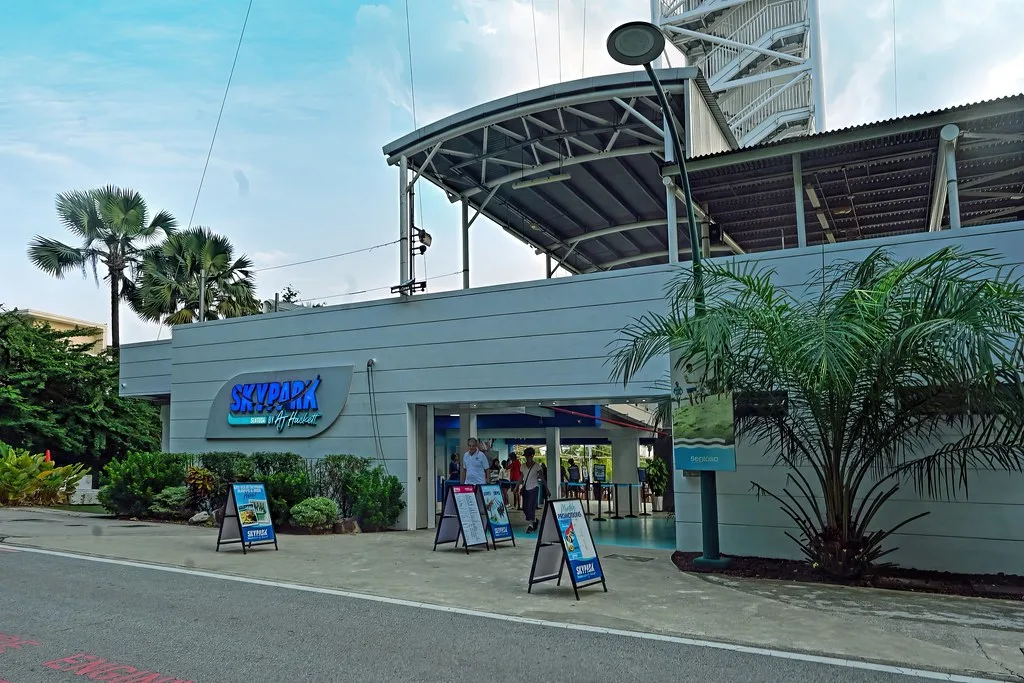
Skypark Sentosa is a single tower at the western end of Siloso Beach running five height activities. Entering the grounds is free, and each activity is bought as its own ticket.
What is sold here is not a set of theme-park rides but the experience of coming down from height in a harness. That changes how you decide whether to go. This is not a place you measure by how many attractions it has; you are paying for one short, sharp experience. The five activities line up clearly by how frightening they are, so the only real decision is how far along that line you want to go.
| If this is you | Do this |
|---|---|
| You want to be frightened | Buy a slide package that includes Skydrop, and add the bungy jump if the budget allows |
| Your child measures around 1.2m | Only The Big Klook Slide is open to them. A two-ride package means riding the same slide twice |
| Somebody in the group cannot take part | Entry is free, so they can wait at the base. There is no need to buy a ticket per head |
| You are already on Siloso Beach | Add an hour at the end of your beach time. Nothing opens before 11:30, so mornings are out |
| Photos and video matter to you | Include a Skydrop ride. It is the only slide that produces ride footage |
The site is equally clear about who it does not suit. Everything stands exposed to the weather, and the actual airtime per activity is short against the price. If you want a long stay for your money, other places on the island give more hours per dollar. The full range of options is set out in the Sentosa island guide.
Group size is worth thinking through in advance too. Tickets here are sold per person per activity, so a group of four or five runs up a meaningful bill on slide packages alone, and adding bungy jumps compounds it. The reverse also holds: one or two people can concentrate the budget on a single activity, buying the bungy outright and picking up the Skybridge along with it.
There is also no indoor alternative on site. The whole operation is one tower and the ground beneath it, so when rain or strong wind arrives your options are to wait or to come back another day. If your schedule is tight with no slack to move things around, put this on a day when you have hours to spare.
2. How the two slides differ
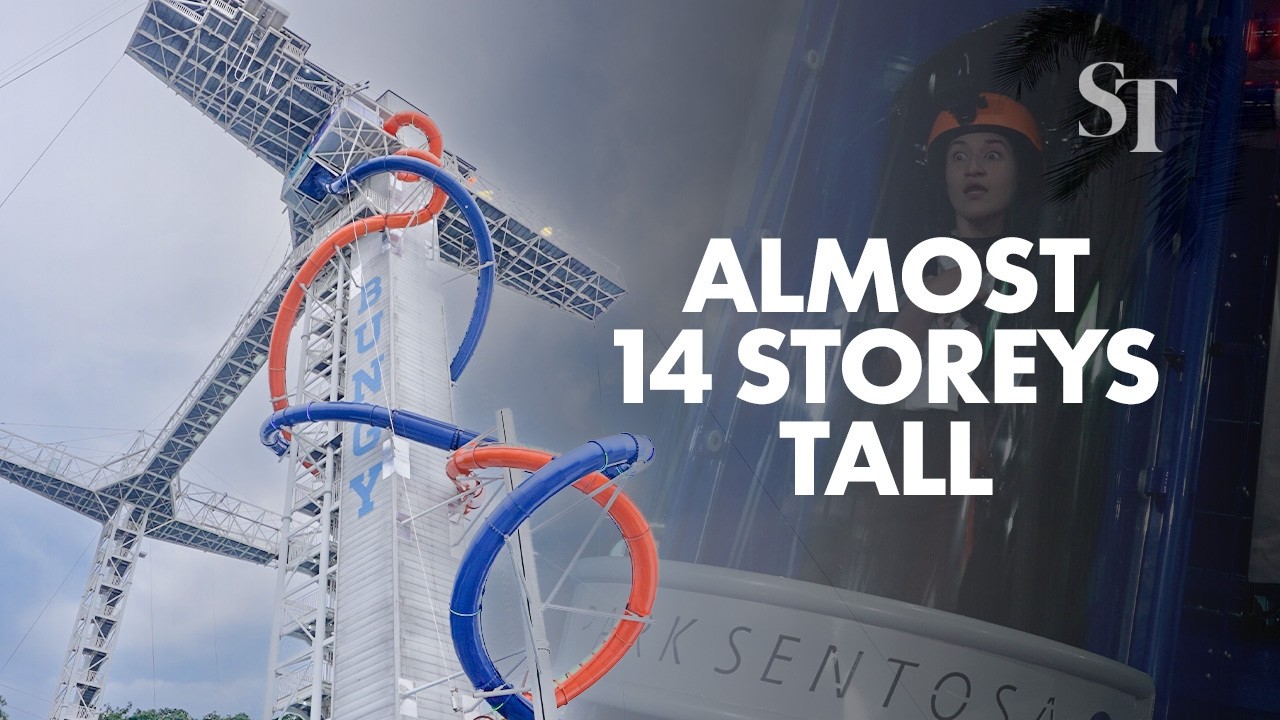
Skyslides is the name covering both slides, and they stand at the same height of 44 metres. What separates them is the structure and the minimum height, not the drop.
Skydrop is the blue one, and it is a closed tube. Partway down there is a drop section where the floor gives way beneath you before the ride settles into a curve. The Big Klook Slide is orange and takes a gentler gradient. Its interior carries six themed sections picked out in UV lighting, and the operator positions it as the relaxed way down.
| Feature | Skydrop | The Big Klook Slide |
|---|---|---|
| Colour | Blue | Orange |
| Structure | Enclosed tube with a drop section | Gentler descent, UV-lit sections |
| Height | 44m | 44m |
| Equivalent storeys | About 14 | About 14 |
| Interior | None | Six UV-lit themed sections |
| Helmet | Worn | Not worn |
| Ride video | Available at S$20 | Not available |
| Minimum height | 1.4m | 1.2m |
| Maximum height | 2.0m | 2.0m |
| Weight limit | 130kg maximum | None |
Rides from a package can be divided between the slides, so a three-ride package might cover Skydrop twice and The Big Klook Slide once. Anyone under 1.4m cannot spend a ride on Skydrop, which makes measuring the group the first step rather than the last.
Group composition decides which package makes sense. Adults travelling together will generally want the three-ride package so they can try both slides. With a child in the low 1.2m range the calculation changes, because that child will be riding the same slide repeatedly; asking whether they want to do that three times is worth doing before you pay. Plenty of children ride once and decide they are finished, which is an argument for starting with two.
One more thing is worth knowing: both slides launch from the same platform. The climb to 44 metres is shared, and the two only diverge once you are standing at the top. Switching slides is therefore no help to anyone who finds the height itself the problem. For them the Skybridge, which is walked rather than ridden, is the better answer.
3. Skydrop: the enclosed tube
Skydrop is the blue enclosed slide, billed by the operator as the world’s tallest land-based drop slide. The rules are a 1.4m minimum height, a 2.0m maximum and a 130kg weight ceiling.
Calling it a drop slide means there is a section where you fall before the slide turns into a conventional descent. Because the tube is closed you cannot see out, so all of your attention lands on speed and direction. At 44 metres the starting platform sits roughly fourteen storeys up.
| Item | Detail |
|---|---|
| Minimum height | 1.4m |
| Maximum height | 2.0m |
| Maximum weight | 130kg |
| Age limit | None |
| Helmet | Worn, with a camera mount fitted |
| Ride video | S$20 |
This is the only slide with a ride video. The footage comes from the mount on the helmet, so what is recorded is your point of view rather than your face. If video is the point of the visit, a Skydrop ride has to be in the package, and the purchase can be settled on site.
The 130kg ceiling applies to Skydrop alone out of the two slides. Anyone above it can put their rides on The Big Klook Slide instead, which carries no weight restriction at all.
The 1.4m minimum sits twenty centimetres above the other slide because the drop section requires riders to hold their own position. Adults will not give it a thought; it only matters if a primary-school child is coming. The ride itself is taken seated, so there is no technique to learn.
Whether the enclosed tube appeals is a matter of taste. With no view out, the sensation narrows to speed and the change of direction, which some riders love and others find claustrophobic. Anyone uneasy in tight dark spaces will be more comfortable on the slide without the drop section, even though both start from the same height. Conversely, if the moment of falling is the part of a rollercoaster you enjoy, Skydrop is the closest thing on this site.
4. The Big Klook Slide: a gentler descent and UV lighting
The Big Klook Slide is the orange one, taking a gentler gradient, and its minimum height is 1.2m. There is no weight limit at all, only the shared 2.0m height ceiling.
The gradient is shallower than Skydrop, which trades the falling sensation for a longer slide, and the operator bills it as the scenic way down. Inside, six themed sections run one after another, lit in UV and named along the lines of Disco, Magic, Space and Jungle.
| Item | Detail |
|---|---|
| Minimum height | 1.2m |
| Maximum height | 2.0m |
| Weight limit | None |
| Age limit | None |
| Helmet | Not worn |
| Ride video | Not available |
| Interior | Six UV-lit themed sections |
At 1.2m most primary-school children clear it, which also makes this the easiest choice when younger kids are along. The whole family angle on Singapore is covered in Singapore with kids.
No helmet means no footage on this slide. If you want a recording, put one of your rides on Skydrop.
The six themed sections work by changing the light around you as you descend. Dark stretches give way to sudden shifts in colour, so this one rides on atmosphere rather than speed. Anyone who came specifically to be frightened may find it tame; anyone who finds height uncomfortable will find it about right.
The absence of a weight limit is the other distinguishing feature. Skydrop caps riders at 130kg while this slide sets no ceiling, so nobody has to abandon the activity on those grounds. The upshot is that the two lowest barriers on the whole site are this slide and the Skybridge.
A question families ask often is whether an adult can ride along. They cannot: each rider goes down the chute alone, so a parent cannot carry a child through. The child has to meet the height rule and ride independently. That differs from the theme-park convention of an adult companion satisfying the requirement, and knowing it in advance avoids disappointment at the platform.
The open structure also makes this slide more sensitive to the weather. In strong sun the surface itself warms up, so arriving around midday in shorts and a t-shirt can mean a hot seat. Going shortly after opening or towards the evening avoids that, and it dodges the peak of the queue at the same time.
5. Height and weight rules for all five activities
Here are the participation rules for all five activities in one place. Most people clear them without thinking, so in practice only a couple are worth checking in advance.
No activity sets a minimum age; the rules go by height and weight instead, because the harness and helmet have to fit properly.
| Activity | Height | Weight | Other |
|---|---|---|---|
| Skydrop | 1.4 to 2.0m | 130kg maximum | No age limit |
| The Big Klook Slide | 1.2 to 2.0m | None | Medical conditions declared |
| Bungy Jump | No requirement | 45 to 150kg | Under 18 needs parental authorisation |
| Giant Swing | 1.2m and up | 60kg minimum to ride solo / 150kg maximum per adult / 300kg maximum combined / child harness from 30kg | Harness and helmet must fit |
| Skybridge | No requirement | No requirement | All ages |
The one worth noting is the bungy’s lower bound of 45kg. Most people assume weight limits only work in one direction, so if anyone in your group is slightly built it is worth a look. The Giant Swing’s 60kg applies only to riding solo, and riding with someone else settles it.
For the bungy, the list of conditions requiring declaration is long. It covers high blood pressure, heart conditions, diabetes, pregnancy, epilepsy, recent dislocations and sprains, neurological conditions, asthma, visual and hearing impairments, recent surgery, prosthetics, physical impairments, spinal injuries and contact lens use. If any of these apply, the process is to declare them at registration and let the staff make the call.
These thresholds exist because the harness and helmet have to fasten properly, so they are not adjusted on the day. Adults generally clear them without thinking, and the only real check is measuring a child before you go.
Registration itself is simple. You pick your activities at the counter, get weighed if you are jumping, confirm the health questions and collect your equipment. No passport or ID is required, though anyone under 18 needs a parent present to authorise it.
6. The 47-metre bungy jump
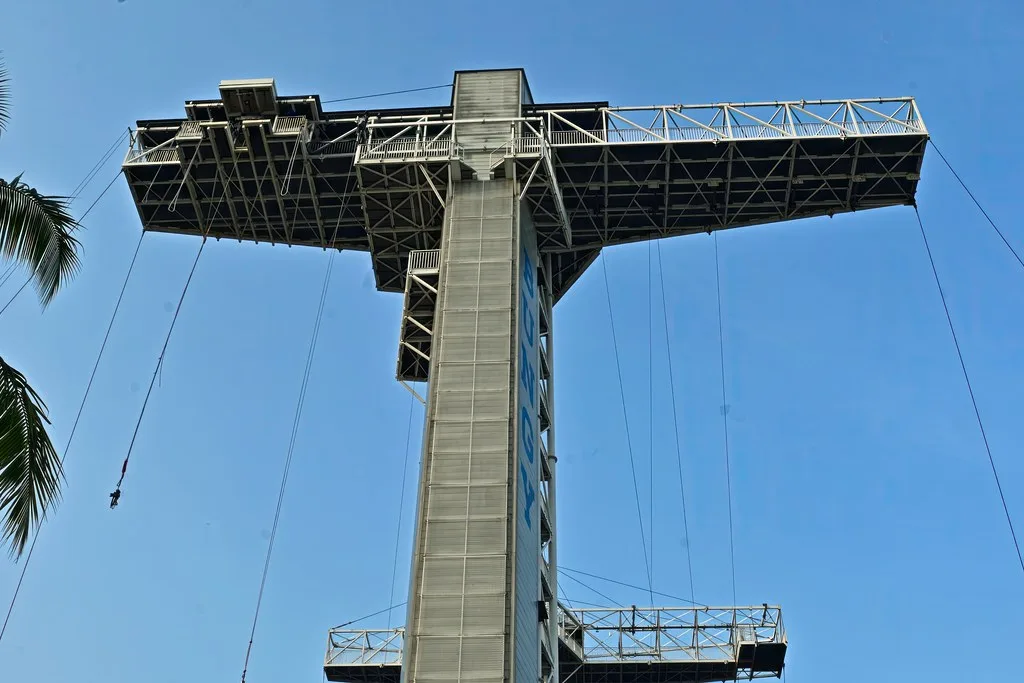
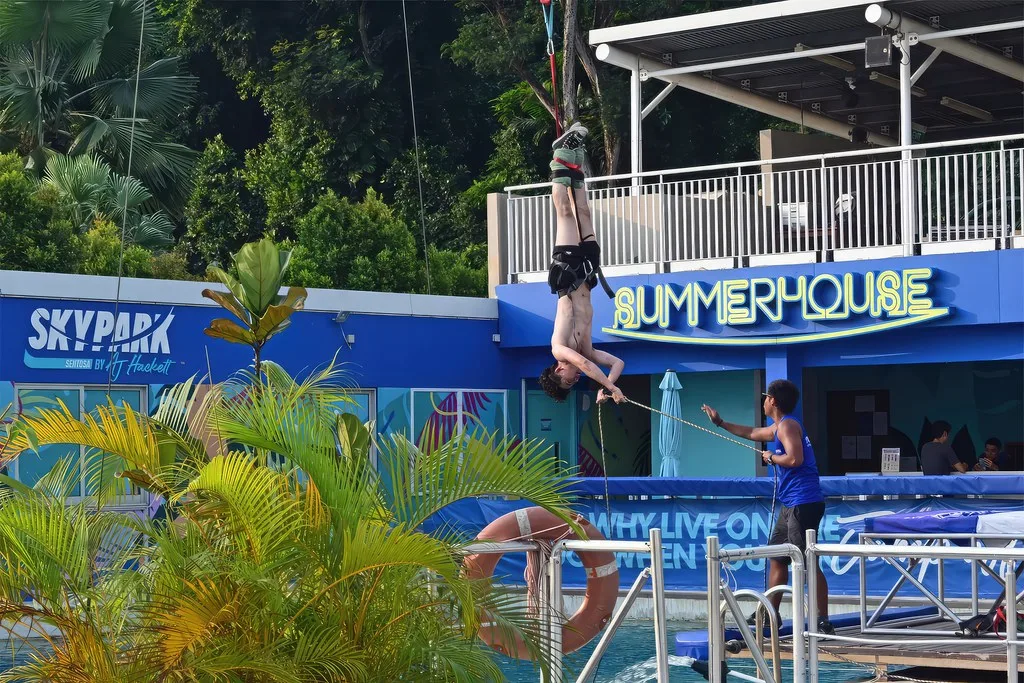
The bungy at Skypark Sentosa is the only one in Singapore, and the platform stands 47 metres up. A solo jump costs S$99 and a tandem jump for two costs S$179.
You jump from the top of the tower facing out towards Siloso Beach. There is no minimum age, though anyone under 18 needs parental authorisation, and the weight range runs from 45kg to 150kg.
| Item | Detail |
|---|---|
| Height | 47m |
| Solo price | S$99 |
| Tandem price | S$179 |
| Weight | 45 to 150kg |
| Age | No limit. Under 18 needs parental authorisation |
| Included | Skybridge access, Skypark Global Membership |
| Video | Sold separately |
Skybridge access comes bundled with the jump. Bought separately the Skybridge is S$15, so that is the saving. The ticket also includes a Skypark Global Membership giving 20% off at AJ Hackett sites worldwide, which is a genuine benefit if you expect to visit another of their locations.
Video is not included and has to be bought on its own. Deciding at registration rather than afterwards is simpler.
AJ Hackett is the company that made bungy jumping a commercial activity in the first place, and it runs comparable sites in several countries. Sentosa is one of them, positioned so that jumpers face the beach on the way down. Against the company’s other locations 47 metres is mid-range, but within Singapore there is nothing to compare it to.
The length of the declaration list is itself a signal of how demanding the activity is. Alongside the obvious entries such as heart conditions, pregnancy and spinal injuries, it reaches down to recent sprains, dislocations and even contact lens use. Borderline cases are better raised at registration than glossed over, since being stopped at the platform is the worse outcome.
It helps to know roughly how the jump unfolds. After the paperwork you are weighed, fitted with equipment and sent up the tower, and a stretch of time passes before you are actually standing on the platform. The whole sequence usually runs longer than people expect, so if you have something else booked that day, do not schedule it tightly afterwards.
On price, S$99 is the most expensive single item here, close to three times a slide package. If members of your group feel differently about jumping, settling who is in and who is out before you reach the counter costs a lot less than deciding on the spot. The included Skybridge access is a fair argument to put on the other side of the ledger.
7. The Giant Swing, for up to three
The Giant Swing straps you into a harness, winches you up and releases you forwards, and it costs S$69. Up to three people ride at once.
Two different heights are quoted for it, and both are correct. Riders are winched to 40 metres, and the arc of the swing carries them to a high point of 45 metres. Speed reaches 120km/h. The rig uses 6mm steel cables and a full-body harness, and riders choose from six different positions.
| Item | Detail |
|---|---|
| Price | S$69 |
| Winch height | 40m |
| High point of the swing | 45m |
| Top speed | 120km/h |
| Riders at once | Up to 3 |
| Minimum height | 1.2m |
| Solo minimum weight | 60kg |
| Maximum per adult | 150kg |
| Maximum combined | 300kg |
| Child harness | From 30kg |
The weight conditions are more involved than the bungy’s. Riding alone requires 60kg, and a group has to come in under 300kg combined. For two adults plus a child, doing that arithmetic first is the sensible order of operations.
Where the bungy drops you straight down, this swings you through a long arc. Visitors who find the falling sensation unbearable often pick it as the alternative, and within Singapore there is nowhere else offering the same thing.
Being able to ride together rather than alone matters more in practice than the specifications suggest. People who would never jump solo will often agree to a swing with a friend beside them. Three is the ceiling, so a group of three is done in one go while a group of four splits into two rides.
Choosing from six positions means deciding whether to sit or lie back, and whether to face forwards or go backwards. Starting with a straightforward position and varying it on a second ride is the usual approach, though since the price applies per ride, working through several positions adds up quickly.
Compared with the bungy, the barrier here is noticeably lower. There is no 45kg floor to clear; instead you need 1.2m in height and, if riding alone, 60kg. That combination means primary-school children often can take part, provided they ride with an adult. Families looking for one fast, shared activity tend to land here.
At S$69 it sits between the slides and the bungy on price. If the budget stretches to only one activity, the deciding question is not which is cheaper but whether you want the instant of falling or the sustained arc of a swing. The two sensations are far apart, and picking the wrong one is how people end up feeling short-changed.
8. The Skybridge and its glass floor
The Skybridge is walked rather than ridden, and it costs S$15. With no age restriction attached, it is the one thing here that an entire family can do together.
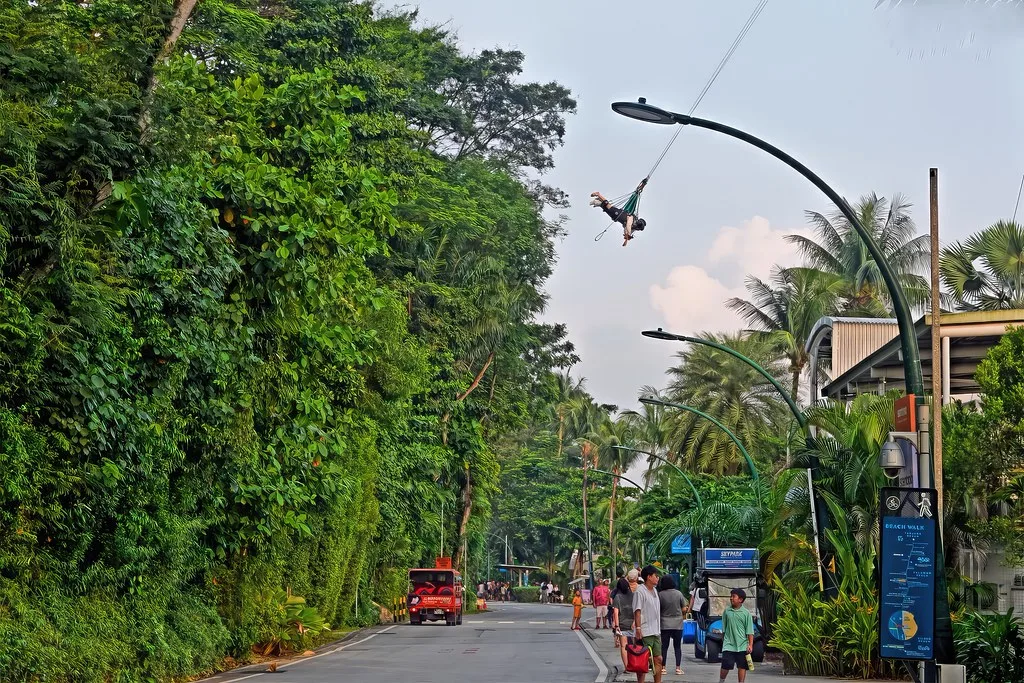
Sections of the floor are transparent, so the ground is visible beneath your feet. It involves no falling and no jumping, but for anyone who finds height itself difficult that is beside the point. It also puts you close enough to watch bungy jumpers go over the edge.
| Item | Detail |
|---|---|
| Price | S$15 |
| Floor | Transparent in places |
| Age limit | None |
| Height or weight rules | None |
| With a bungy ticket | Included free |
When only one person in a group is jumping, the arithmetic works out neatly. The jumper has the Skybridge included, everyone else pays S$15 to go up and watch from above, and waiting at the base costs nothing at all.
Because there are no height or weight rules, even young children can come up with everyone else.
Families often find the whole visit revolving around this. One parent jumping while the rest of the family watches from the bridge is a common arrangement, and even very young children can come up, so nobody has to split off.
The caveat is that walking takes very little time. You cross, take photographs and come down, which is not enough to justify a trip to Sentosa on its own. Treat it as something to add when you are already on Siloso Beach, or as a way to spend the time while somebody else in the group is doing an activity.
As a place to take photographs it is genuinely good. The deck sits above the surrounding trees, so Siloso Beach and the ships offshore both fit in the frame, and the transparent section is something people come up specifically to shoot. To capture a companion going over the edge, the bridge gives a far better angle than the ground does.
Bear in mind that the Skybridge is weather-dependent in the same way as everything else. It closes in strong wind or rain, and there is no roof, so walking it in the middle of the day gets hot. If you are bringing older relatives or young children up, avoiding midday in favour of the late afternoon makes the whole thing more pleasant.
A question that comes up often is whether it suits people afraid of heights. The answer depends on what the fear attaches to. If it is the sensation of falling, walking across presents no problem at all. If it is looking down from a height, the transparent stretch will be hard work. When in doubt, walk the solid sections first and decide about the glass afterwards.
9. Prices, packages and booking
The grounds are free to enter and every activity is ticketed on its own. Slides are sold as ride packages: S$28 for two rides or S$33 for three.
Gathered in one table, the adult prices look like this. Because ride packages can be split across both slides, a single three-ride package is enough to try Skydrop and The Big Klook Slide in one visit.
| Activity | Price (adult) | Note |
|---|---|---|
| Skyslides, 2 rides | S$28 | Can be split across both slides |
| Skyslides, 3 rides | S$33 | Lower cost per ride |
| Bungy Jump | S$99 | Skybridge included |
| Tandem Bungy | S$179 | Two people together |
| Giant Swing | S$69 | Up to 3 riders |
| Skybridge | S$15 | Free with a bungy ticket |
| Skydrop ride video | S$20 | Skydrop rides only |
Broken down per ride, the two-ride package works out at S$14 each and the three-ride package at S$11 each. Unless you are certain one go will be enough, the larger package is the better value. The exception is a rider under 1.4m, who will be using all three rides on the same slide, and that is worth weighing before choosing.
The discounts attached to the June 2026 opening have ended. Figures from that period, including a S$40 bungy and a S$20 Giant Swing, are still circulating online and are no longer current, so do not budget against them. Wider costs are set out in the Singapore budget guide.
Tickets are sold both on site and through booking platforms. Fixing a date and time in advance shortens the wait at the registration desk. Current prices and conditions can be compared below.
Adding a few items together brings the scale into focus. Two adults each taking a three-ride package and each jumping the bungy comes to S$264 at this site alone; swap the bungy for the Giant Swing and it is S$204. The totals climb that fast because every item is priced independently, with no in-house bundle covering several activities at once.
With no bundle of their own, saving money comes down to two moves. The first is cutting the list to the one or two activities you genuinely want. The second is checking whether a pass covering several Sentosa attractions includes anything here, in which case the detail that matters is which specific activity is covered, since passes differ on that point.
10. What to wear and what to bring
Two requirements are stated: comfortable clothing and closed-toe shoes.
Given that the site sits directly beside Siloso Beach, a lot of visitors turn up in sandals or flip-flops, and that footwear will stop you taking part. If you are combining this with beach time, the answer is to carry shoes to change into.
| Item | Detail |
|---|---|
| Clothing | Comfortable. You will move a lot and wear a harness |
| Footwear | Closed-toe. Sandals and flip-flops are a problem |
| Glasses and lenses | Contact lens use appears on the bungy declaration list |
| Video | S$20, on Skydrop rides only |
| Filming from below | Free, since standing at the base costs nothing |
Pockets have to be emptied before an activity. Phones and wallets cannot go up with you, so either hand them to somebody waiting below or ask about storage when you register.
The same applies to hats and sunglasses. The Siloso Beach side has little shade and the midday sun is strong, yet those items have to come off before you take part. Planning around sun and rain together is covered in the rainy day guide.
Skirts are the other awkward case, because the harness passes between the legs, and the slides are ridden seated. Trousers are simply easier. Coming straight off the sand, packing something to wear over a swimsuit and a pair of shoes ends up being the same piece of preparation.
Heat and humidity are worth a thought as well. You climb stairs outdoors and queue in the open, so on a humid day your clothes will be damp by the end. If a restaurant or an indoor attraction follows, a spare top is a small thing to carry. If that feels like too much, handing your bag to whoever is waiting below is the simplest solution.
Sun protection deserves handling in advance. Ultraviolet levels along this stretch of Siloso Beach run high through the middle of the day, and both queueing and getting harnessed happen outdoors, so you will have been in the sun a while by the time your turn arrives. Applying sunscreen before you leave and topping it up before you go up is easier than dealing with the consequences later.
Water is the last thing worth carrying. There is no space here designed for sitting and resting: once an activity finishes you are generally standing around waiting for the next one or walking back to the beach. Bringing a bottle, or knowing in advance which place you will sit down at afterwards, beats toughing it out in the heat.
11. Getting there from Beach Station
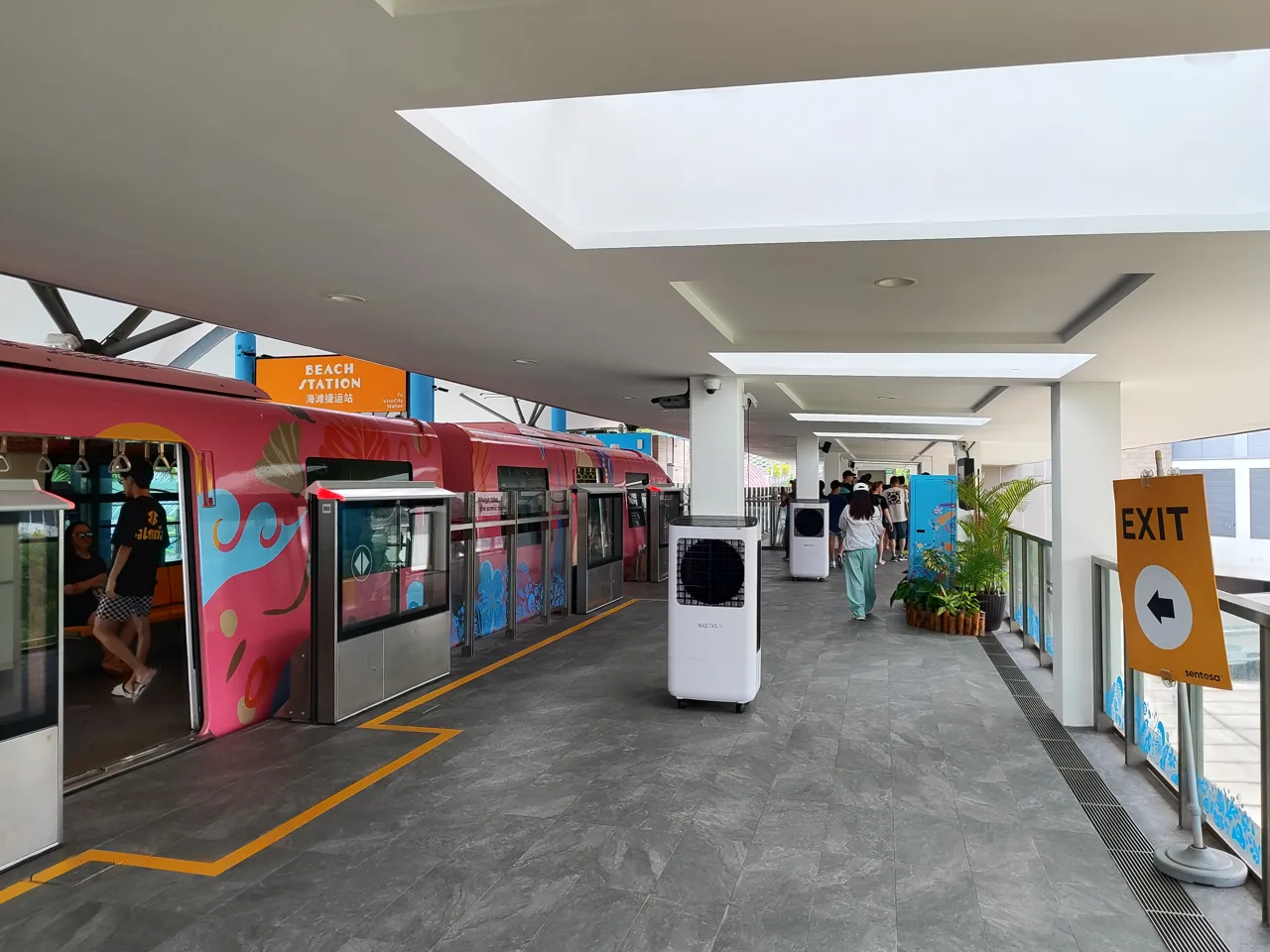
The address is 30 Siloso Beach WalkMap. Take the Sentosa Express to Beach Station and walk 5 to 10 minutes towards Siloso Beach.
Coming from the mainland the sequence runs like this. From HarbourFront MRT, go up to level 3 of VivoCityMap, board the Sentosa Express and ride to the last stop at Beach Station. Leave the station heading down towards the sand, pick up Siloso Beach Walk and follow it along the front.
| Leg | How |
|---|---|
| Mainland link | HarbourFront MRT (NE1/CC29), then VivoCity level 3 |
| Onto the island | Sentosa Express |
| Where to get off | Beach Station, the terminus |
| Station to site | 5 to 10 minutes on foot towards Siloso Beach |
| If you would rather not walk | The island Beach Shuttle bus |
Finding it is not difficult. The bungy tower is the tallest structure in the area, so once you reach Siloso Beach you can navigate by eye. Large lettering runs down the side of the tower, visible from a distance.
Island transport and fares are covered separately in the Singapore transport guide, and routes that combine this with other sites appear in the Sentosa island guide.
Beach Station being the terminus of the Sentosa Express makes the trip straightforward, since there is no risk of travelling in the wrong direction. Signage on the platform is clear and the exits point towards the beach.
Allow extra time for the mainland leg. Getting from HarbourFront up to level 3 of VivoCity and locating the monorail platform takes longer than expected, and the monorail itself gets busy at weekends. If you are aiming for the 19:00 last registration, leave a margin.
Plan the return leg as well. Beach Station is the terminus, so everyone heading back from the beach in the evening converges on the same monorail, and the platform wait after sunset runs longer than it did on the way in. If you have a table booked in the city that evening, give the journey back more room than you think it needs.
Sentosa can also be entered on foot rather than by monorail. The Sentosa Boardwalk beside VivoCity leads onto the island, from where the internal shuttle buses reach the Beach Station area. At busy times, when the monorail queue is long, walking in is not necessarily the slower option.
Ride-hailing works too, though the internal road network and drop-off points on Sentosa do not behave like an ordinary kerbside pickup, and a driver may not be able to stop at the entrance itself. If you are travelling with older relatives or anyone with limited mobility, confirming the drop-off point on a map beforehand saves asking around once you are on the island.
12. When to go
Opening is daily at 11:30 with closing at 19:30, and last registration is at 19:00, half an hour before the site shuts.
The late start shapes the rest of the day. If you are entering Sentosa first thing, something else has to fill the morning and this comes later. Booking it for the evening instead means seeing Siloso Beach from height with the sun low.
| Time | What to expect |
|---|---|
| Just after 11:30 | Short queues. The sun is already strong by then |
| Middle of the day | Overlaps with beach crowds, so registration can back up |
| Around sunset | The best views from the top |
| 19:00 | Last registration. You need to be at the desk by then |
Weather is the variable. Everything is exposed, and operations stop in strong wind or heavy rain. Singapore gets short, intense afternoon downpours often enough that it belongs in your planning. Month-by-month rainfall patterns are set out in the best time to visit guide.
Rain means you need an indoor fallback. Options on Sentosa and across the city are collected in the rainy day guide.
The late opening also changes how a Sentosa day is built. Anyone entering the island in the morning will find this pushed to the back automatically, which is why a full day here usually runs as other attractions first, lunch, then Siloso Beach in the afternoon.
Budget your time by activity as well. A slide package is done inside an hour, but the bungy and the swing add registration, harnessing and queueing on top. Planning two or more activities means setting aside two to three hours.
Weekdays and weekends differ noticeably. Siloso Beach is busy at weekends to begin with, and the counter and queues lengthen accordingly, while a weekday afternoon is comparatively relaxed and the same block of time yields an extra ride or two. If your schedule has any flexibility, a weekday here goes further.
If sunset is the point of the visit, aim at closing time rather than last registration. Registering at 19:00 still leaves queueing and harnessing ahead of you, so the light when you actually reach the top is dimmer than it was at the desk. Arriving an hour earlier lines the ride up with the best of the light.
There is no meaningful high and low season across the year. Singapore’s temperatures stay close to constant, and what matters on any given day is whether it rains rather than which month it is. School holidays and long weekends do draw bigger crowds, and during those stretches shifting your visit to just after opening helps.
13. Building a half day around Siloso Beach
Taken alone, the slides fill about an hour and adding the bungy or the swing brings it to two or three. That makes a half-day block the natural unit for planning.
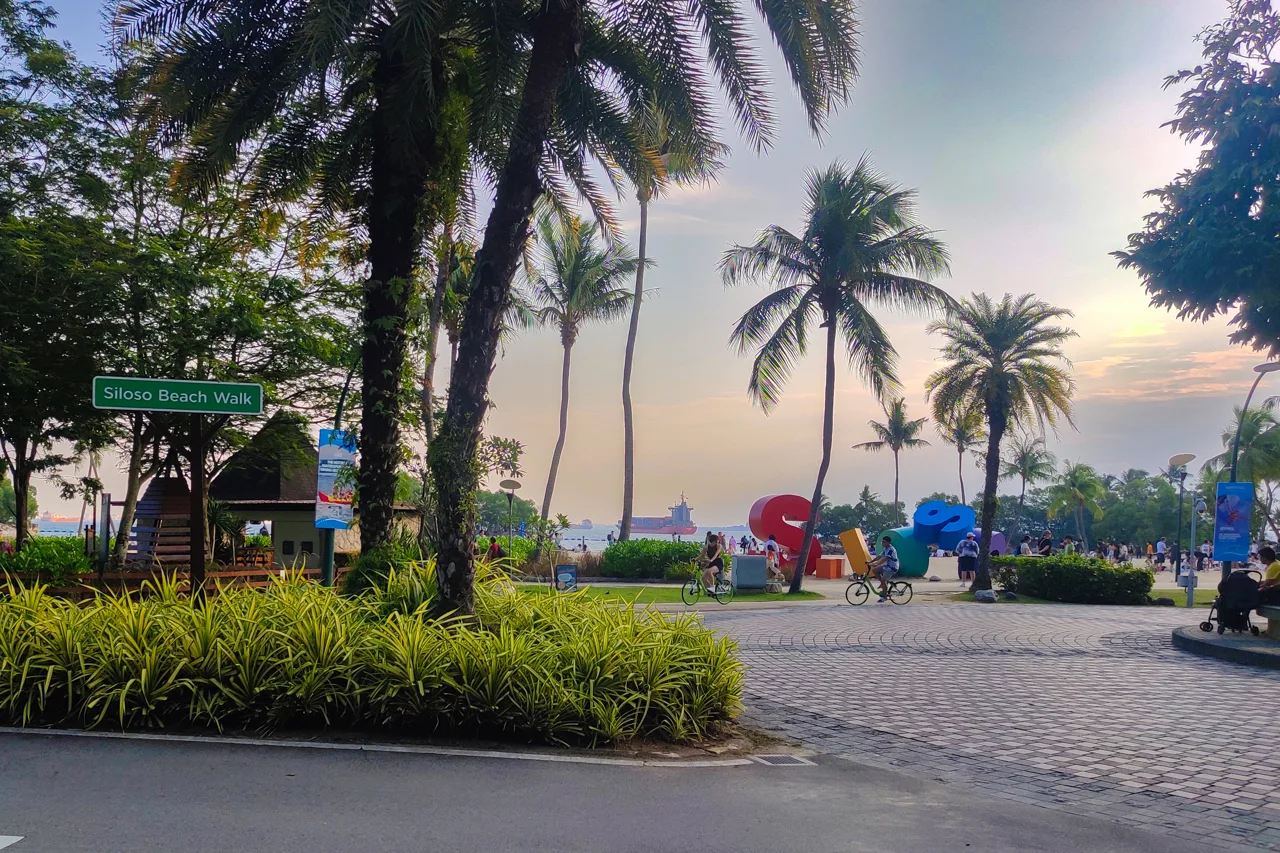
Its position inside Siloso Beach does most of the work in setting the route. The beachfront attractions cluster within walking distance of Beach Station, so cutting the time spent moving between them leaves room for three or four things in half a day.
| Time | Route |
|---|---|
| Morning | Start elsewhere on the island. Skypark Sentosa does not open before 11:30 |
| Lunch | Eat around Beach Station, then move on to Siloso Beach |
| Afternoon | Use the slide package here. Allow longer if the bungy is included |
| Sunset | Stay on Siloso Beach or head back to the mainland |
Costs mount quickly once several island attractions are combined. If you plan to visit a number of them, comparing individual tickets against passes is worth the effort, and the arithmetic is laid out in the Singapore attraction pass guide.
The largest site on the island is Universal Studios Singapore, which absorbs a full day and does not combine with this one. Staying overnight on the island is covered in where to stay on Sentosa.
Siloso Beach itself anchors the route. Restaurants and bars run along the sand, so there is somewhere to sit the moment an activity finishes. Anyone not taking part can spend that time on the beach and rejoin afterwards, and since entry to the grounds is free there is no real need to separate at all.
If the shape of the day is still unclear, settle where Sentosa sits within the trip first. Whether the island gets a full day or a half, and which day of the trip it lands on, determines where this fits. That decision is worked through in the Singapore itinerary guide.
There are a couple of ways to combine this with the non-beach side of the island. Starting the morning at the cultural or indoor attractions and moving towards the beach after lunch is the common one; the reverse, swimming first and going up the tower towards evening, suits anyone who wants the sunset. The two differ mainly in where they place the hottest part of the day.
One warning about putting this last: the risk is weather. An afternoon thunderstorm means waiting it out, and if it does not clear you have to abandon the plan with no time left to make it up. If this activity is the thing you most want from the trip, place it in the middle of the day and keep a buffer behind it.
14. An honest verdict, and what to read next
The drawbacks first. Time spent actually doing each activity is short and the prices are not low. Everything is outdoors and weather-dependent, and there is no indoor fallback if it rains.
| Worth it if | Not worth it if |
|---|---|
| Siloso Beach is already on your plan and you can add an hour or two | You would be crossing to Sentosa for this alone |
| You want to try throwing yourself off something high | Height itself is the problem for you |
| You are willing to pay for something short and intense | You want hours of value for the money |
| You have an afternoon or evening free | Only your mornings are free. Nothing opens before 11:30 |
| You want it on video | Recording it does not interest you |
What it offers that nowhere else on the island does is nonetheless clear. This is the only place in Singapore to bungy jump or ride a giant swing, and the two 44-metre slides that opened in June 2026 have no counterpart either. The free entry matters more than it sounds, because it lets people who are not taking part stay with the group at no cost.
For what to read next: to plan the island as a whole, go to the Sentosa island guide; to rank this against everything else in the city, see the things to do in Singapore guide. If the question is where Sentosa belongs across several days, the Singapore itinerary guide is the place to work that out.
To go back over the whole preparation sequence, return to the Singapore planning guide. Multi-attraction passes and individual tickets can be compared below.
If it comes down to a single line: this is somewhere you add to a plan rather than build one around. Anyone already spending half a day on Siloso Beach will rarely regret slotting it in, while anyone who clears a whole day for it tends to find the substance shorter than expected.
One last point is that the place is still new. The two slides only opened in June 2026, operational details and prices may yet shift, and opening-period figures are still circulating online. Checking the official channels for the day’s operating status and current prices before you set out is the single most useful thing to do with an attraction this recent.
🎡Things to Do52
🍜Food6
🏨Where to Stay10
🚇Getting Around4
🧭Travel Tips20
Frequently asked questions
The Big Klook Slide starts at 1.2m and Skydrop starts at 1.4m. Both slides share the same upper limit of 2.0m.
Because the two thresholds differ inside the same attraction, a child measuring in the low 1.2m range can ride The Big Klook Slide but not Skydrop. A two-ride package still works in that case: you simply use both rides on the same slide.
Two rides cost S$28 and three rides cost S$33. You can split the rides across both slides, so a three-ride package can cover Skydrop twice and The Big Klook Slide once.
There is no separate admission charge for the grounds, so anyone in your group who is only watching pays nothing at all.
Only Skydrop offers a ride video, and it costs S$20. Skydrop is ridden with a helmet, and that helmet carries a camera mount, which is what produces the first-person footage.
The Big Klook Slide is ridden without a helmet, so no ride video exists for it. If footage matters to you, at least one of your rides has to be on Skydrop.
Jumpers must weigh between 45kg and 150kg. The lower limit catches people out more often than the upper one, and anyone under 45kg cannot jump.
There is no minimum age, though anyone under 18 needs parental authorisation. Conditions including high blood pressure, heart conditions, pregnancy, epilepsy, recent surgery and spinal injuries have to be declared before you jump.
You can, but riding solo requires a minimum weight of 60kg. Up to three people can ride together, and the combined weight of a group cannot exceed 300kg.
The ceiling for a single adult is 150kg, and the child harness fits from 30kg. The minimum height is 1.2m.
Skypark Sentosa opens daily at 11:30 and closes at 19:30, with last registration at 19:00. Nothing runs in the morning, so an early Sentosa start has to be spent somewhere else.
Note that last registration falls a full thirty minutes before closing. An evening visit means being at the counter by 19:00, not merely on the island.
It is a 5 to 10 minute walk towards Siloso Beach. The address is 30 Siloso Beach Walk: leave the station, head down towards the sand, and follow the beachfront road.
The island Beach Shuttle covers the same stretch if you would rather not walk. The bungy tower is the tallest structure around, so once you are on Siloso Beach you can navigate by sight.
Closed-toe shoes are required, along with comfortable clothing. Sandals and flip-flops will stop you taking part, which is a common problem given that the site sits directly on a beach.
Skirts are also awkward, because the harness passes between the legs. If you are coming straight from the sand, pack shoes and something to change into.
There is no admission fee for the grounds. Tickets are bought per activity, so anyone not taking part can wait at the base without paying anything.
The Skybridge is the exception among the non-thrill options: walking across it is a separate S$15 ticket.
Yes, Skybridge access is bundled into the bungy jump ticket. Bought on its own the Skybridge costs S$15, so that is the amount you save.
The bungy ticket also carries a Skypark Global Membership, which gives 20% off at AJ Hackett sites worldwide. That is worth checking if another of their locations is on a future itinerary.
Skydrop is an enclosed tube with a drop section, while The Big Klook Slide takes a gentler, steadier descent. Both start from the same height of 44 metres.
The Big Klook Slide runs through six themed sections lit with UV lighting. Choose Skydrop if you want the fright and The Big Klook Slide if you want the view.
Yes. The 47-metre bungy at Skypark Sentosa is the only one in the country, and the Giant Swing is likewise unique to this site.
A tandem jump for two people is also offered. A solo jump costs S$99 and the tandem costs S$179.