
Chinese New Year in Singapore: What’s Open, What’s Closed and Where to See the Celebrations
| Next holiday | Day 1 is Saturday 6 February and day 2 is Sunday 7 February, with Monday 8 February also a public holiday. |
|---|---|
| The eve | Friday 5 February is a working day, but banks, post offices and supermarkets close early that afternoon. |
| Quietest day | Day 1 has the most closures, day 2 is about halfway back, and day 3 is close to normal. |
| River Hongbao | A free lantern festival at Gardens by the Bay that opens 2 days before day 1 and stays open until 12.15am on the eve. |
| Chingay Parade | A ticketed night parade at the F1 Pit Building on a Friday and Saturday 9 to 14 days after day 1. |
| Getting home on the eve | Trains run late, to about 2am on the North-South and East-West lines and a little earlier on the others, but the Changi Airport branch and Bukit Panjang LRT keep their usual hours. |
1. When Chinese New Year falls and how the days off work
2. What’s open and shut on the eve, day 1 and day 2
3. Eating over the holiday: hawker centres and restaurants by name
4. Shopping, money, post and seeing a doctor
5. Chinatown: the light-up, the street bazaar and the countdown
6. River Hongbao at Gardens by the Bay
7. Chingay Parade: tickets, dates and how to watch for free
8. Temples and other celebrations around the island
9. Getting around: late trains on the eve, taxis and the Malaysia border
10. Rooms and crowds over the holiday
11. A plan for the eve, day 1 and day 2
12. Chinese New Year customs, in brief
1. When Chinese New Year falls and how the days off work
This coming new year, day 1 falls on Saturday 6 February and day 2 on Sunday 7 February, and Monday 8 February is also a public holiday because day 2 is a Sunday. The eve, Friday 5 February, stays a working day in law. The Ministry of Manpower sets the dates and lists them on its public holidays page.
Newcomers tend to miss that the eve is a half day in practice. Families leave work early for the reunion dinner, and banks, post offices and supermarkets close in the afternoon; the closing times are in the next section. If you need a bank counter or want to send a parcel, do it before Friday lunchtime.
The date moves with the lunar calendar. Day 1 lands somewhere between 21 January and 20 February, so in some years the holiday is in late January and in others in February. Chinese New Year has 2 public-holiday days, day 1 and day 2. When one of them is a Sunday, the next working day is a day off; when one is a Saturday, there is no extra public holiday, and employers give staff another day off or a day’s pay instead.
Count the season from day 1, not from the month
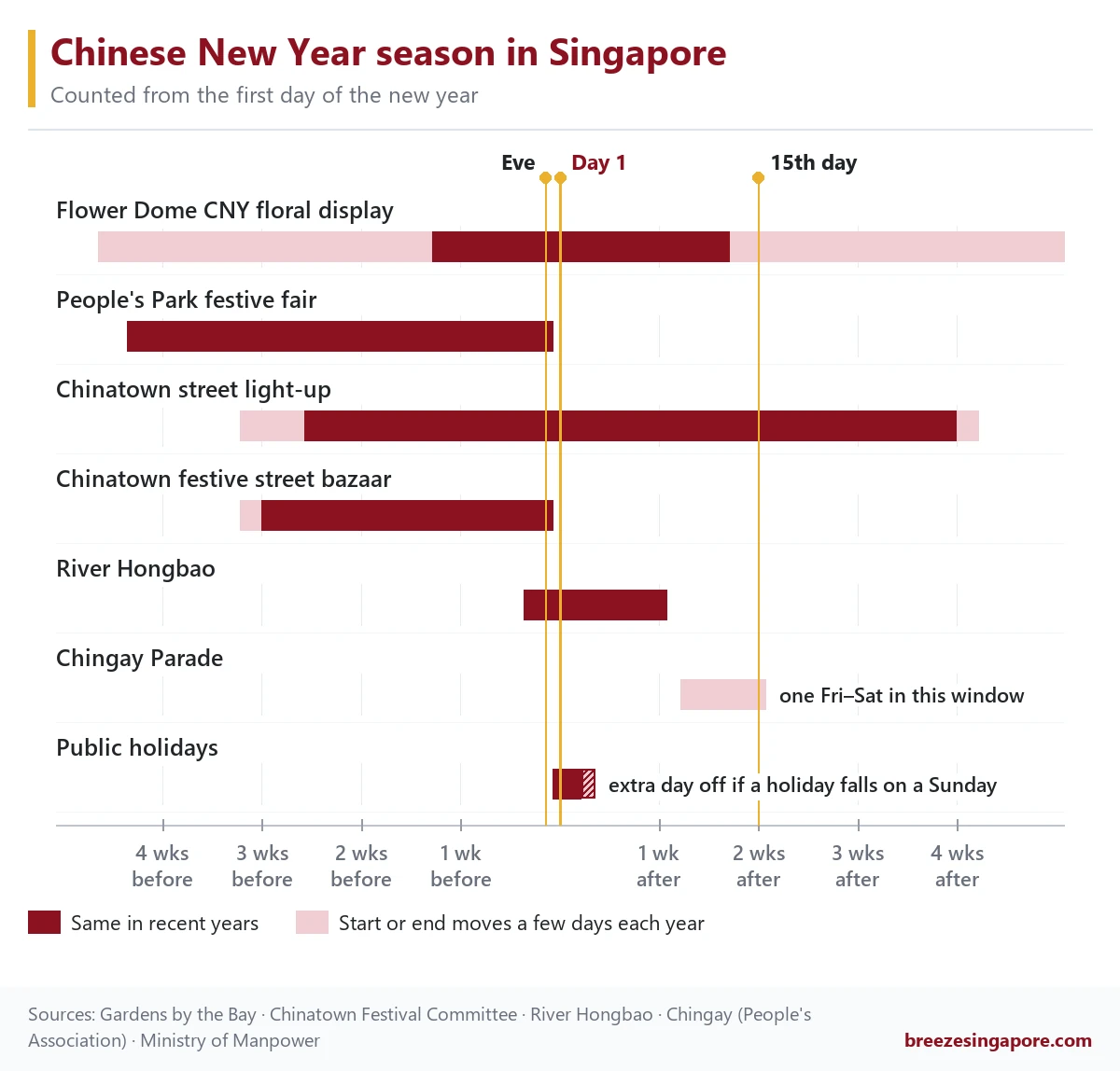
Because the date shifts, the events around the holiday are easier to plan if you count the days before and after day 1. The table shows how the season has run in recent years. The 15th day, known locally by its Hokkien name Chap Goh Meh, ends the festive period, and most programmes finish around then.
| Event | Starts | Ends |
|---|---|---|
| People’s Park festive fair | About a month before day 1 | The eve |
| Flower Dome Chinese New Year display | A Friday in mid-January | 5 to 8 weeks later |
| Chinatown street lights | About 3 weeks before day 1, with a 6pm opening ceremony | About 4 weeks after day 1 |
| Chinatown festive street bazaar | About 3 weeks before day 1 | 1am on the eve |
| River Hongbao | 2 days before day 1 | 7 days after day 1 |
| Public holidays | Day 1 | Day 2, or the next day if day 2 is a Sunday |
| Chingay Parade | A Friday 9 to 13 days after day 1 | The Saturday after |
| Sentosa, Mandai and Jewel programmes | Varies | Around the 15th day last time; the end date varies |
Dates for this coming new year are not out yet, though the Chinatown committee has said its street lights will go up again. Each organiser announces on its own timetable: Chinatown publishes its programme in January, River Hongbao posts its schedule close to the opening, and Chingay tickets go on sale in November or December. The Singapore Tourism Board collects the details on the Visit Singapore Chinese New Year page. The dates and hours in this guide are the ones that repeated over the last few seasons, so use them to plan and check the official page before you go.
2. What’s open and shut on the eve, day 1 and day 2
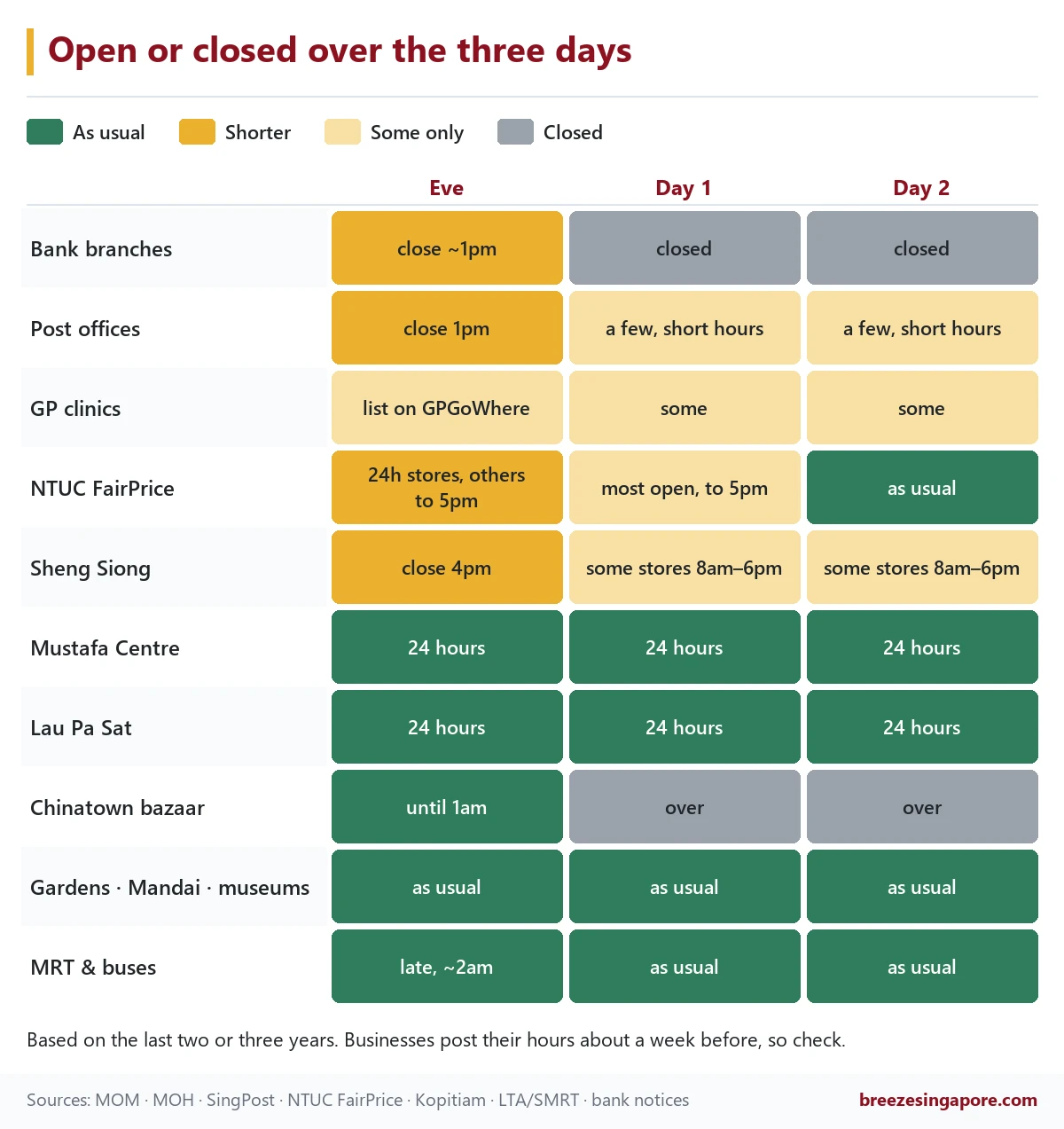
The eve is a short working day, day 1 is when the most places close, day 2 is about halfway back to normal, and from day 3 almost everything runs as usual. Attractions, the big tourist malls and the trains keep going through all of it, so the holiday changes where you eat and shop more than what you can see.
On the eve, closing times come early: bank branches around 1pm, post offices at 1pm, Sheng Siong supermarkets at 4pm and ordinary FairPrice stores at 5pm. Restaurants that serve reunion dinners stay open for those bookings, the Chinatown bazaar trades until 1am, and the trains and buses run late that night.
Day 1 is the quiet day. Many Chinese-run businesses close, from family hawker stalls to small shops in Chinatown. Bank branches, polyclinics and nearly all post offices are shut, while attractions, hotels and the large malls stay open, and the trains follow their normal timetable.
On day 2, most FairPrice stores are usually back to normal hours (in one recent year that waited until day 3), but Sheng Siong still opens only some of its stores. More stalls reopen, though some family businesses stay closed until day 3 or later. When day 2 is a Sunday, as it is this coming new year, banks and polyclinics also stay closed on the Monday.
Places you can count on
- Lau Pa Sat, the food centre at Raffles Quay, listed as open 24 hours on all 3 days the last two times.
- Mustafa Centre in Little India, open 24 hours with no holiday closure notice in recent years.
- FairPrice 24-hour stores, about 36 of which stayed open through the eve last time.
- Gardens by the BayMap, whose conservatory domes keep their normal 9am to 9pm hours.
- The Mandai wildlife parks, open normal hours at peak-day prices.
- The National Museum, Asian Civilisations Museum, Peranakan Museum, National Gallery, ArtScience MuseumMap and the Singapore Flyer, none of which posted holiday closures.
- Jewel and the restaurants at Changi Airport.
- The big tourist malls: ION Orchard, VivoCity, Suntec City, Bugis Junction, Raffles City and The Shoppes at Marina Bay SandsMap, where the Watsons stores kept normal hours on all 3 days last time.
Where it gets thin
Chinatown’s own malls shorten their hours the most. Going by the Watsons stores there last time, shops in Chinatown Point and People’s Park Complex closed at 4pm on the eve and opened only from 12pm to 4pm on day 1, and the Watsons in Ngee Ann City closed for the whole of day 1. Chinese-run hawker stalls, bank branches, polyclinics, post offices and the money changers in town are the other gaps.
| What you need | Where to go over the holiday |
|---|---|
| Groceries late at night | FairPrice 24-hour stores, Mustafa Centre |
| A meal in the small hours | Lau Pa Sat |
| Shopping on day 1 | ION Orchard, VivoCity, Suntec City, Bugis Junction, Marina Bay Sands |
| Cash | ATMs, open 24 hours, or the money changers at Changi Airport |
| A doctor | GP clinics on the government holiday list, hospital A&E for emergencies |
| Something to do on day 1 | Gardens by the Bay, Mandai, museums, Singapore Flyer |
3. Eating over the holiday: hawker centres and restaurants by name
You can eat well on day 1 if you know where to go: Lau Pa SatMap runs 24 hours, the big hawker centres open with fewer stalls, and the chain restaurants post their holiday hours. The gaps are the family-run stalls, many of which take the first days of the new year off.
None of the big hawker centres, including Maxwell, Chinatown ComplexMap, Newton, TekkaMap, Geylang Serai, Old Airport Road, Amoy Street and Tiong Bahru, was closed for cleaning in Chinese New Year week the last two times. So the centre is open and each stall decides whether to trade. Halal Malay and Indian stalls are the ones most likely to be open on day 1 and day 2. For which stalls are worth the trip on a normal day, see our guide to Singapore hawker food.
The hawker centres run by Kopitiam list “selected stalls” for day 1 and day 2, and one of them listed only its halal stalls. Lau Pa Sat, also on Kopitiam’s list, was open 24 hours across the eve and both holiday days. Food Folks, the food court inside Lau Pa Sat, closed on day 1 and day 2, and nothing has been published about the satay stalls on the street outside, so don’t count on them.
Restaurant hours by name
These are the hours each restaurant posted the last two times, or the last time for Old Chang Kee. They tend to repeat, but check the restaurant’s own page in the week before.
| Restaurant | Eve | Day 1 | Day 2 |
|---|---|---|---|
| JUMBO Seafood (East Coast, Riverside Point, The Riverwalk, Dempsey, ION Orchard) | Lunch and dinner | No lunch; dinner from about 4.30pm to 5pm | Normal |
| JUMBO Seafood at Jewel | Lunch and dinner | All day | Normal |
| Ng Ah Sio Bak Kut Teh, Rangoon Road | Closes 3pm | Closed | Closed |
| Ng Ah Sio Bak Kut Teh, Clarke Quay Central | Closes 5pm | 10am to 10pm | Open |
| Old Chang Kee (curry puffs) | Closes 5pm | Most outlets 11am to 9pm | Most outlets 11am to 9pm |
| Old Chang Kee at the airport and Jewel | Normal | Normal | Normal |
| Long Beach Seafood (Dempsey, Robertson Quay, UDMC) | Separate lunch and dinner sittings | Public-holiday hours | Public-holiday hours |
| Lau Pa Sat | 24 hours | 24 hours | 24 hours |
Famous stalls: check their own posts
Stalls such as Tian Tian Hainanese Chicken Rice at Maxwell, Hill Street Tai Hwa Pork Noodle and Song Fa Bak Kut Teh have no official holiday notice you can find in advance. Chinese-run stalls commonly close for the first days, and owners post their dates on Facebook or Instagram a week or two before. If one is on your list, look for that post rather than an old blog, and keep a second choice from the Michelin Bib Gourmand list in case it is shut.
Reunion dinner, yusheng and surcharges
The eve is the night of the reunion dinner. Many restaurants serve set menus for that evening only, and tables are booked weeks ahead. Hotel set menus over the season have cost about S$118 to S$168 per person. Yusheng, the raw fish salad tossed at the table, costs from about S$40 at casual places to several hundred dollars at hotels.
Some restaurants and coffee shops add a surcharge on the holiday days. Past cases include 10% at some restaurants, an extra S$0.20 on drinks at some coffee-shop groups, and a per-person charge at a Chinatown restaurant. Singapore’s price-transparency guidelines say a surcharge must be shown clearly, so look for a notice at the counter or on the menu and ask before you order.
4. Shopping, money, post and seeing a doctor
Buy groceries before 4pm on the eve, change money before the eve or at the airport, and if you fall ill, use the government’s list of GP clinics that open over the holiday. Here is how each service has run over the last few holidays.
| Store | Eve | Day 1 | Day 2 |
|---|---|---|---|
| NTUC FairPrice | About 36 stores open 24 hours; the rest close 5pm | Most stores open, about 40 for 24 hours and the rest until 5pm | Mostly normal hours; in one recent year only from day 3 |
| Sheng Siong | All stores close 4pm | About 26 stores, 8am to 6pm | About 26 stores, 8am to 6pm |
| Mustafa Centre | 24 hours | 24 hours | 24 hours |
FairPriceMap has kept its 24-hour stores open through the eve and day 1 the last three times, and went back to normal hours on day 2 in two of those years. Sheng Siong’s pattern has repeated each recent year. If you are staying in a serviced apartment, stock up by the morning of the eve, before the early closing.
Money
Bank branches close early on the eve, DBS and POSB at 1pm and other banks between late morning and early afternoon, then stay shut on both holiday days and the extra Monday. ATMs work around the clock, including those in every Changi AirportMap terminal and at Jewel B1.
Money changers in town, such as those at The Arcade in Raffles Place, are generally closed on Sundays and public holidays and post no holiday notice. Change money before the eve, or at Changi Airport, which has money changers in every terminal. Our guide to money changers and paying in Singapore covers rates and cards. Locals queue at banks for new notes to put in red packets, but that service runs on pre-booking for bank customers and is not really open to visitors.
Post
Post offices close at 1pm on the eve. On the holiday days only a few post offices open, and only for part of the day, so check SingPost’s holiday notice before you go. If you have a parcel to send, the easiest plan is to do it by the eve morning or wait until day 3.
If you fall ill
The Ministry of Health has published a list of GP clinics open over Chinese New Year the last three times, about 1,100 clinics at varying hours. Search it by area and date on GPGoWhere. Polyclinics are closed on public holidays. Hospital A&E departments stay open for serious emergencies, and the NurseFirst hotline on 6262 6262 gave advice from 8am to 11pm last time.
5. Chinatown: the light-up, the street bazaar and the countdown
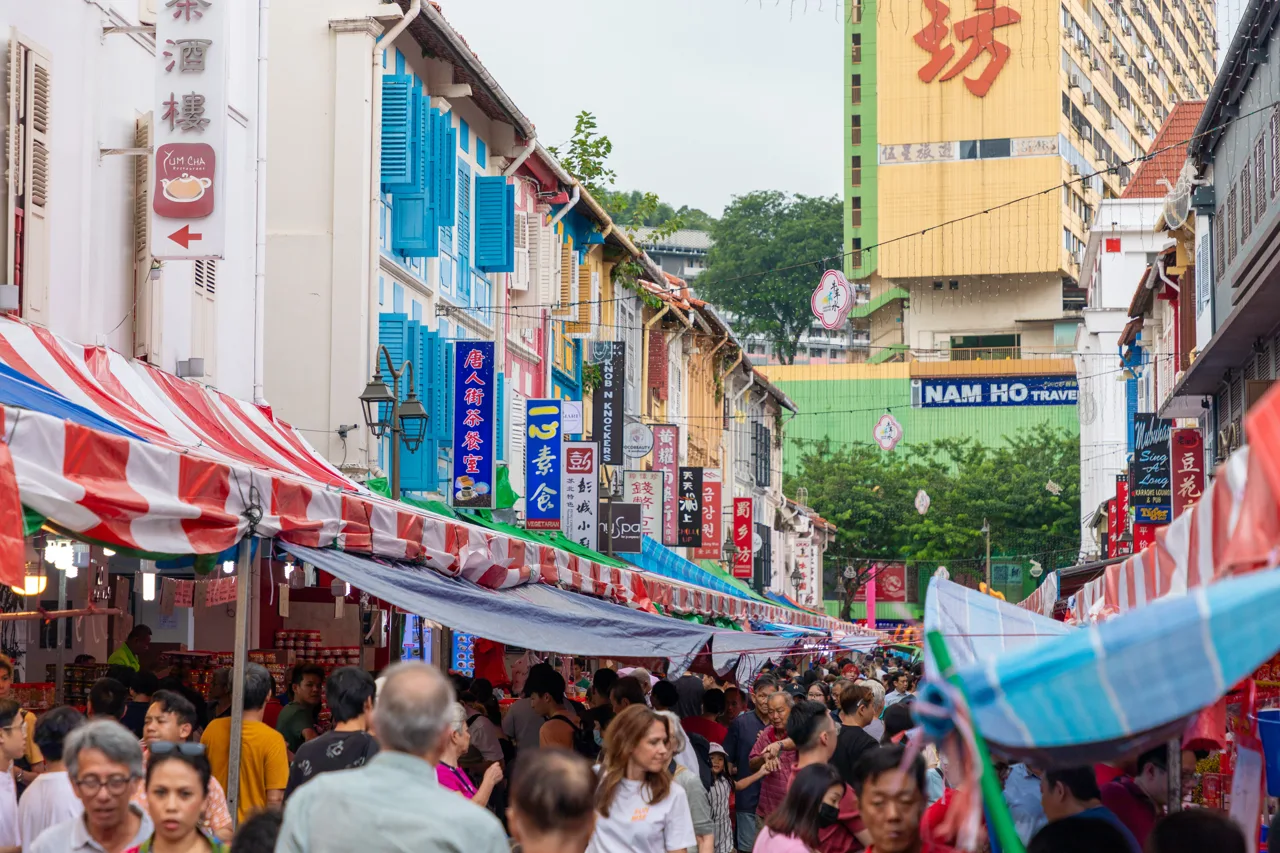
In recent years Chinatown has lit 4 main streets from about 3 weeks before day 1, run a street bazaar until 1am on the eve and held a countdown party with firecrackers at midnight. The programme is announced in January on chinatownfestivals.sg, so check there before you plan around it.
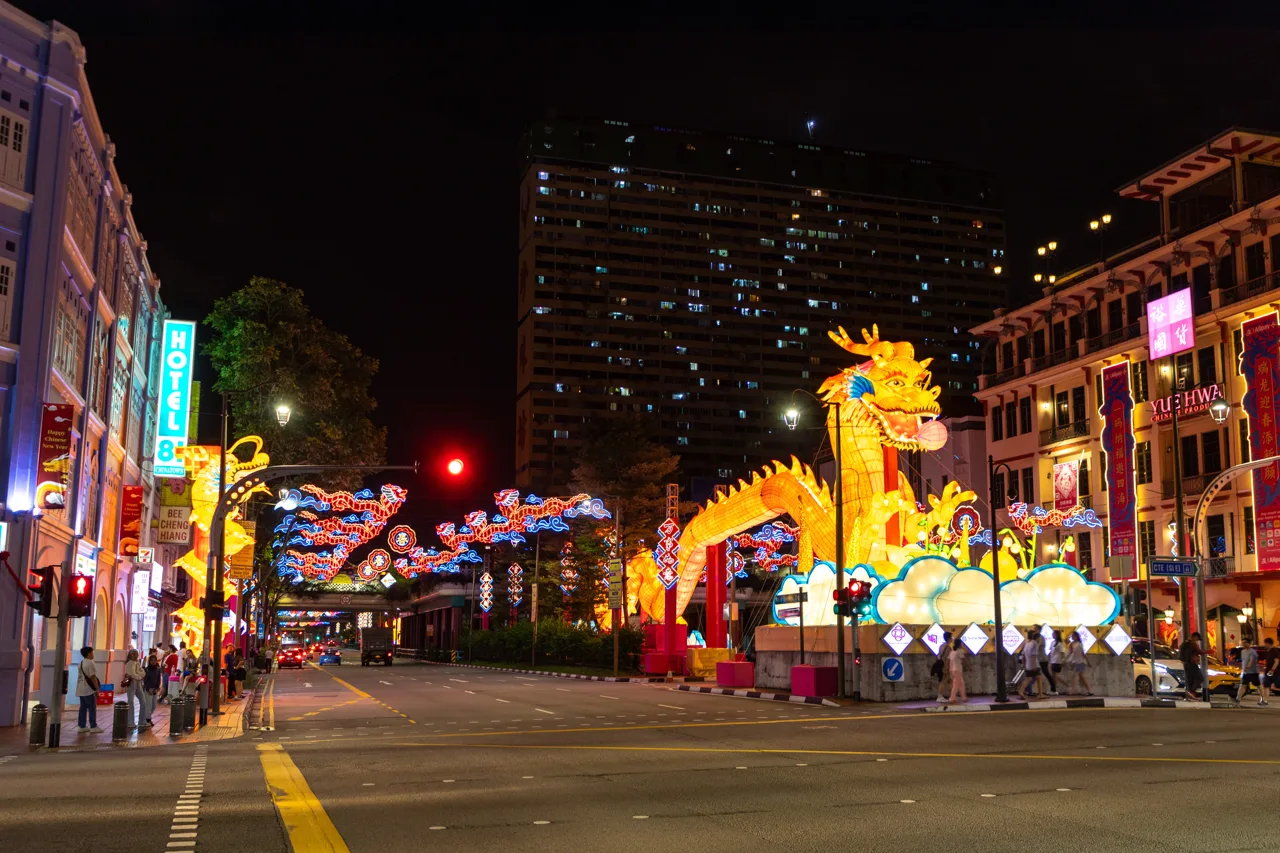
The lights cover New Bridge Road, Eu Tong Sen Street, South Bridge Road and Upper Cross Street. They come on at an opening ceremony at 6pm in Kreta Ayer SquareMap and stay up until about 4 weeks after day 1, lit from 7pm to midnight. On the eve they stay on until 6am on day 1. The centrepiece is the zodiac animal of the year, which this coming new year is the Goat; its design went to a public vote.
The Mid-Autumn Festival before this coming new year was done differently: for the first time in 24 years Chinatown did not light up Eu Tong Sen Street and New Bridge Road, and hung lanterns in Kreta Ayer Square and Banda Street instead. That change was for Mid-Autumn only. The festival committee’s chairman said at the time that the Chinese New Year street lights will carry on. What is still to come is the dates and the programme, so treat the hours here as the recent pattern until January.
Hours and places
| What | Where | Hours |
|---|---|---|
| Street lights | New Bridge Road, Eu Tong Sen Street, South Bridge Road, Upper Cross Street | 7pm to midnight; on the eve until 6am on day 1 |
| Opening ceremony | Kreta Ayer Square | 6pm, about 3 weeks before day 1 |
| Festive street bazaar | Pagoda, Smith, Temple, Trengganu and Sago Streets | Mon to Thu 11am to 10.30pm; Fri to Sun 11am to 11.30pm; eve 11am to 1am |
| People’s Park fair | People’s Park Square | 10am to 10pm, from about a month before day 1 to the eve |
| Countdown party | Kreta Ayer Square in most years | Eve from 10pm, firecrackers at midnight |
The bazaar has over 200 stalls selling pineapple tarts, bak kwa, yusheng packs, decorations and mandarin oranges. It runs for about 3 weeks and ends at 1am on the eve, so by day 1 most of the stalls are gone. Weekday evenings are the easiest time to walk it.
The countdown on the eve starts at 10pm with a stage show. At midnight long strings of firecrackers go off; there are no fireworks in Chinatown that night, as the fireworks are at River Hongbao. A lion dance competition at the Kreta Ayer People’s Theatre has been held in only two of the last four seasons, so don’t plan around it. The Buddha Tooth Relic TempleMap at 288 South Bridge Road appears on Visit Singapore’s Chinese New Year page, but its hours on the eve are not published.
A walking order for one evening
- Come out at Chinatown MRT (NE4/DT19) in the late afternoon and walk the bazaar streets: Pagoda, Trengganu, Smith, Temple and Sago.
- Cut through to People’s Park Square for the fair before it closes at 10pm.
- After 7pm, walk New Bridge Road and Eu Tong Sen Street for the lights. In the Year of the Dragon the centrepiece stood on New Bridge Road in front of People’s Park ComplexMap.
- Finish along South Bridge Road and Upper Cross Street, or at Kreta Ayer Square if it is the eve and you are staying for the countdown.
The busiest times are weekend nights and the eve. Police close Temple Street to vehicles from 2pm to 1.30am on the eve, and the streets are very crowded until the bazaar ends. For the rest of the area, from food to temples, see our Chinatown guide.
6. River Hongbao at Gardens by the Bay
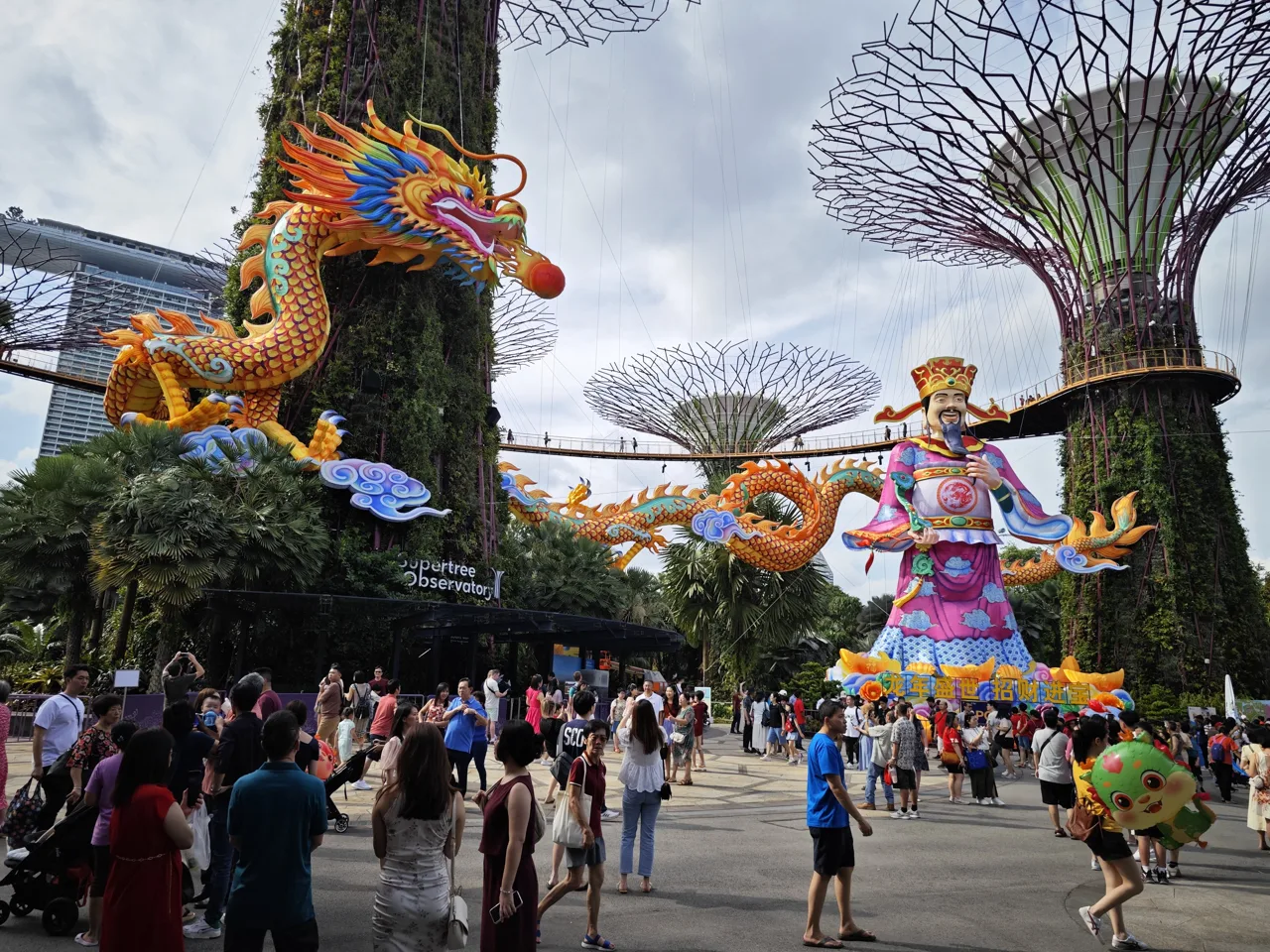
River Hongbao is a free lantern festival at Gardens by the Bay that opens 2 days before day 1 and runs for 10 days, with the longest night on the eve, from 6.30pm to 12.15am. There are no tickets. You walk in through bag checks at the gated grounds around Supertree GroveMap and The Meadow.
The grounds hold sets of lanterns themed on the zodiac animals, a large God of Fortune lantern at The Meadow, a food street, stage shows and carnival rides, including a double-decker carousel. Rides are paid with a ride card bought at the carnival entrance, and the card cannot be refunded, so top up only what you will use.
| Day | Hours | Notes |
|---|---|---|
| Opening night (2 days before day 1) | 6.30pm to 10.30pm | Fireworks at 8pm last time |
| The eve | 6.30pm to 12.15am | Stage shows 10pm to midnight, then the midnight bang |
| Day 1 to the last day | 2.30pm to 10.30pm | Stage shows 8pm to 10pm; fireworks at 9pm on day 1 and day 2 last time |
These hours have been the same the last four times. What goes off at midnight on the eve has changed: there were fireworks last time, and firecrackers instead of fireworks in the two years before. The schedule for each night goes up on riverhongbao.sg before the opening.
Getting there and what to leave behind
Take the MRT to Bayfront (CE1/DT16) and use Exit B and the linkway, or to Gardens by the Bay (TE22) and use Exit 1. The entry checkpoints are at the Floral Clock by the main entrance, at Meadow Bridge from the Bayfront side, and at the Meadow car park. Taxis drop off at Bayfront Plaza or the main entrance. A taxi out of Gardens by the Bay carries a S$3 location charge, and after midnight the 50% late-night charge is added on top.
The festival runs rain or shine. When The Meadow fills up, staff send people to other parts of the grounds, which is most likely on the eve.
- Bicycles, scooters, skateboards and personal mobility devices
- Pets, except guide dogs
- Drones
- Knives and other sharp objects
- Fireworks and flares
The rest of the Gardens that week
During River Hongbao, the usual Supertree light show is replaced by a 5-minute Chinese New Year show at 7.45pm and 8.45pm, free to watch. The Flower DomeMap has a Chinese New Year flower display from a Friday in mid-January, which needs a dome ticket, and the domes keep their usual 9am to 9pm hours over the holiday. Supertree Grove and The Meadow close briefly before each night’s opening, and the OCBC SkywayMap has shorter hours. More on the domes and tickets is in our Gardens by the Bay guide.
7. Chingay Parade: tickets, dates and how to watch for free
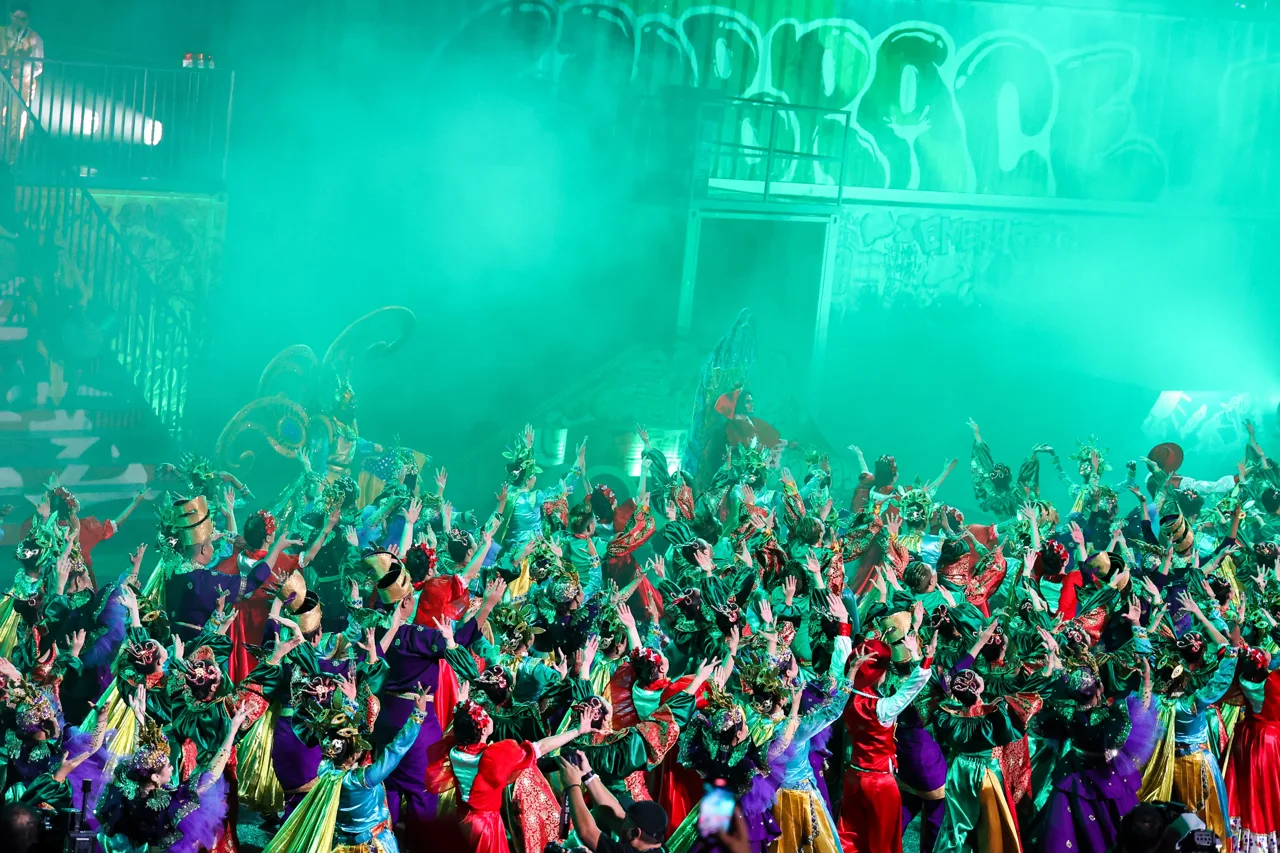
The Chingay Parade is a ticketed night parade held on a Friday and the following Saturday, 9 to 14 days after day 1, starting at 8pm at the F1 Pit BuildingMap. The day, time and venue have been the same the last four times, and the show ended at about 9.30pm last time.
Chingay is run by the People’s Association. Dates and the theme are posted on chingay.gov.sg, and tickets are sold only through SISTIC.
Tickets
| Item | Details |
|---|---|
| Prices | S$20, S$28.50, S$40, S$50 and S$60, plus a booking fee |
| Dearest seats | The top category on the Saturday, last time |
| On sale | About 11 to 13 weeks before the parade in the last two years |
| Where | SISTIC |
| Rain | No refunds for weather |
Tickets have sold out in most recent years, so if you know your dates, buy as soon as sales open. Prices have stayed the same the last four times.
Watching without a ticket
Before each show there is a free area with installations and performances outside the venue, open from about 5.30pm to 8.30pm last time. The Friday show is streamed live on Chingay’s YouTube and Facebook, and a TV replay follows weeks later. Smaller free shows called Chingay@Heartlands tour the housing estates on the weekends after the parade.
Getting there
Promenade MRT is about an 11-minute walk from the F1 Pit Building, and EsplanadeMap MRT about 14 minutes. There is no parking at the venue, so come by train or taxi.
8. Temples and other celebrations around the island
Beyond Chinatown and Marina Bay, the main things to see are the day 1 queue at Kwan Im Thong Hood Cho Temple, lion dances at SentosaMap, Resorts World, Mandai and Jewel, and free lanterns at the Chinese Garden. Last time the Sentosa, Mandai and Jewel programmes ended around the 15th day, but their end dates change from year to year.
Kwan Im Thong Hood Cho Temple at 178 Waterloo Street draws long queues on day 1. Older guides still send people there at midnight on the eve for the first joss stick of the year, but the temple has not held that for 6 years. It opens from 7am to 6.30pm on the eve and the following days, and on day 1 people start queuing well before dawn. In one recent year people queued from just after midnight, and the doors opened at about 6.30am. Fortune-stick readings are paused around the holiday.
Sentosa, Resorts World and Mandai
Sentosa has a free light installation in the evenings at Sentosa Sensoryscape, and a lion dance on poles on day 1 and day 2 at 5pm and 6.30pm; the venue has changed between years. See our Sentosa guide for getting there. At Resorts World Sentosa, the Gods of Fortune walk about and a lion dance is performed at the Grand Steps on the morning of day 1. Universal StudiosMap‘ holiday hours were not published in advance, so check its calendar.
The Mandai wildlife parks keep normal hours, but the holiday days count as peak days with higher prices, and parking is limited on day 1 and day 2. Last time there were lion dances at the Bird ParadiseMap entrance at 9.30am on the holiday days. Prices and park choices are in our guide to the Singapore Zoo and Mandai parks.
Jewel, Marina Bay and the west
Jewel puts up decorations from about 19 days before day 1. Last time it had a lion dance at 5.38pm on the eve and 12.38pm on day 1, and the Rain Vortex ran until midnight over the season. Marina Bay Sands decorates its shopping centre and lights the building in gold and pink around the holiday. In the west, the Chinese Garden at Jurong Lake Gardens hangs lanterns from about 10 days before day 1 to the 15th day, lit up in the evenings and free to visit. There is no Chinese New Year light-up on Orchard Road; its street lights are for Christmas.
| Place | What | When (last time) |
|---|---|---|
| Kwan Im Thong Hood Cho Temple | Day 1 prayers | 7am to 6.30pm; queue from before dawn on day 1 |
| Sentosa Sensoryscape | Light installation, free | Evenings |
| Sentosa | Lion dance on poles | Day 1 and day 2, 5pm and 6.30pm |
| Resorts World Sentosa | Gods of Fortune, lion dance | Day 1 morning, Grand Steps |
| Bird Paradise | Lion dance | 9.30am on the holiday days |
| Jewel | Lion dance; Rain Vortex until midnight | 5.38pm on the eve, 12.38pm on day 1 |
| Chinese Garden, Jurong Lake Gardens | Lanterns, free | Evenings, to the 15th day |
| National Museum of Singapore | Free entry to all galleries | The public holidays |
The National Museum of Singapore has opened all its galleries free on the Chinese New Year public holidays the last three times, from 10am to 7pm. The National Library closed at 5pm on the eve and the Former Ford Factory closed on day 1; the other national museums kept their normal hours.
9. Getting around: late trains on the eve, taxis and the Malaysia border
On the eve, trains and buses run late, to about 2am on the North-South and East-West lines and a little earlier on the others, and on day 1 the normal timetable applies. The late running has happened the last four times. SMRT and SBS Transit announce the exact times about 2 weeks before.
| Line | Last train on the eve |
|---|---|
| North South Line from City Hall towards Jurong East | 2.09am |
| North South Line from City Hall towards Marina South Pier | 1.54am |
| East West Line from City Hall towards Pasir Ris | 2.14am |
| East West Line from City Hall towards Tuas Link | 1.59am |
| Circle Line | 1.15am to 1.28am |
| Thomson-East Coast Line | 1.30am to 1.42am |
| North East and Downtown Lines | About 2 hours 15 minutes later than usual |
| Changi Airport branch and Bukit Panjang LRT | Usual last trains, not extended |
The times in the table are from last time, and the City Hall times have barely moved from one year to the next. About 55 bus services also run later, with last buses between 2.30am and 3.30am. The peak-hour express and City Direct buses did not run on the evening of the eve last time.
If you are flying out late on the eve, don’t count on a late train to the airport: the Changi Airport branch keeps its usual hours. Our guide to the MRT and getting around Singapore covers fares and cards.
Taxis and ride-hailing
Flag-down fares differ a little between taxi companies, but the surcharges are the same for all of them and are set by the Land Transport Authority. Public holidays use the weekend surcharge times, and there is no special Chinese New Year surcharge. The full table is on the LTA taxi fares page.
| Surcharge | When | Amount |
|---|---|---|
| Peak (weekends and public holidays) | 10am to 1.59pm, 5pm to 11.59pm | 25% of the metered fare |
| Late night (every day) | Midnight to 5.59am | 50% of the metered fare |
| Changi Airport pickup | 5pm to midnight / other times | S$8 / S$6 |
| Gardens by the Bay or Resorts World Sentosa pickup | Any time | S$3 |
Grab and Gojek use dynamic pricing and publish no holiday surcharge, so expect higher fares around midnight on the eve, when the countdowns end.
Crossing to Malaysia
The land crossings to Malaysia are at their worst around Chinese New Year. ICA warns of very heavy traffic at Woodlands and Tuas from about a week before the new year until after the holiday, and has warned of car waits of up to 3 hours. ICA suggests cross-border buses and QR clearance; its notices are in the ICA newsroom. Leave a Johor Bahru day trip for another week. Ferries to Bintan also charge peak fares over the holiday; see our Batam and Bintan guide.
10. Rooms and crowds over the holiday
Rooms around Chinese New Year cost more than in the weeks before, and the airport, Jewel, Sentosa and Gardens by the Bay are busy. Rooms in Chinatown and around Marina Bay let you walk to the events, so book early if your dates are fixed.
In years when the holiday falls in February, average February room rates have been higher than January’s. The Formula 1 month is still dearer than Chinese New Year. Visitors from mainland China peak around the holiday, Chinese passport holders can stay 30 days without a visa since the visa-free deal, and Changi added hundreds of extra flights to Chinese cities over the season last time.
Where you stay matters most on the eve, when the celebrations end after midnight. If you want the Chinatown countdown and the lights, a room you can walk back to saves a wait for a late train or a taxi. Our guide to staying in Chinatown lists the areas and hotels there.
Where to stay for each plan
| Your plan | Stay near | Why |
|---|---|---|
| Chinatown countdown and lights | Chinatown or Clarke Quay | Walk home after midnight |
| River Hongbao on the eve | Marina Bay | Walk home after 12.15am |
| Chingay Parade | Marina Bay or City Hall | Short walk from the F1 Pit Building |
| Late flight on the eve | Near Changi Airport | The airport branch line does not run late on the eve |
For neighbourhoods across the island, see our guide to where to stay in Singapore. If you need a Chinese visa or consular service in Singapore, note that the Chinese Embassy’s consular section closes for about a week over China’s own Spring Festival holiday.
11. A plan for the eve, day 1 and day 2
Spend the eve on errands in the morning and the celebrations at night, day 1 on attractions that stay open, and day 2 on the food and shops that reopen. This order fits the way the city closes and reopens over the three days.
The eve
Do anything that needs a bank, post office or supermarket before lunch. In the late afternoon, walk the Chinatown bazaar on its last day before it closes at 1am. If you have a reunion dinner booked, it will take up the early evening.
- Morning: change money, buy groceries, post anything.
- Late afternoon: Chinatown bazaar and People’s Park fair.
- Evening: reunion dinner, or a hawker meal at Lau Pa Sat.
- From 10pm: the Chinatown countdown, or River Hongbao, which stays open until 12.15am.
- After midnight: take a late train home; the North-South and East-West lines run to about 2am and the others stop a little earlier.
Day 1
Many stalls and small shops are closed, so plan around places that open. Go to Kwan Im Thong Hood Cho TempleMap early if you want to see the queue, then a lion dance at Resorts World SentosaMap in the morning or Jewel at lunchtime. In the afternoon, Mandai, the museums or Gardens by the Bay are open; River Hongbao opens at 2.30pm, and the National Museum has had free entry on the public holidays.
Day 2
Most FairPrice stores are usually back to normal hours, though Sheng Siong still opens only some stores, and more hawker stalls reopen while some family stalls wait until day 3. This is a good day for the big malls, Sentosa’s evening lion dance at 5pm or 6.30pm, and a second evening at River Hongbao before it closes 7 days after day 1.
12. Chinese New Year customs, in brief
A few customs are worth knowing as a visitor: the yusheng toss, bak kwa, mandarin oranges in pairs, red packets and wearing red when you visit someone. Our Singapore in February guide covers them in detail, along with the weather.
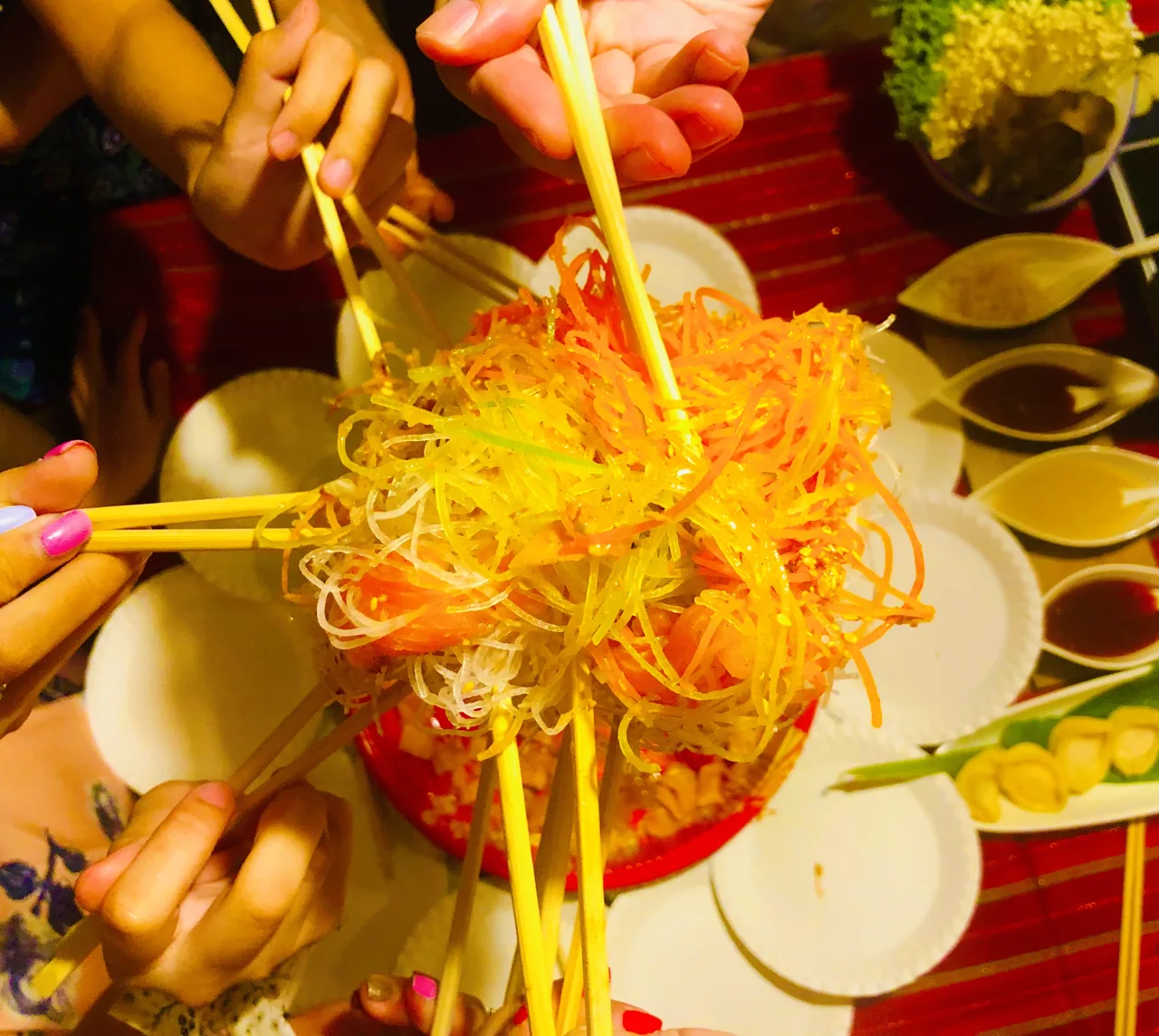
Lo hei is the tossing of yusheng, a salad of raw fish and shredded vegetables. Everyone at the table lifts the strands high with chopsticks while saying wishes for the year, and restaurants serve it through the season.
Food gifts and visiting
Bak kwa is sweet grilled dried meat, given and eaten over the new year. The queue at Lim Chee Guan in Chinatown is longest in the last week before day 1, when it charged about S$80 per kilo last time; Bee Cheng Hiang charged about S$72 to S$74.
When visiting a home, bring 2 mandarin oranges, since oranges are given in pairs. Red packets hold money in even amounts, avoiding the number 4. Wear red if you can, and avoid all black or all white on a visit.
🎡Things to Do55
🍜Food6
🏨Where to Stay10
🚇Getting Around4
🧭Travel Tips22
Chinese New Year in Singapore: questions
Day 1 is Saturday 6 February and day 2 is Sunday 7 February, and Monday 8 February is also a public holiday.
The extra Monday is given because day 2 falls on a Sunday. The eve, Friday 5 February, is a normal working day, though many offices, banks and shops close early that afternoon.
No, the eve is a working day in law.
In practice, bank branches close around 1pm, post offices at 1pm, Sheng Siong at 4pm and most FairPrice stores at 5pm, so run errands in the morning.
The big hawker centres stay open, but many Chinese-run stalls close for the first days.
Halal Malay and Indian stalls are the ones most likely to be trading on day 1 and day 2. Lau Pa Sat was listed as open 24 hours on the eve, day 1 and day 2 the last two times.
The malls open, and each shop inside sets its own hours.
Going by one pharmacy chain’s store hours last time, shops in the big tourist malls such as ION OrchardMap, VivoCityMap, Suntec City, Bugis Junction, Raffles City and Marina Bay Sands kept normal hours, while those in Chinatown Point, People’s Park Complex and Ngee Ann CityMap shortened their hours or closed on day 1.
Yes, entry to River Hongbao is free and there are no tickets.
You pass a bag check at the gates. Carnival rides are paid with a ride card bought at the carnival entrance, and the card cannot be refunded.
On the eve, River Hongbao has run from 6.30pm to 12.15am the last four times.
On the opening night it runs from 6.30pm to 10.30pm, and from day 1 until the last day it runs from 2.30pm to 10.30pm.
Trains run late, to about 2am on the North-South and East-West lines and a little earlier on the others.
Last time the last North-South and East-West trains left City Hall between 1.54am and 2.14am. The Changi Airport branch and the Bukit Panjang LRT keep their usual last trains. SMRT and SBS Transit announce the exact times about 2 weeks before.
Buy them on SISTIC as soon as they go on sale; in the last two years sales opened about 11 to 13 weeks before the parade.
Tickets cost S$20 to S$60 plus a booking fee and have sold out in most recent years. Without a ticket, you can watch the free live webcast of the Friday show on Chingay’s YouTube or Facebook.
No, the temple has not held the midnight first joss stick on the eve for 6 years.
It opens from 7am to 6.30pm on the eve, and on day 1 people queue before dawn for the morning opening.
Search GPGoWhere for the GP clinics on the government’s holiday list.
Polyclinics are closed on public holidays. For a serious emergency, go to a hospital A&E, which stays open.
Change money before the eve, or at Changi Airport, which has money changers in every terminal and 24-hour ATMs.
Money changers in town are generally closed on public holidays. ATMs work around the clock.
No, the land crossings to Malaysia are at their worst over Chinese New Year.
ICA warns of very heavy traffic at Woodlands and Tuas from about a week before the new year until after the holiday, with car waits of up to 3 hours.
Planning the rest of your trip? Start with our main Singapore guide.