
Kampong Glam: Sultan MosqueMap, Haji LaneMap and Arab Street
Singapore’s Malay-Muslim quarter and its most photogenic — the golden Sultan Mosque, the textiles of Arab Street and the street-art alley of Haji Lane in a few walkable blocks. What to see, where to eat and how to do it in a day.
- Kampong Glam (officially Kampong Gelam) is Singapore’s Malay-Muslim quarter and its most photogenic — the golden-domed Sultan Mosque, the textile shops of Arab Street and the mural-lined Haji Lane all within a few walkable blocks.
- Its centrepiece is the magnificent Sultan Mosque, Singapore’s largest, best photographed from the café-lined Bussorah Street that runs straight to its steps.
- The quarter blends deep heritage with a hip, creative present: Arab Street for textiles and carpets, Haji Lane for indie boutiques, street art and bars, and the streets around for some of the city’s best Malay and Middle-Eastern food.
- It’s free to wander, easy to combine with the other cultural quarters, and a brilliant half-day — historic, colourful and full of character.
- Pair it with the rest of our Singapore neighbourhoods guide and the neighbouring quarters of Little India and Chinatown.
| Where | Around Arab Street & Bussorah Street, just north of Bugis |
|---|---|
| Getting there | Bugis MRT (Downtown & East-West lines), Exit B/C |
| Cost | Free to wander; Sultan Mosque free; meals ~S$6–15 |
| Time needed | Half a day to wander, eat and shop |
| Don’t miss | Sultan Mosque, Bussorah Street, Haji Lane, Arab Street |
| Best time | Late afternoon into the evening; sunset over the mosque |
| Good to know | Dress modestly for the mosque (robes provided); closed to visitors at prayer times |
1. Kampong Glam orientation: how to do it
2. The story of Kampong Glam
3. The Sultan Mosque
4. Bussorah Street & the heritage core
5. Arab Street: textiles, carpets & perfumes
6. Haji Lane: street art, boutiques & bars
7. Malay Heritage Centre & the royal palace
8. What & where to eat
9. Nightlife, cafés & shisha
10. Instagrammable Kampong Glam
11. Getting there, timing & etiquette
12. Where to stay in Kampong Glam
13. Plan it: routes & what’s nearby
Kampong Glam is the most photogenic corner of Singapore and one of its most rewarding half-days — a compact, atmospheric quarter where a magnificent golden-domed mosque rises at the end of a palm-lined pedestrian street, where textile merchants and perfume sellers trade on Arab Street, and where a single narrow lane (Haji Lane) packs more street art, indie boutiques and bars than seems possible. This is Singapore’s Malay-Muslim heart, once the seat of Malay royalty, and it wears its history beautifully while buzzing with a young, creative present. The word kampong means ‘village’ in Malay and gelam refers to the paperbark trees that once grew here; today the quarter is a living mix of the sacred and the hip — a mosque and a record shop, a heritage palace and a craft-cocktail bar, nasi padang and Turkish mezze, all in a few blocks you can cross on foot. This guide covers all of it: the story of the quarter, the Sultan Mosque and how to visit, Bussorah Street and the heritage core, Arab Street’s textiles, Haji Lane’s art and shops, the Malay Heritage Centre, where and what to eat, the bars and shisha, the best photo spots, and the practical details — getting there, timing, mosque etiquette and where to stay. Use it with our complete Singapore neighbourhoods guide to make the most of a day here.
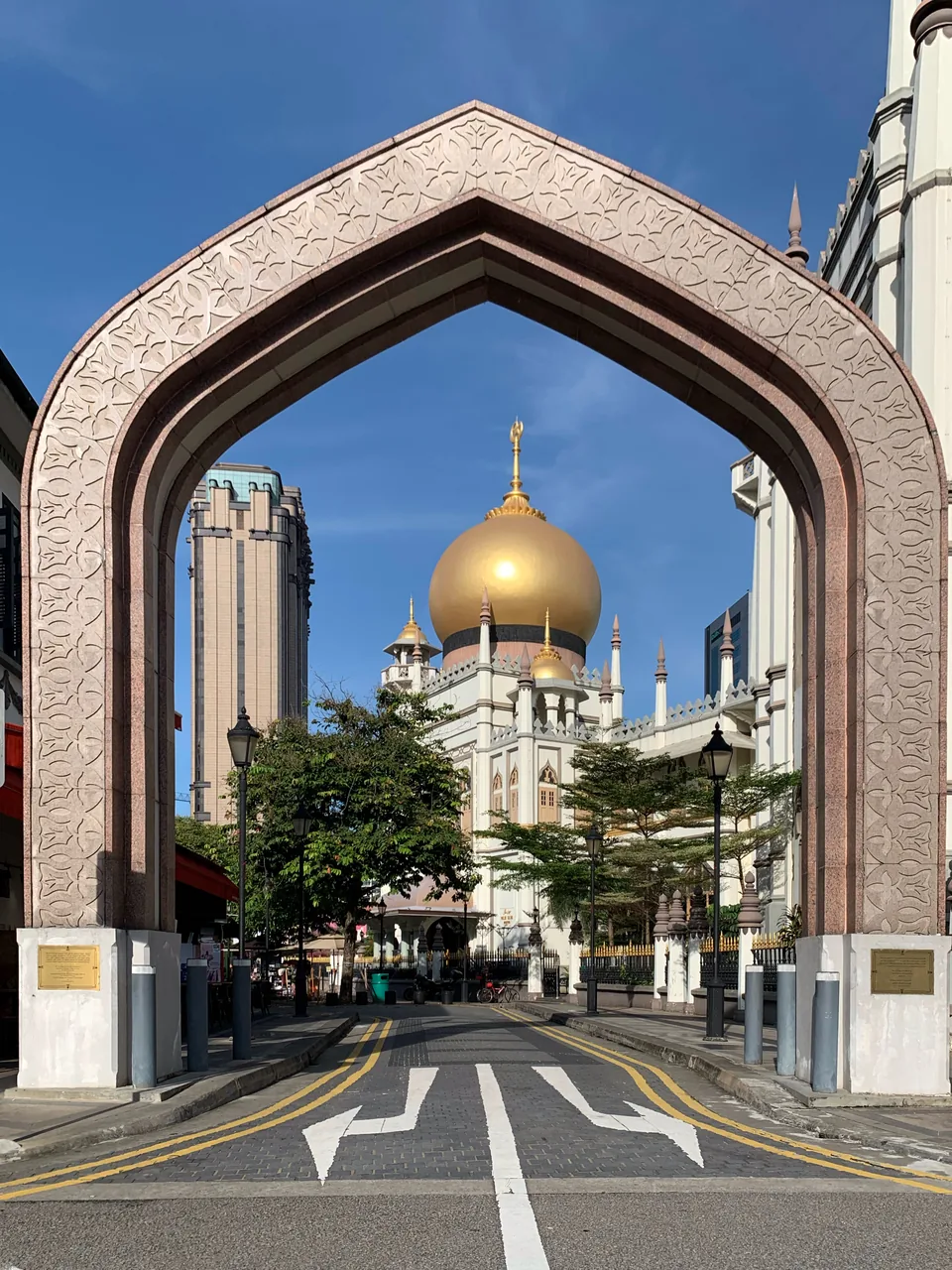
1. Kampong Glam orientation: how to do it
Kampong Glam is small, vivid and made for walking — arrive at Bugis MRT, aim for the golden dome of the Sultan Mosque, and let Bussorah Street, Arab Street and Haji Lane pull you around.
The quarter sits just north of Bugis, a compact grid of heritage streets. From Bugis MRT (Exit B or C) it’s a couple of minutes to the heart of it. The natural centre is the Sultan Mosque, with the palm-lined pedestrian Bussorah Street running straight to its steps — the classic photo. Around it: Arab Street (textiles and carpets) to one side, the narrow Haji Lane (street art, boutiques, bars) parallel, Kandahar and Baghdad Streets for food and cafés, and the Malay Heritage Centre in the former palace just behind. A simple plan: photograph the mosque from Bussorah Street, visit inside (outside prayer times), browse Arab Street and Haji Lane, then settle in for Malay or Middle-Eastern food and a coffee or shisha. Late afternoon into the evening is the prettiest time, with the mosque lit at dusk. Why Malay is the national language, and where you actually hear it, are covered in what language they speak in Singapore.
2. The story of Kampong Glam
Kampong Glam was the seat of Malay royalty in early Singapore — its name from the ‘gelam’ paperbark trees that grew here, and its history written into its royal palace and grand mosque.
When the British established modern Singapore in 1819, the area was allotted to Sultan Hussein Shah and the Malay and Muslim community, and it became the seat of Malay royalty and the centre of Muslim life and trade. Kampong means ‘village’ and gelam refers to the paperbark (gelam) trees that once grew in the area. The royal connection is everywhere: the Istana Kampong Glam (the former palace, now the Malay Heritage Centre) and the grand Sultan Mosque anchor the quarter, while the surrounding streets — named for Middle-Eastern and South-Asian places (Arab, Baghdad, Kandahar, Bussorah, Muscat) — recall the Muslim traders, pilgrims and textile merchants who gathered here. That layered heritage, now mixed with a creative, youthful energy, is exactly what gives Kampong Glam its character. The Malay Heritage Centre tells the full story.
3. The Sultan Mosque
The Sultan Mosque is Singapore’s largest and grandest mosque, and the magnificent centrepiece of Kampong Glam — its golden dome visible across the quarter.
First built in 1824 for Sultan Hussein Shah and rebuilt in its current form around 1928 in the elegant Indo-Saracenic style, the Sultan Mosque (Masjid Sultan) is crowned by a massive golden onion dome and ringed by minarets. Look closely at the base of the dome: it’s decorated with a ring of dark glass bottle-ends, donated by poorer members of the community so that everyone could contribute to its construction — a lovely detail. The mosque is a national monument and the spiritual heart of Singapore’s Malay-Muslim community. Non-Muslim visitors are welcome to enter outside prayer times, free of charge; dress modestly (robes are provided), remove your shoes, and be quiet and respectful. Photograph the exterior from Bussorah Street for the classic shot, especially at golden hour and dusk when it’s beautifully lit.
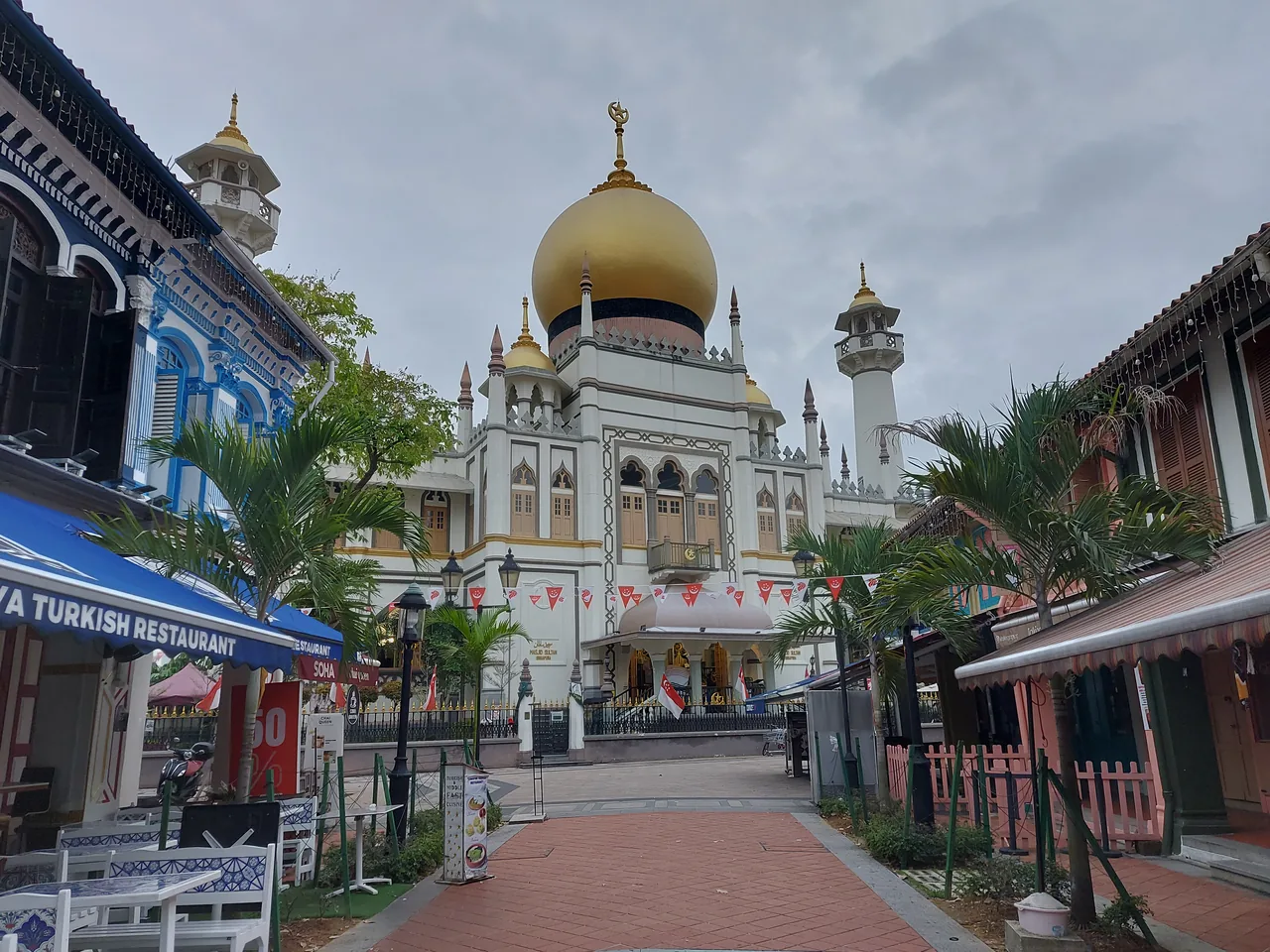
4. Bussorah Street & the heritage core
Bussorah Street is the postcard of Kampong Glam — a palm-lined pedestrian mall of restored shophouses leading straight to the Sultan Mosque.
Pedestrianised and lined with date palms, Bussorah Street frames the golden dome of the Sultan Mosque perfectly and is the quarter’s most photogenic spot. Its restored shophouses hold cafés, craft and souvenir shops, perfume and textile boutiques and restaurants, with tables spilling onto the street in the evenings. The surrounding lanes — Kandahar Street, Baghdad Street, Muscat Street (with its decorative Arabesque arch) — are equally atmospheric, full of murals, heritage trades and good food. This is the part of Kampong Glam to wander slowly: the architecture is beautiful, the light at dusk is magic, and almost every corner is a photo. Grab a Turkish tea or a coffee, find a table on Bussorah Street, and watch the mosque glow as the sun goes down.
5. Arab Street: textiles, carpets & perfumes
Arab Street is the traditional trading heart of Kampong Glam — a colourful strip of textile merchants, carpet dealers and perfume sellers that has done business here for generations.
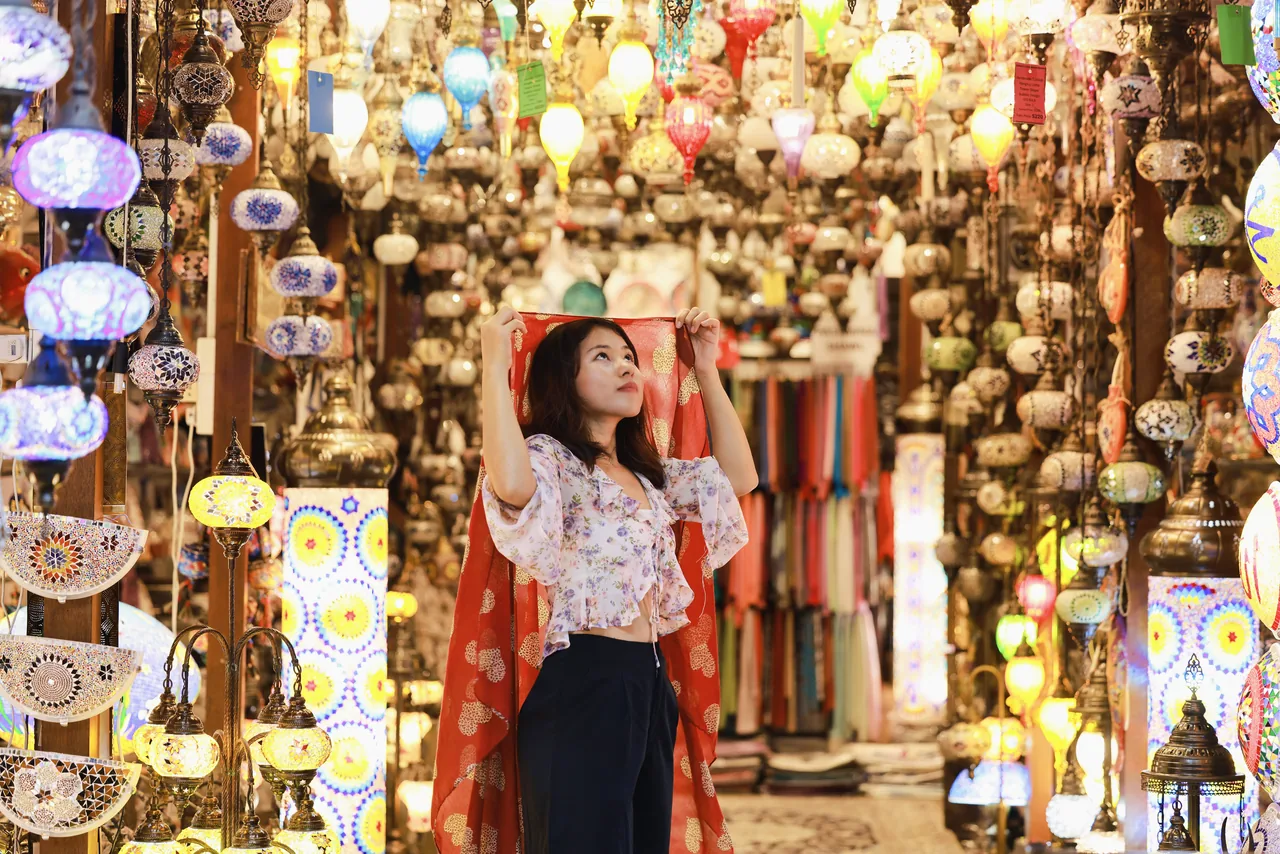
Arab Street is stacked with shops selling fabrics and textiles (this is the place for silk, batik and dressmaking materials), Persian and Turkish carpets, perfumes and attars, leather goods, baskets and Middle-Eastern homeware. Even if you’re not buying, the shopfronts piled high with bolts of colourful cloth make a wonderful wander and a great photo. It’s where locals come for materials and where you can pick up unusual gifts and souvenirs — and a little gentle haggling is fine. The street connects naturally to Bussorah Street and Haji Lane, so it slots into any Kampong Glam loop. For tourists, the GST refund applies on larger purchases — see our budget guide.
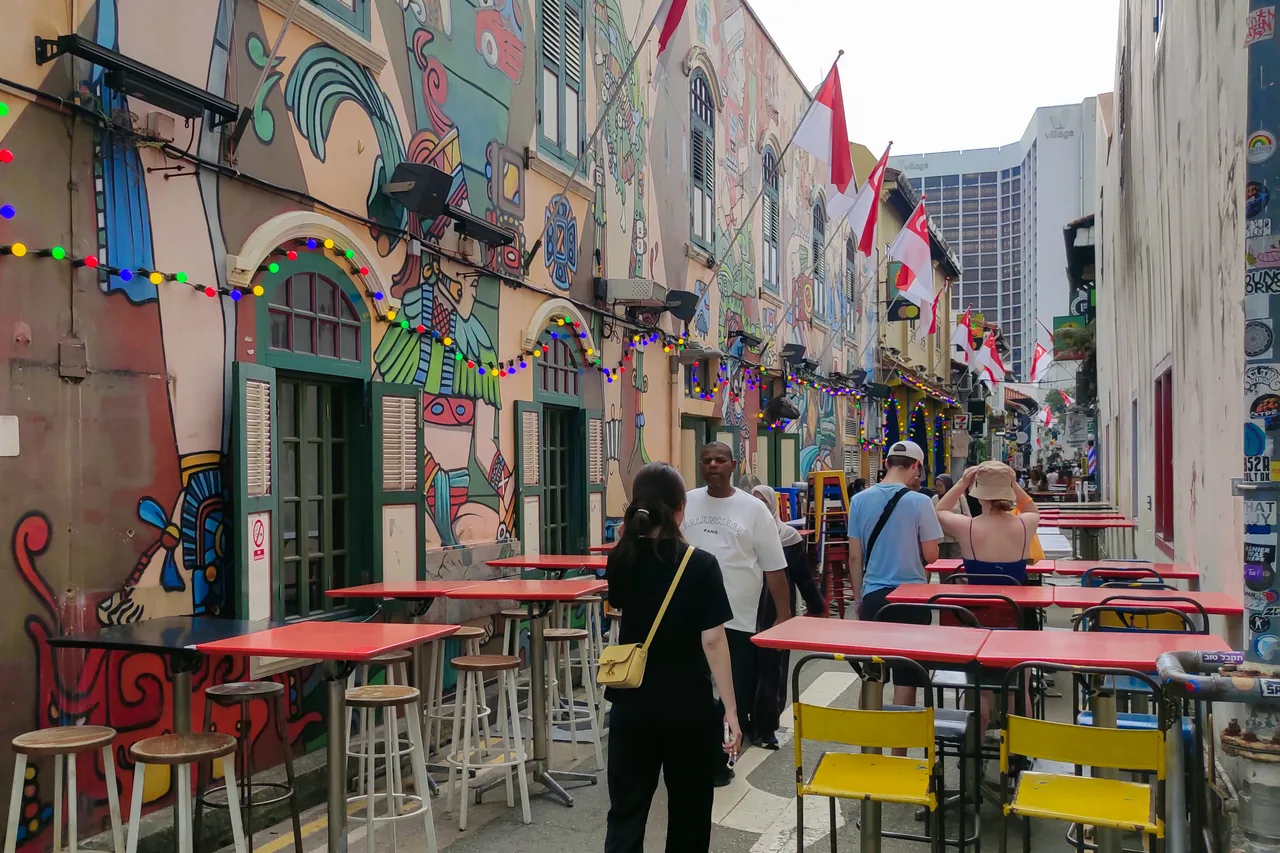
6. Haji Lane: street art, boutiques & bars
Haji Lane is Singapore’s most famous hip alley — a narrow lane crammed with street-art murals, independent boutiques and bars, and one of the city’s most Instagrammed spots.
Just a few metres wide, Haji Lane packs an astonishing amount into a short walk: vivid street-art murals covering whole walls, independent fashion boutiques, vintage and record shops, homeware and design stores, tattoo studios and a string of cafés and bars. By day it’s for shopping and photos — the murals are a guaranteed highlight — and by night it transforms into a buzzy strip of bars and shisha spots. Parallel Bali Lane adds more bars and live music. It’s the creative, youthful counterpoint to the heritage of the mosque just around the corner, and the two side by side are what make Kampong Glam so special. Come in the afternoon for the murals and shops, and stay into the evening for a drink.
7. Malay Heritage Centre & the royal palace
Behind the Sultan Mosque, the former royal palace tells the story of Singapore’s Malay community — the historic heart of the quarter.
The Istana Kampong Glam, a graceful palace built around 1840 for the family of Sultan Hussein Shah, sits in pleasant grounds a short walk behind the Sultan Mosque, and houses the Malay Heritage Centre, which traces the history, culture and contributions of Singapore’s Malay community. Note: the centre has been undergoing a major revamp, so check its current opening status before you go — but the elegant palace building and its grounds, with the old Gedung Kuning (‘yellow mansion’) nearby, are a worthwhile and peaceful stop in any case. Together with the mosque, it anchors the royal, historic side of Kampong Glam — a calm counterpoint to the buzz of Haji Lane.
8. What & where to eat
Kampong Glam is a feast — Malay and Middle-Eastern food at its best, and the city’s top quarter for halal dining.
Start with nasi padang (a spread of Malay curries and dishes over rice) — the famous Hajah Maimunah is the classic. On North Bridge Road, the old institutions Zam Zam and Victory have served murtabak (stuffed savoury pancake) and biryani for over a century. Around Bussorah and Baghdad Streets you’ll find Middle-Eastern mezze, shawarma and grills, Turkish food and tea, and plenty of cafés. As Singapore’s Muslim quarter, this is the best area for halal food of every kind, and the dessert and coffee scene is strong too. Budget around S$6–15 a head for a great meal. For more on the city’s food, see our food guide.
9. Nightlife, cafés & shisha
By night, Kampong Glam swaps heritage for a relaxed bar-and-shisha scene — one of the city’s most atmospheric evenings, and largely casual and affordable.
As the light fades, the quarter comes alive. Haji Lane and Bali Lane fill with bars and live music, from tiny shophouse cocktail spots to rooftop terraces; the streets around Bussorah and Kandahar are dotted with Middle-Eastern shisha cafés where you can linger over mint tea and a hookah; and the restored shophouses glow against the lit-up mosque. It’s a more low-key, characterful night out than Marina Bay’s rooftops or Clarke QuayMap‘s clubs — think a cocktail in a heritage alley or shisha under the palms rather than a big night. Note that, as a Muslim quarter, some venues are alcohol-free, especially nearer the mosque — part of the area’s distinctive character.
10. Instagrammable Kampong Glam
Kampong Glam is the most photogenic quarter in Singapore — here’s where to point the camera.
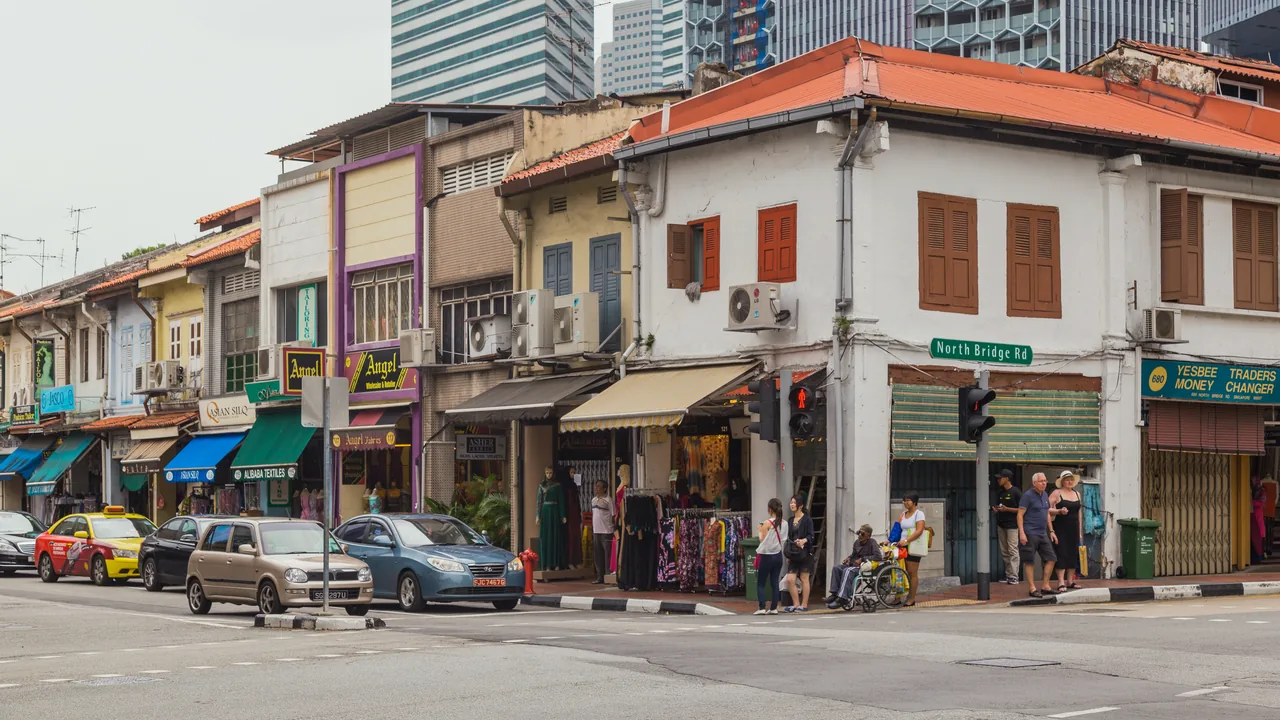
The signature shot is the golden Sultan Mosque framed by Bussorah Street, especially at golden hour and dusk when the dome is lit and the palm-lined street glows. Haji Lane is wall-to-wall street art, with new murals appearing regularly — the most colourful photo trail in the city. Add the decorative Muscat Street arch, the brightly painted shophouses of Kandahar and Baghdad Streets, the bolts of colourful cloth on Arab Street, and the quirky boutique shopfronts, and you have an endless supply of photos. For the best light, come in the late afternoon and stay through sunset. It’s compact, so you can capture all of it in a relaxed couple of hours.
11. Getting there, timing & etiquette
Kampong Glam is one of the easiest quarters to reach and explore — here’s the practical detail to get it right.
Getting there: take the MRT to Bugis station (Downtown and East-West lines, Exit B or C); it’s a two-minute walk to the mosque and Haji Lane. Best time: late afternoon into the evening is prettiest, with the mosque lit at dusk and the bars opening; daytime is best for the mosque interior and shopping. How long: a half-day for the essentials. Mosque etiquette: dress modestly (cover shoulders and knees; robes provided), remove your shoes, keep quiet, and don’t visit during the five daily prayers or Friday midday prayers. Money: cards are widely taken, but carry a little cash for small shops and the market; a little haggling is fine on Arab Street. Sort an eSIM so maps work from the start.
| Practical | Detail |
|---|---|
| Nearest MRT | Bugis (DT/EW), Exit B/C |
| Cost to explore | Free (mosque free; food affordable) |
| Best time of day | Late afternoon & evening |
| Time needed | Half a day |
12. Where to stay in Kampong Glam
Kampong Glam and neighbouring Bugis are a great-value, central and characterful base — walkable to the cultural quarters and well connected.
The quarter and adjacent Bugis are full of boutique hotels in restored shophouses and good-value hostels, all a short walk to Haji Lane, Arab Street and the mosque, and a quick MRT ride from the icons. It suits travellers who want character, central location and excellent cheap food on the doorstep, at better value than Marina Bay or Orchard. The trade-off is evening noise around the Haji Lane bar streets — light sleepers should pick a quieter lane. It’s a particularly good base for exploring the three cultural quarters, which are all within easy reach. For a full comparison of where to base yourself, see our where to stay in Singapore guide.
13. Plan it: routes & what’s nearby
Kampong Glam fits neatly into a day of cultural quarters — here’s how to structure it and what to pair it with.
Half-day: Bugis MRT → Sultan Mosque & Bussorah Street → Arab Street → Haji Lane (art & shops) → Malay Heritage Centre grounds → nasi padang or Middle-Eastern dinner, staying into the evening for the bars. Because the cultural quarters sit close together, Kampong Glam pairs naturally with its neighbours: Little India is a short walk or one MRT stop north, and Chinatown is a few stops away on the same lines — many visitors do all three in one big day of temples, mosques and food. It’s also next to Bugis and a quick ride to Marina Bay for the evening. A classic plan: the three quarters by day, the bay and its light shows by night. Plan the rest with our complete neighbourhoods guide and Singapore travel guide.