
Singapore to Kuala Lumpur: Bus, Train or Flight, and Where Each One Drops You
| Bus | More than 700 departures a day. Close to half of them end at TBS, which is outside the city centre |
|---|---|
| City-centre buses | Bukit Bintang and Berjaya Times Square. Pick the drop-off point, not just the fare |
| Train | One change at Johor Bahru. The five-minute border leg runs 13 times a day and sells out |
| Last train | The final Kuala Lumpur service leaves Johor Bahru at 17:30 |
| Flight | Two departure airports and two arrival airports. The pair you pick changes your door-to-door time |
| Paperwork | Only Singapore citizens are exempt from the Malaysia arrival card. Everyone else files it within three days |
1. A bus can drop you at fifteen different places
2. TBS is a good terminal, but it is not the city centre
3. Some buses stop in the middle of the city
4. More than seven hundred buses run every day
5. Twenty-nine pick-up points in Singapore
6. Fares and journey time
7. Twenty-three operators, very unevenly sized
8. By train, you change at Johor Bahru
9. The five-minute leg is the hardest ticket to get
10. The same five minutes costs three times more northbound
11. Johor Bahru to Kuala Lumpur takes a little over four hours
12. The last train to Kuala Lumpur leaves at 17:30
13. Three classes, very different availability
14. The railway’s own pages do not agree with its booking system
15. Trains put you down at KL Sentral
16. Flying means four possible airport pairs
17. Getting from Kuala Lumpur International Airport into the city
18. Subang airport is much closer to town
19. What happens at the border
20. Documents
21. If you are a Singapore citizen or resident
22. A new rail crossing opens at the end of 2026
23. Which one should you take
24. When to book
1. A bus can drop you at fifteen different places
The route does not have one arrival point. Counting a single Friday’s departures on a booking site returns fifteen separate drop-off points in and around Kuala Lumpur.
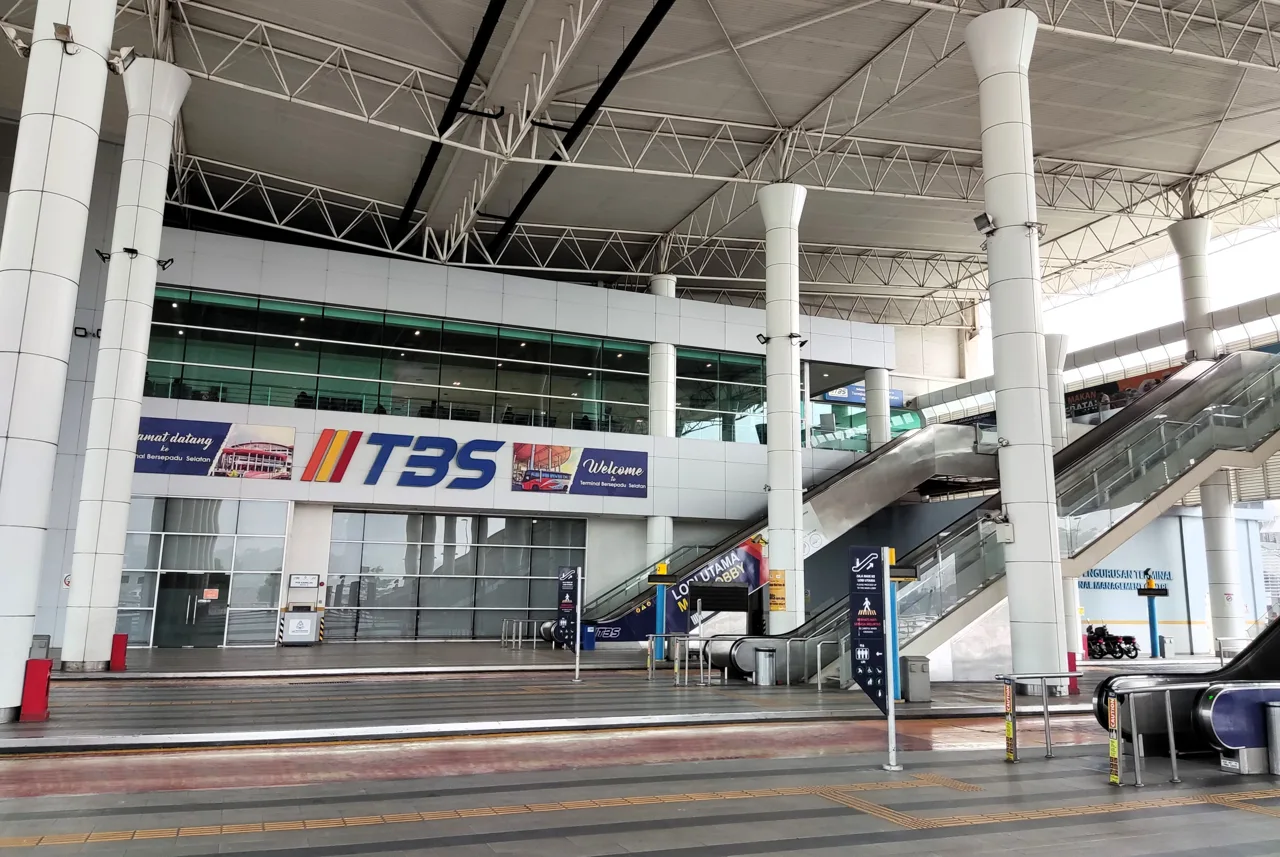
The one to understand first is TBS. On that Friday, 322 of the 769 departures ended there, which is close to half the traffic on the route. Terminal Bersepadu Selatan is a large, modern terminal, but it stands at Bandar Tasik Selatan on the southern edge of the city, so arriving there means continuing by rail or road into town.
Services to Bukit Bintang and Berjaya Times Square, by contrast, stop in the middle of the shopping and hotel district. The fare gap between the two kinds of service is small. What changes is the half hour or hour you spend after you arrive.
Drop-off points by number of departures
| Drop-off point | Departures | Where it leaves you |
|---|---|---|
| TBS (Terminal Bersepadu Selatan) | 322 | Southern edge. Change to rail for the centre |
| LaLaport Bukit Bintang | 210 | Central shopping district, walkable |
| Berjaya Times Square | 103 | Middle of the city |
| Bukit Bintang | 48 | Middle of the city |
| Nu Sentral | 39 | Mall attached to KL Sentral station |
| KL Sentral | 20 | Main rail interchange |
| TBG (Terminal Bersepadu Gombak) | 10 | Northern edge |
| Hentian Duta | 5 | North-west, away from the centre |
| Subang Parade, Sungai Besi Toll, 1 Utama and others | 12 | Outside Kuala Lumpur, in the surrounding towns |
Sort by drop-off point, then by fare
Booking screens lead with price and departure time, and print the arrival point in smaller type underneath. Decide where you are staying first, then filter for services that stop near it. The cheapest ticket on the page is often the one that leaves you furthest out.
The same operator will sometimes sell the same departure time with two different drop-off points. Before you pay, look up the name of the arrival point on a map, especially if it is one you do not recognise.
2. TBS is a good terminal, but it is not the city centre
Terminal Bersepadu SelatanMap sits at Bandar Tasik SelatanMap, south of central Kuala Lumpur. It replaced a scattering of older bus stations and handles long-distance services for the whole southern half of the peninsula.
The building is joined to a rail station, so the transfer is undercover and short. Commuter trains, the Sri Petaling light rail line and the airport train all call there. The airport train operator’s own fare table lists Bandar Tasik Selatan as a separate sector, which is a useful detail if you are flying out of Kuala Lumpur at the end of your trip.
Getting from TBS into town
By rail the centre is roughly fifteen to twenty-five minutes away, depending on which line you take and where you are heading. Tickets are sold at the station. Taxis and ride-hailing cars pick up from a dedicated area inside the terminal and run at night, although at rush hour the train is usually quicker than the road.
None of this makes TBS a poor choice. It is a straightforward arrival if you are travelling light and arriving during the day. It becomes tiring with heavy luggage, with small children, or at two in the morning when the connecting services have not started.
3. Some buses stop in the middle of the city
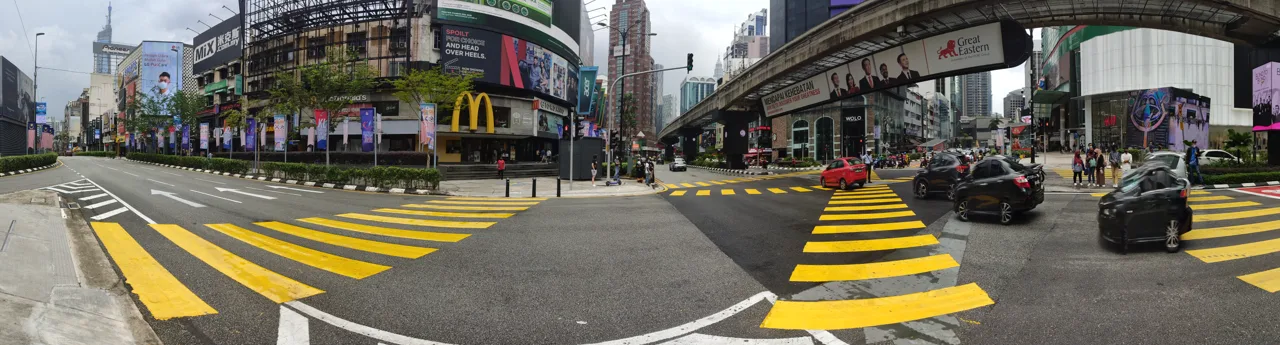
Bukit BintangMap and Berjaya Times SquareMap are both inside the main hotel and shopping area. From either one you can walk to a large number of hotels or take a short ride.
On the Friday we counted, LaLaport Bukit Bintang took 210 departures and Berjaya Times Square 103. A further 48 were listed simply as Bukit Bintang. Together that is well over a third of the day’s services arriving within walking distance of each other.
The stop names overlap
Booking screens show Bukit Bintang, LaLaport Bukit Bintang and Bukit Bintang (LaLaport) as separate entries. They are variations on the same area, a few minutes apart on foot. There is no need to hunt for a specific spelling.
A smaller group of services stops at KL Sentral or the Nu Sentral mall attached to it. That is the same building trains arrive at, which makes it convenient if you are moving on to another Malaysian city the next day, or heading to the airport.
4. More than seven hundred buses run every day
Capacity is not the constraint on this route. We counted 769 departures on a Friday and 809 on a Wednesday, in the Singapore to Kuala Lumpur direction alone.
Departures cluster at each end of the day. Morning services carry the largest share, evening services almost the same, and the middle of the day is quieter. Overnight departures are a smaller group, around fifty.
Departures by time of day (Friday, Singapore to Kuala Lumpur)
| Departure window | Departures | You arrive |
|---|---|---|
| Midnight to 06:00 | 56 | In the morning, before most check-in times |
| 06:00 to noon | 273 | Afternoon or early evening |
| Noon to 18:00 | 170 | Late evening |
| 18:00 to midnight | 270 | Small hours. Check how you will reach your hotel |
Two booking sites, two different totals
Search the same date in two places and the numbers will not match. One returned 769 bus departures; another listed 282 buses alongside 107 flights, two vans and three taxis, for 394 options in total. The operators each site sells are not the same, so neither total is the whole picture.
If the time you want looks full on one site, check another. Some operators appear on only one of them.
The return direction runs on a different rhythm. Counting a Sunday, 591 services left Kuala Lumpur for Singapore, and the largest block, 236 of them, departed between noon and 18:00.
5. Twenty-nine pick-up points in Singapore
Coaches do not all leave from one station. They pick up across the island, which usually means there is a departure point near wherever you are staying.
Golden Mile TowerMap handles the most departures, followed by Grantral Mall, Boon Lay, Oxley Bizhub, Bugis and Lavender. The old Golden Mile Complex, which appears in a lot of older travel writing as the place to catch a Malaysia-bound coach, is down to two departures a day; the trade moved next door.
Pick-up points by number of departures
| Pick-up point | Departures | Nearest MRT |
|---|---|---|
| Golden Mile Tower | 131 | Nicoll Highway, Lavender |
| Grantral Mall | 86 | Paya Lebar |
| Boon Lay | 74 | Boon Lay |
| Oxley Bizhub | 63 | Ubi |
| Bugis MRT | 62 | Bugis |
| Lavender MRT | 57 | Lavender |
| The Plaza, Beach Road | 50 | Nicoll Highway |
| Jurong East (two points) | 76 | Jurong East |
| Hotel Boss | 37 | Lavender |
| Kitchener Complex, Tai Seng, Kovan and others | 62 | North-east |
Choosing where to board
A pick-up point close to your hotel saves an awkward taxi ride at five in the morning or late at night. The cost is choice: the smaller points may only have three or four departures all day, so if your departure time is fixed, start from the busier locations.
Several pick-up points are kerbside rather than inside a building. If yours is one of those, arrive about fifteen minutes early, and take a photo of the boarding instructions on your ticket, because there is often no staffed counter.
6. Fares and journey time
Around twenty Singapore dollars gets you a seat. On the day we checked, fares ran from S$18.00 to S$48.58, and the booking site’s own average sat in the low thirties.
The published average journey time is five hours and fifty-one minutes. That is the running time between pick-up and drop-off in normal conditions, and it does not include a long wait at the checkpoints. First departure of the day is at midnight, last at 23:59.
Seat layouts
Two layouts dominate: a single-deck coach with three seats across, and a double-decker. On the Friday we counted, 451 departures used the three-across layout and 309 were double-deckers. The three-across seats are wider and recline further, and they cost a few dollars more.
Some coaches have an onboard toilet and some do not. Those without make a rest stop on the way. On an overnight service the seat layout matters more than the fare difference between operators.
7. Twenty-three operators, very unevenly sized
The route is shared between 23 companies, and the largest few carry most of the traffic.
CityLine ran 160 departures on the Friday we counted and Billionstars Express 149. Qistna Express, StarMart Express and Transtar follow. Below them are companies running five or six departures a day.
The larger operators
| Operator | Departures |
|---|---|
| CityLine | 160 |
| Billionstars Express | 149 |
| Qistna Express | 91 |
| StarMart Express | 64 |
| Transtar Express Xtras | 42 |
| KKKL Travel & Tours | 34 |
| Grassland Coach | 32 |
| The One Tours & Travel (Five Stars Express) | 31 |
The small operators are worth a look
Some of the companies with only a handful of departures run them straight to a city-centre drop-off point. Sorting a booking page by operator size hides those services; filtering by arrival point brings them back to the top.
Ratings on booking sites vary widely between operators on this route, and the cheapest fare is not always from the largest company. If you are travelling overnight, it is worth reading a few recent reviews for the specific operator rather than the route.
8. By train, you change at Johor Bahru
No train runs from Singapore all the way to Kuala Lumpur. The journey splits into two legs with a change at JB Sentral.
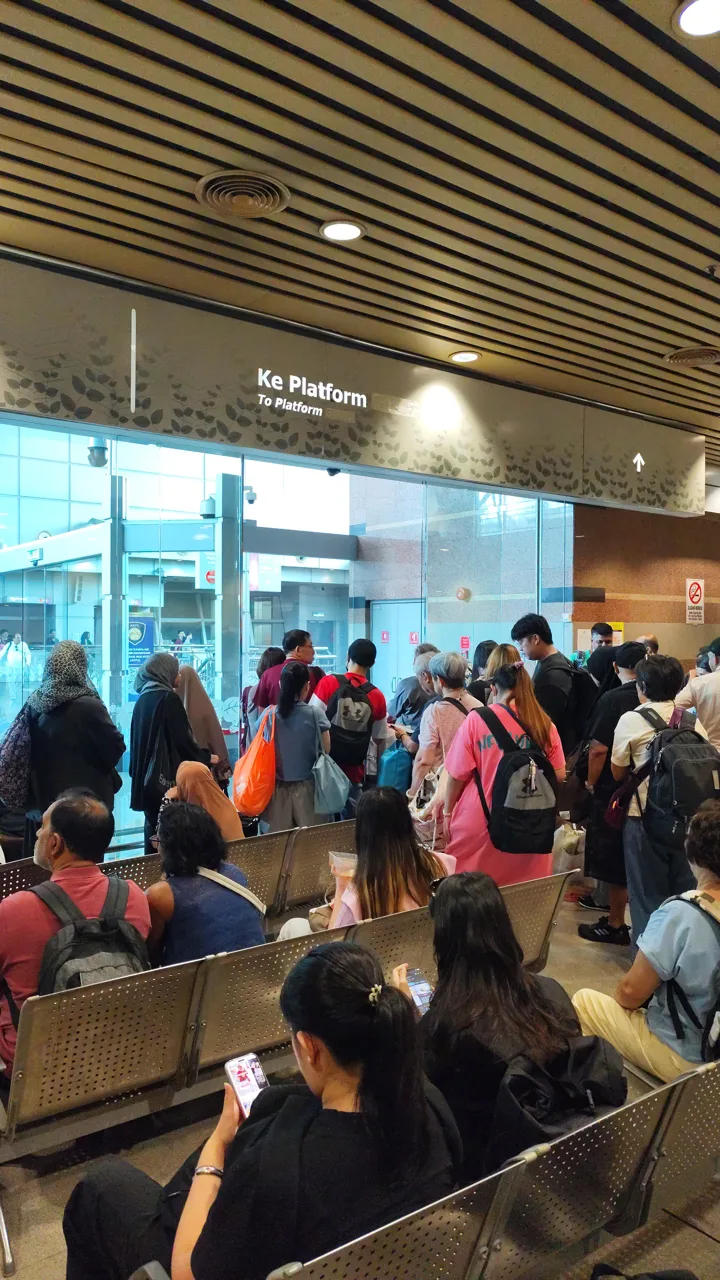
The first leg is the Shuttle Tebrau, a five-minute crossing from Woodlands CIQ in Singapore to JB Sentral in Malaysia. The second is an intercity service from JB Sentral to KL Sentral, taking a little over four hours.
Two tickets, two separate bookings
On the railway’s reservation site the two legs sit under different menus and are paid for separately. There is no through ticket. Book the border leg first and then pick a Kuala Lumpur departure that fits behind it, rather than the other way round.
Leave a margin between the two. The walk inside JB Sentral is short, but if the shuttle runs late you will be watching your connection leave. The station sits directly beside the immigration building, so if the shuttle is sold out you can cross by bus or taxi and still catch your onward train.
9. The five-minute leg is the hardest ticket to get
Only thirteen shuttles a day run from Woodlands, and the first is at 08:30. On the Friday we checked, every one of the thirteen was sold out.
This is a commuter service as much as a traveller’s one, and the seats go quickly. On the Sunday we checked, three of the thirteen were already full and the rest were filling. Booking opens on a fixed schedule ahead of travel, and popular departures go within minutes of the release.
Woodlands CIQ to JB Sentral
| Detail | |
|---|---|
| Departure times | 08:30, 09:45, 11:00, 12:30, 13:45, 15:00, 16:15, 17:30, 18:45, 20:00, 21:15, 22:30, 23:45 |
| Journey time | 5 minutes |
| Fare | MYR 16.10 |
| Seats left on the Friday checked | Zero on all thirteen |
If it is sold out
Cross the border by bus or taxi and join the train at JB SentralMap. The station is next to the immigration complex, so the walk is short once you are through. You lose the convenience of the rail crossing but keep the four-hour train to Kuala Lumpur, which is the part that matters for comfort.
There is also no shuttle before 08:30. If you need to be across the border earlier than that, the rail option does not exist for you that morning.
10. The same five minutes costs three times more northbound
Woodlands to JB Sentral is MYR 16.10. JB Sentral to Woodlands is MYR 5.00.
The northbound service is priced in Singapore dollars and shown converted, so the difference on screen is the exchange rate rather than a different product. It is the same rolling stock over the same five minutes of track.
The southbound direction has more room
Coming back, eighteen departures a day run from JB Sentral, starting at 05:00 and finishing at 22:45. The early departures are half an hour apart, which makes this a practical way to reach Singapore for a morning flight or meeting.
Even so, eleven of the eighteen were sold out on the Sunday we checked. Weekend returns fill up in this direction the way weekday mornings fill up in the other.
Both directions at a glance
| Direction | Departures | First | Last | Fare |
|---|---|---|---|---|
| Woodlands CIQ to JB Sentral | 13 | 08:30 | 23:45 | MYR 16.10 |
| JB Sentral to Woodlands CIQ | 18 | 05:00 | 22:45 | MYR 5.00 |
11. Johor Bahru to Kuala Lumpur takes a little over four hours
Nine services a day, arriving between four hours ten minutes and four hours thirty-six minutes later.
The first leaves at 07:00 and the last at 17:30. Fares on the day we checked ran from MYR 86.00 to MYR 119.00 depending on class. Every service ends at KL Sentral.
JB Sentral to KL Sentral, the Friday we checked
| Depart | Arrive | Duration | From |
|---|---|---|---|
| 07:00 | 11:10 | 4h 10m | MYR 119.00 |
| 07:35 | 12:11 | 4h 36m | MYR 86.00 |
| 08:40 | 13:00 | 4h 20m | MYR 116.00 |
| 09:55 | 14:05 | 4h 10m | MYR 116.00 |
| 11:25 | 15:35 | 4h 10m | MYR 113.00 |
| 12:45 | 17:05 | 4h 20m | MYR 113.00 |
| 15:00 | 19:20 | 4h 20m | MYR 113.00 |
| 16:20 | 20:40 | 4h 20m | MYR 113.00 |
| 17:30 | 21:40 | 4h 10m | MYR 119.00 |
What the journey is like
The line runs north through Johor and Negeri Sembilan, calling at towns along the way. Faster classes stop only at the larger stations. There is a bistro car, and luggage racks at both ends of each coach.
Four hours is long enough that it is worth buying something to eat before you board, particularly on the early morning departures.
12. The last train to Kuala Lumpur leaves at 17:30
Leave Singapore in the evening and the train is no longer an option for that day.
The final Kuala Lumpur service departs JB Sentral at 17:30 and arrives at 21:40. After that there is nothing until 07:00 the next morning. Combined with the first border shuttle at 08:30, the rail option only works if you are moving in the morning.
The morning combination
Take the 08:30 shuttle and you are in JB Sentral at 08:35. The 08:40 departure to Kuala Lumpur leaves five minutes later and arrives at 13:00. That is the tightest and fastest combination available by rail.
If five minutes feels too tight with luggage, the 09:55 departure arrives at 14:05, an hour later, and gives you well over an hour in the station. Most people find that a better trade.
13. Three classes, very different availability
The same train has classes that sell out at completely different rates.
On the Friday we checked, the faster Platinum services were down to two to four seats each, while the Express services still had around 300. The fare gap between them was about MYR 30, which is not large against the difference in availability.
What changes between classes
Platinum services call at fewer stations and are marginally quicker. Gold and Express services stop more often. The spread across all nine departures is only about twenty-six minutes, so the class you can actually get a seat in is usually the right one to take.
Book late and the choice is made for you. This is the second reason, after the border shuttle, to treat the rail option as something you fix early rather than decide on the day.
14. The railway’s own pages do not agree with its booking system
The official information page does not list Johor Bahru among the main intercity routes. The reservation system sells nine departures a day from JB Sentral.
The information page describes the electrified route as running between Gemas and Padang Besar, and lists the main routes as Gemas to KL Sentral to Padang Besar, KL Sentral to Ipoh, KL Sentral to Butterworth, and KL Sentral to Padang Besar. Johor Bahru does not appear in that list.
Which one to trust
Use the reservation system. It is the source that actually sells tickets, and it returns live departure times, fares and seat counts for the date you enter. The information pages carry older timetable documents, some dating back several years.
The times and fares in this article come from that reservation system on 7 September 2026, for travel on 11 and 13 September. Check your own dates before you travel, because seat availability in particular changes daily.
15. Trains put you down at KL Sentral
The arrival station is the hub of the city’s rail network. Against the bus, this is the clearest advantage the train has.
Several city lines meet at KL SentralMap, and the airport train starts there. The Nu SentralMap shopping mall is attached to the station, and there are hotels within a few minutes’ walk.
Connections from the station
If you are continuing to another Malaysian city, or flying out of Kuala Lumpur at the end of the trip, arriving here saves you dragging luggage across town. Taxis and ride-hailing pick-ups are signposted from the concourse.
Around sixty bus departures a day also end at KL Sentral or Nu Sentral. If the train times do not suit you, those services deliver you to the same place.
16. Flying means four possible airport pairs
Two airports in Singapore, two in Kuala Lumpur. The ticket you buy decides which pair you get, and they are not interchangeable.
On the date we checked, 107 flights were listed for the day. Changi accounted for 91 departures and Seletar 16. On the arrival side, Kuala Lumpur International AirportMap took 88 and Subang 19. Singapore Airlines, Malaysia Airlines, AirAsia, Firefly and Batik Air Malaysia all appear on the route.
The four combinations
| Airport | Flights that day | Notes |
|---|---|---|
| Departure: Changi (SIN) | 91 | On the MRT network |
| Departure: Seletar (XSP) | 16 | Small airport in the north, no MRT station |
| Arrival: Kuala Lumpur International (KUL) | 88 | Far from the city, airport train or car |
| Arrival: Subang (SZB) | 19 | Much closer to the city, no airport train |
Counting door to door
The flight is about an hour. Add the trip to the airport, two hours for check-in and boarding, and the ride into Kuala Lumpur, and four to five hours is a fair estimate. Checked baggage adds more at both ends.
What flying does remove is the border stop. You clear immigration inside the terminals rather than standing in a queue beside a coach with your bag. With small children or heavy luggage that is worth a lot.
17. Getting from Kuala Lumpur International Airport into the city
The airport train runs to KL Sentral. Two services use the same line: a non-stop one and a stopping one.
The stopping service calls at Bandar Tasik SelatanMap, which is the station attached to the TBS bus terminal. If your onward plan involves a long-distance bus, that connection saves a trip through the city centre.
Ways to pay less
Groups of three or more get a lower per-person fare, and there is a family package covering two adults and two children. Children under six travel free, up to three free children per paying adult, and children from six to fifteen have their own fare.
Purchases are capped at ten tickets per transaction and there is a daily spending limit per card, so a large group will need to split the booking.
Taxis and ride-hailing also serve the airport. They make more sense late at night or with a lot of luggage, and less sense during the evening peak, when the train is faster.
18. Subang airport is much closer to town
SubangMap sits just west of Kuala Lumpur, far closer than the main international airport.
It has far fewer flights. Nineteen served it on the day we checked, mostly operated with smaller aircraft. Baggage allowances on those services can differ from the full-size carriers, so read the fare conditions before booking.
Onward from Subang
There is no airport train. You reach the city by taxi or ride-hailing, and because the distance is short the fare is modest. The terminal is small, so if you are travelling with hand luggage only you can be outside within about fifteen minutes of landing.
For a short trip into the city centre, a Subang arrival can be quicker overall than a cheaper flight into the main airport.
19. What happens at the border
On a bus you get off twice. Once to leave Singapore, once to enter Malaysia.
You take your documents, clear the counters, and reboard. Coaches sometimes leave without waiting for everyone, and passengers are put on the next vehicle from the same operator, so keep your ticket where you can reach it.
The busiest times
Friday evenings, Sunday afternoons and the days around Malaysian and Singaporean public holidays are the heaviest. At those times the checkpoints alone can take an hour or two. A weekday mid-morning crossing is far quicker.
There are two land crossings, and which one your coach uses is the operator’s decision rather than yours. The step-by-step procedure and the queue patterns are set out in our Johor Bahru day trip guide.
20. Documents
A passport, and the Malaysia Digital Arrival Card unless you are exempt.
The card must be submitted within three days before arrival, on every visit, and it is free. It has been compulsory for foreign nationals since 1 January 2024. At the counter you show the registration and your passport is verified as usual.
Who does not need one
The Immigration Department lists seven exempt groups: Singapore citizens; diplomatic and official passport holders; Malaysian permanent residents and long-term pass holders; Brunei General Certificate of Identity holders; Brunei-Malaysia Frequent Traveller Facility holders; Thailand border pass holders; and holders of the Indonesian cross-border travel document.
Paid intermediaries buy search advertising against the card’s name. The official submission page is on the Immigration Department’s own domain and costs nothing.
21. If you are a Singapore citizen or resident
The paperwork is lighter for you than for visitors, and the automated lanes change the timing.
Singapore citizens are exempt from the arrival card entirely, including at the land crossings. Malaysian permanent residents and long-term pass holders are also exempt.
The automated lanes at the land crossing
Malaysia’s automated clearance system at the Johor Bahru complex covers all Singaporean passport holders, except those who are Malaysian permanent residents, and anyone enrolled in the scheme. Your passport must have at least three months of validity remaining, and there is a minimum height requirement of 120 cm, which matters if you are travelling with children.
First-time users enrol at a manual counter and can use the automated gates from then on. On a busy weekend this is the difference between a few minutes and a long queue.
Everyone else, including holders of most other passports living in Singapore, files the arrival card and clears at a staffed counter.
22. A new rail crossing opens at the end of 2026
A four-kilometre link between Woodlands North and Bukit Chagar is targeted to begin passenger service at the end of 2026.
The journey time is about five minutes, and the line is built to carry up to 10,000 passengers an hour in each direction at peak times.
What changes for travellers
Passengers will clear both countries’ immigration at the point of departure and will not be checked again on arrival. That removes the two-stop routine that makes the bus crossing unpredictable today.
It also adds capacity where the current bottleneck sits, since the existing shuttle runs only thirteen times a day northbound. What it does not change is the second half of the journey: the new line ends in Johor Bahru, and Kuala Lumpur is still a train or coach ride beyond that.
Opening dates for cross-border rail projects move. Plan around what runs today and treat the new line as a bonus if it is open when you travel.
23. Which one should you take
Work backwards from where you are sleeping and what time you can leave.
By situation
| If this is you | Take | Why |
|---|---|---|
| Staying in Bukit Bintang | Bus to Bukit Bintang | You walk from the drop-off point |
| Staying near KL Sentral | Train, or a bus to KL Sentral | Arrival point is the interchange |
| Leaving in the morning | Train is possible | The 08:30 shuttle connects at 08:40 |
| Leaving after midday | Bus or flight | The last Kuala Lumpur train leaves at 17:30 |
| Heavy luggage or small children | Train or flight | No unloading at the border |
| Keeping costs down | Bus | From about S$18 |
You do not have to use the same mode both ways. A morning train up and an evening coach back is a common pattern, and it fits the timetables better than trying to force one option to work in both directions.
Check the drop-off point on the return leg too. On the Sunday we counted, 55 southbound services ended at Woodlands Checkpoint and another 22 simply at Woodlands, which is a long way from the city centre if you were expecting Bugis or Lavender.
24. When to book
Buses a few days ahead. Trains as early as you can.
With more than 700 departures a day across 23 operators, bus seats are usually available at short notice. The exceptions are Friday evenings, Sunday afternoons, and the weeks around Malaysian public holidays and school breaks.
The rail bottleneck
The five-minute border shuttle is what sells out first. All thirteen northbound departures were gone on the Friday we checked. Behind it, the faster classes on the Kuala Lumpur leg were down to a handful of seats.
Book the shuttle the day reservations open for your date, then the Kuala Lumpur leg, then everything else.
The return
Southbound coaches concentrate in the afternoon: 236 of the 591 Sunday departures left between noon and 18:00. Seats are not the problem; the checkpoint queues at that hour are. If you have anything scheduled in Singapore the next morning, take an earlier service than you think you need.
🎡Things to Do51
🍜Food4
🏨Where to Stay10
🚇Getting Around4
🧭Travel Tips16
Frequently asked questions
About six hours. Booking sites show an average running time in the five hours fifty minutes range.
That figure assumes the border is moving. You clear Singapore immigration on the way out and Malaysian immigration on the way in, and between those two stops everyone gets off the coach and back on again. On Friday evenings and around public holidays the checkpoints alone can add an hour or two. Give yourself slack if you have anything booked in Kuala Lumpur that evening, and treat the arrival time on your ticket as the best case rather than the plan.
Most of them stop at TBS, and TBS is not the city centre.
Counting one Friday, more than 320 of the 769 departures ended at Terminal Bersepadu Selatan, a large terminal on the southern edge of the city at Bandar Tasik Selatan. It is well connected, with commuter rail, light rail and the airport train all calling at the station attached to the building, but it still means one more ride with your luggage. If you want to be dropped in the middle of town, look for services to Bukit Bintang or Berjaya Times Square. The drop-off point is written on the booking screen, usually in smaller type than the fare.
Yes, once, at Johor Bahru. No single train runs from Singapore to Kuala Lumpur.
The first leg is the Shuttle Tebrau from Woodlands to JB Sentral, which takes five minutes. The second leg is the intercity service from JB Sentral to KL Sentral, which takes a little over four hours. The two are sold separately on the railway’s site, under different menus. Book the border leg first, because it is the one that runs out. On the Friday we checked, all thirteen departures from Woodlands were already full.
Yes. Woodlands to JB Sentral is priced at MYR 16.10, and JB Sentral to Woodlands at MYR 5.00.
The Singapore-side departure is sold in Singapore dollars and displayed converted into ringgit, so the exchange rate shows up as a threefold gap on the same five-minute ride. It is still quicker than walking or busing across, and you clear each country’s checks once. The return direction also has more departures, eighteen a day starting at 05:00, against thirteen a day from Woodlands starting at 08:30.
In the air, yes. Door to door, the gap narrows to about an hour or two.
The flight itself is around an hour. Add the trip out to Changi or Seletar, two hours for check-in and boarding, and the ride from your arrival airport into central Kuala Lumpur, and four to five hours is realistic. Kuala Lumpur International Airport is a long way out and needs the airport train or a car; Subang is much closer to town but has far fewer flights. Check which of the four airport pairs your ticket actually uses before you book.
A passport and, unless you are a Singapore citizen, the Malaysia Digital Arrival Card.
The card has been compulsory for foreign nationals since 1 January 2024 and must be submitted within three days of arrival, every visit. The exemptions are Singapore citizens, diplomatic and official passport holders, Malaysian permanent residents and long-term pass holders, Brunei General Certificate of Identity holders, Brunei-Malaysia Frequent Traveller Facility holders, Thai border pass holders and Indonesian PLB holders. It is free, and it is filed on the Immigration Department’s own site. Paid look-alike sites rank well in search results, so check the address.
Yes. Close to 270 departures leave between 18:00 and midnight.
They arrive in the small hours, and most of them arrive at TBS, where the connecting trains have not started running yet. If you take a night bus, plan how you will get from the terminal to your accommodation at that hour, and remember that check-in is usually in the afternoon. For many people an early morning departure works out better than an overnight one on this route.
Buses, a few days. Trains, as soon as your dates are fixed.
With 769 departures on the Friday we counted and 809 on the Wednesday, spread across 23 operators, bus seats are rarely a problem outside holiday weekends. Trains are the opposite. Every one of the thirteen border shuttles from Woodlands was sold out, and on the Kuala Lumpur leg the faster classes were down to two to four seats while the stopping service still had around 300.