
Changi Airport Transit Hotels: Aerotel, Ambassador & YOTELAIR Compared
A full comparison of Changi’s four private-room transit hotels — where each one sits, whether you need to clear immigration first, minimum stays, room types and prices, so you can pick the right one for your layover.
| Airside hotels | Aerotel (T1) and Ambassador Transit Hotel (T2 & T3) — no immigration needed |
|---|---|
| Landside hotel | YOTELAIR at Jewel — you must clear immigration first |
| Shortest minimum stay | YOTELAIR, bookable from about 4 hours |
| Longer bookings | Aerotel from 6-hour blocks; Ambassador hotels in 6 or 12-hour blocks only |
| Signature amenity | Aerotel’s outdoor pool, believed to be the only one airside at any airport |
| Room counts | Aerotel 70 rooms, Ambassador T3 66 rooms, YOTELAIR 127 rooms |
| Ambassador eligibility | Valid boarding pass or confirmed onward ticket within 24 hours required |
| Typical rates | Roughly S$50s to S$400-plus depending on hotel, room and length of stay — always check the live rate when you book |
1. Do You Actually Need a Transit Hotel at Changi?
2. The Biggest Decision: Do You Need to Clear Immigration First?
3. Aerotel Singapore (Terminal 1): Full Review
4. Ambassador Transit Hotel (Terminal 2): Full Review
5. Ambassador Transit Hotel (Terminal 3): Full Review
6. YOTELAIR at Jewel: Full Review
7. All Four Transit Hotels Compared
8. Ultra-Short Layovers (2 to 4 Hours): What Actually Works
9. Half-Day to Full-Day Layovers (6 to 24 Hours): Comparing the Airside Three
10. JetQuay Sleeping Suite: The Ultra-Premium Option
11. How to Book, and Why Timing Matters
12. Common Mistakes That Ruin a Layover Hotel Booking
13. Practical Logistics: Kids, Luggage and What to Expect
14. Transit Hotel vs Pay-Use Lounge: The Final Decision Matrix
15. Sticking to Free? The Snooze Lounges
16. Summary and What’s Next
Changi AirportMap has four private-room transit hotels: Aerotel Singapore in Terminal 1 and the two Ambassador Transit Hotels in Terminal 2 and Terminal 3 are all airside, so you must not clear immigration to use them, while YOTELAIR at Jewel is landside and requires you to clear immigration first. Between the four, almost any layover is covered, from a short four-hour nap to a full day’s proper sleep, at prices that vary by hotel, room type, season and how far ahead you book. This guide compares all four side by side, works out which one actually fits your layover, and flags the one mix-up that causes more headaches than any other. For everything else about passing through the airport, see our complete Singapore travel guide.
1. Do You Actually Need a Transit Hotel at Changi?
You only need a private-room transit hotel if you specifically want a locked door and a real bed — for a shorter rest, Changi’s free snooze lounges and paid shared lounges are cheaper options worth ruling out first.
Think of it as three tiers. At the bottom, every terminal has free snooze lounges with reclining chairs, no cost and no booking, but also no privacy and no shower. One step up, pay-use shared lounges (Plaza Premium and SATS Premier among them) sell time-based entry to a shared seating area with showers and a buffet spread, which our sister guide to Changi’s airport lounges covers in full. At the top sits the private-room transit hotel: a locked room, a proper bed, and a door you can close, at a noticeably higher price than either lounge option.
If your layover is under about four hours, or you just need to shower and eat before a flight, a lounge will usually serve you better and cost far less. A transit hotel earns its price when you need genuine, private sleep, typically on layovers of six hours or more, or when you are travelling with someone and want your own space rather than shared seating.
Getting the decision wrong is not just a mild inconvenience — it can cost you the whole booking. Book an airside hotel like Aerotel or an Ambassador Transit Hotel and then accidentally clear immigration before check-in, and you cannot simply walk back into the restricted transit zone to reach it; you are effectively locked out of a room you have already paid for, with no straightforward way to get a refund since you failed to show up through no fault of the hotel. Go the other way and book YOTELAIR without actually being eligible to clear Singapore immigration (no valid visa or visa-free entry), and you cannot use the room at all, because the hotel sits on the public side of the border you cannot cross. Both mistakes are avoidable, but only if you settle which side of immigration you need to be on before you book, not after you land.
2. The Biggest Decision: Do You Need to Clear Immigration First?
Three of the four transit hotels sit airside inside the restricted transit zone and require you not to clear immigration, while the fourth, YOTELAIR, sits landside and requires you to clear immigration first — mixing this up is the single most disruptive mistake you can make.
| Hotel | Terminal | Zone | Immigration required? |
|---|---|---|---|
| Aerotel Singapore | Terminal 1 | Airside | No — do not clear immigration |
| Ambassador Transit Hotel | Terminal 2 | Airside | No — do not clear immigration |
| Ambassador Transit Hotel | Terminal 3 | Airside | No — do not clear immigration |
| YOTELAIR | Jewel, between T1 & T2 | Landside | Yes — clear immigration first |
In practice this single fact should drive your whole decision. A genuine international transit passenger who never intends to enter Singapore should be looking at Aerotel or one of the Ambassador hotels. Someone who is already entering Singapore, or is happy to formally clear immigration during a long layover, has YOTELAIR as an option that the other three simply cannot offer.
If you are not sure which side of the line you are actually on, there is a simple self-check: if you have not yet walked up to an immigration desk and your boarding pass still shows your onward connecting flight, you are airside and still inside the transit zone. If you already have an entry stamp in your passport, or an e-arrival record from clearing Singapore immigration, you are landside. When in doubt, do not guess — tell airport staff directly, in exactly these words: “I’m in transit, I haven’t cleared immigration,” and they will point you the right way before you commit to a queue you cannot easily reverse.
3. Aerotel Singapore (Terminal 1): Full Review
Aerotel Singapore is a 70-room, 3-star airside hotel on Level 3 of Terminal 1, best known for an outdoor pool that is believed to be the only one located inside any airport’s restricted transit zone.
You will find it in the departure and transit lounge area near gate D41, on Level 3 — take the escalator close to gate D40 and the lobby is roughly a one-minute walk from there, right next to gate D41 itself, so it is one of the more straightforward walks of any of the four hotels. Beyond the pool, guests get a poolside bar, a small workout corner and a library lounge reserved for hotel guests only, alongside the standard mix of private rooms with beds for genuine sleep between flights. If you do get turned around in the terminal, Aerotel’s own transit desk can be reached directly on +65 6701 1185.
Across public reviews, the picture on room quality is genuinely mixed, and it is worth knowing this before you book rather than after. Some guests report being assigned a windowless room, which is a real possibility given the hotel is built into the terminal structure rather than a standalone building, and a number of reviews mention a noisy air-conditioning unit disrupting sleep. Set against that, plenty of other reviewers describe their room as surprisingly spacious and quiet for an airport property, well beyond what they expected walking in — the experience appears to hinge mainly on which specific room you are assigned rather than the hotel as a whole, so it is sensible to keep expectations moderate either way.
| Rooms | Rating | Wayfinding | Standout amenity | Review pattern |
|---|---|---|---|---|
| 70 | 3-star | Escalator near Gate D40, about 1-minute walk, next to Gate D41 | Airside outdoor pool | Room quality varies by unit — some no-window/noisy-AC reports, others call it spacious and quiet |
Rooms are billed in a minimum 6-hour block rather than by the hour, with check-in available from midnight and check-out required before 11:30pm on a 24-hour operating cycle; because the exact check-in and check-out rules are worked around midnight, it is worth confirming the precise timing for your booking before you fly. Rates swing widely by platform and season, with figures reported anywhere from around the low S$100s up past S$200, so treat any number you see as a starting point rather than a promise.
Check today’s live rate below.
4. Ambassador Transit Hotel (Terminal 2): Full Review
The Terminal 2 Ambassador Transit Hotel is an airside property on Level 3 of the southern departure transit hall, restricted to transiting or departing passengers who hold a valid boarding pass or confirmed onward ticket within 24 hours.
The walk in is signposted but easy to overshoot if you are not looking for it: follow the signs for “Sunflower Garden” and “Ambassador Transit Hotel” and take the escalator opposite the Longchamp store up to the Level 3 lobby, or alternatively use Lift 25 near the Orchid Garden, tucked between DFS Wine & Spirits and Bee Cheng Hiang, if you are coming from that side of the transit hall.
Rooms are sold strictly in 6-hour or 12-hour blocks, with no shorter or longer option and no in-between pricing, so a 7-hour layover is billed as a full 12-hour stay. The rate bundles in an hour of lounge access and a buffet meal, which softens the jump between the two block lengths compared with paying for lounge access and food separately.
Across public reviews, rooms are consistently described as small, but a good number of reviewers add that they turned out bigger than expected once inside, and workable for storing a couple of pieces of luggage without it feeling cramped for the length of a sleep stop. A few reviewers also point out that once you work out the rate on a per-hour basis, it is not actually cheap — you are paying for the convenience of a bed steps from your gate, not for value-per-dollar the way you might judge an ordinary city hotel.
Because it shares its brand and general booking rules with the Terminal 3 property, it is worth double-checking which terminal your onward or connecting flight actually departs from before you reserve, since the two hotels are in different buildings and not interchangeable on the day.
Check today’s live rate below.
5. Ambassador Transit Hotel (Terminal 3): Full Review
The Terminal 3 Ambassador Transit Hotel is a 66-room airside property on Level 3 of the departure transit hall, near the cinema and the butterfly garden, with the same eligibility rules and one of the two Ambassador locations’ more detailed published rate cards.
Rooms are air-conditioned, ensuite with a rain shower head, and finished with a down comforter, and every stay includes free wifi, tea and coffee facilities, basic toiletries, a TV and a wake-up call. Like the Terminal 2 property, guests need a valid boarding pass or confirmed onward ticket within 24 hours, and the official schedule runs on a midnight check-in and 8am check-out cycle, which is worth confirming for your exact booking.
To reach it, look for the escalator opposite the Transfer B counter, on the mezzanine level right next to the cinema — it is a short, well-marked walk rather than a maze, though it is easy to head for the wrong escalator if you are not specifically looking for this one. The hotel’s own line can be reached on +65 6507 9788 if you need directions confirmed on the day.
The Standard Ensuite Room’s published rate card, for a single guest, gives a sense of scale across the available blocks, though figures vary a little between sources and should always be checked at the time of booking.
| Block length | Approx. rate (1 guest) | Approx. rate (2 guests) |
|---|---|---|
| 6 hours | Around S$217 to S$228 | Around S$40 more |
| 12 hours | Around S$331 to S$348 | Around S$40 more |
| 18 hours | Around S$353 to S$371 | Around S$40 more |
| 24 hours | Around S$446 | Around S$40 more |
On top of the base rate, an extra guest beyond two is roughly S$30, an extra meal is roughly S$20, and extending your stay costs roughly S$25 per hour. Because published figures differ slightly by source, treat all of these as a guide and confirm the live, exact rate when you book.
Across public reviews, the same small-but-workable pattern seen at the Terminal 2 property shows up here too — rooms are compact but many guests describe them as bigger than the photos suggest, with enough room to deal with carry-on luggage comfortably. One detail that comes up more positively here than at the other airside options is the private ensuite bathroom with a rain showerhead in every room, which several reviewers single out as a genuine step up from a shared bathroom down the hall.
Check today’s live rate below.
6. YOTELAIR at Jewel: Full Review
YOTELAIR is a 127-room landside hotel on Level 4 of Jewel ChangiMap Airport, between Terminal 1 and Terminal 2, and it is the only one of the four transit hotels where you must clear immigration to stay.
Opened in 2019 as the first YOTELAIR property in Asia, it is reachable on foot from Terminals 1, 2 and 3, though Terminal 4 arrivals need a shuttle to reach Jewel. Rooms come as compact Premium Queen Cabins, with a SmartBed, a rain shower, a foldaway workstation and a smart TV with wireless internet, or as Family Rooms pairing a Queen SmartBed with two single bunk beds for travelling with kids.
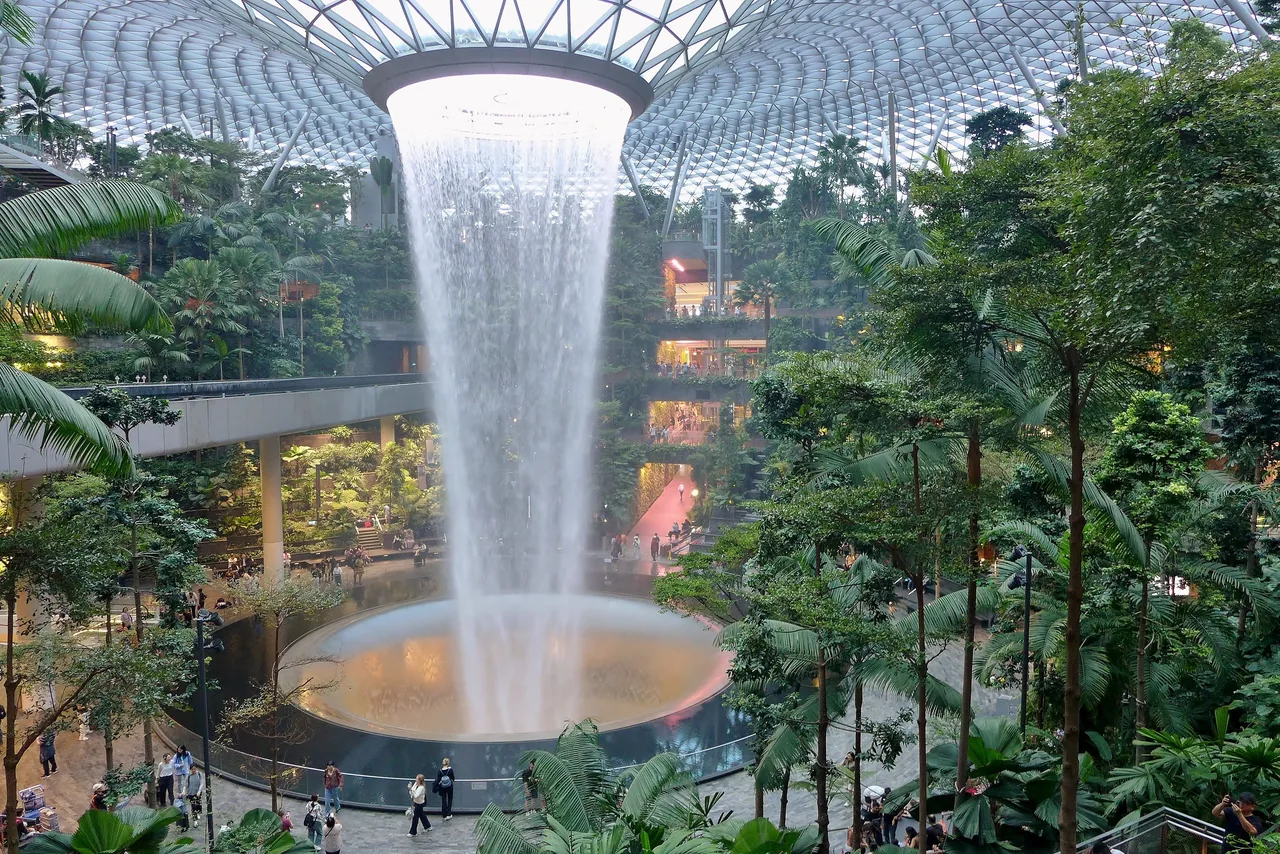
YOTELAIR has by far the shortest minimum stay of the four, bookable from about 4 hours, with same-day daycation slots also available roughly between 6am and 10pm. Guests also get a 24-hour gym and a community lounge with free hot drinks and a view over Jewel’s Rain VortexMap waterfall.
YOTELAIR’s own brand positioning does not hide that these are compact cabins built for efficient sleep rather than spacious stays, and across public reviews that tracks: guests travelling with two or more large suitcases consistently report it is tight to move around the cabin once bags are in, since the SmartBed and workstation do not leave much spare floor space. Cleanliness and design, on the other hand, are the two things reviewers praise most consistently, with the compact layout generally read as intentional and well executed rather than a shortcoming.
Rates move around with time of day, length of stay and season, with figures reported roughly from the high S$50s up into the S$90s and beyond, so check the live rate for your exact dates rather than relying on a single number.
Check today’s live rate below.
7. All Four Transit Hotels Compared
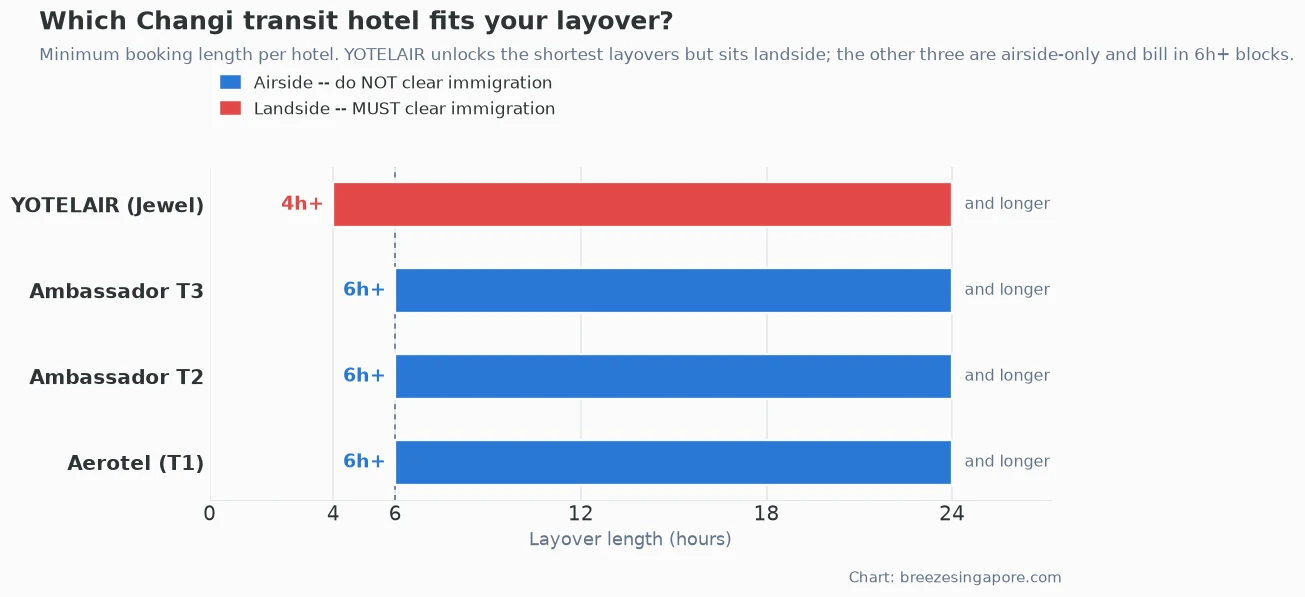
Side by side, the four hotels split cleanly by zone and minimum stay: YOTELAIR is landside and the shortest-stay option, while Aerotel and the two Ambassador Transit Hotels are all airside with 6-hour-plus minimums.
| Hotel | Terminal & zone | Minimum stay | Who can book | Signature feature |
|---|---|---|---|---|
| Aerotel Singapore | T1, airside | 6-hour blocks | Transiting & departing passengers | Airside outdoor pool |
| Ambassador Transit Hotel | T2, airside | 6 or 12-hour blocks | Valid ticket within 24 hours | Lounge access + buffet included |
| Ambassador Transit Hotel | T3, airside | 6, 12, 18 or 24-hour blocks | Valid ticket within 24 hours | Ensuite rooms, rain showers |
| YOTELAIR | Jewel, landside | From about 4 hours | Anyone who clears immigration | Shortest minimum stay, gym |
No single hotel wins outright: which one is right for you depends almost entirely on how long your layover is and which side of immigration you will be on. See the rates and full booking details in the review sections above for each property.
The chart below maps out exactly which hotels are usable for how long a layover.
8. Ultra-Short Layovers (2 to 4 Hours): What Actually Works
For a genuinely short layover of 2 to 4 hours, YOTELAIR is effectively the only transit hotel that fits, and even that is tight once you allow time for immigration, security and walking between terminals.
Aerotel and both Ambassador Transit Hotels are all billed from a minimum 6-hour block, so booking one for a 3-hour connection means paying for hours you will never use, on top of the check-in and check-out overhead of an airside hotel. YOTELAIR’s roughly 4-hour minimum is the shortest of the four, but a genuine 2-hour layover still leaves little room to check in, sleep and check out again in time.
For anything shorter than about 4 hours, a free snooze lounge or a pay-use shared lounge, covered in full in our Changi lounge guide, will almost always serve you better than trying to squeeze a transit hotel booking into the gap.
Be realistic below about 2 hours specifically: once you subtract the time it takes to check in, walk to the hotel, settle in, then check out and walk back to your gate, no transit hotel is genuinely worth booking. On a 2-hour layover you might end up with somewhere between 30 and 60 minutes of actual time in bed, for the same room rate as a much longer stay — at that point a free snooze lounge chair right by your gate will get you more usable rest for zero cost and zero walking.
9. Half-Day to Full-Day Layovers (6 to 24 Hours): Comparing the Airside Three
Once your layover stretches to 6 hours or more, all three airside hotels come into play, and the choice usually comes down to whether the fixed block lengths line up with the time you actually have.
Aerotel bills from a 6-hour minimum and can be booked in longer stretches for those wanting the extra facilities like its pool and library lounge. Both Ambassador Transit Hotels only sell fixed 6-hour or 12-hour blocks (Terminal 3 also offers 18 and 24-hour blocks), so a 9-hour layover, for example, still costs the full 12-hour rate at either Ambassador property, while at Aerotel you may be able to book closer to the time you actually need.
As a rough rule: a 6 to 8-hour overnight-ish layover suits the 6-hour block at any of the three, a 10 to 14-hour layover fits neatly into a 12-hour block, and anything approaching a full day is where Terminal 3’s 18 or 24-hour Ambassador options, or a longer Aerotel stay, start to make more financial sense than paying twice for two separate blocks.
A concrete example makes the arithmetic clearer: say you land at 11pm and depart at 7am, an 8-hour overnight layover. A 6-hour block booked from soon after landing covers almost the entire sleep window, leaving roughly 1 to 2 hours spare for checkout, a coffee and the walk back to your gate — comfortably enough, without paying for hours you will not use. Push past about 10 hours on the ground, though, and the maths flips: the 12-hour block starts working out as better value per hour than stacking a 6-hour block with an extension, so it is worth pricing both options for anything in that upper range before you book.
10. JetQuay Sleeping Suite: The Ultra-Premium Option
JetQuay’s Sleeping Suite is a private, ultra-premium airside option inside JetQuay’s own CIP terminal, but it is built around a dedicated concierge service rather than a normal walk-in hotel booking, so it is not really a fit for most travellers.
Published rates run around S$120 for 6 hours and S$200 for a stay of 10 to 22 hours, with extensions at roughly S$20 per hour, and each room is limited to a single guest. Using it requires booking JetQuay’s Quayside or Jetside service in advance and going through a separate, private immigration clearance process that works differently from any of the four main transit hotels covered above.
We mention it here for completeness, not as a mainstream recommendation: it suits travellers already using a private terminal service, not someone simply looking for a bed during an ordinary layover.
11. How to Book, and Why Timing Matters
Booking a Changi transit hotel ahead of time, rather than walking in and hoping, is the safer approach, because every one of these hotels has a limited number of rooms and can genuinely sell out.
- Match the hotel to your layover length. YOTELAIR from about 4 hours; Aerotel and the Ambassador hotels from 6-hour blocks upward.
- Confirm which side of immigration you’ll be on. Airside for Aerotel and both Ambassador properties, landside for YOTELAIR.
- Check your connection time is realistic. Build in time for check-in, security and walking between the hotel and your next gate.
- Book ahead, especially in peak season. Room counts range from 66 to 127 across the four hotels, and rooms can sell out around holidays and busy travel dates.
- Have your documents ready. Airside hotels expect a valid boarding pass or confirmed onward ticket; keep it handy at check-in.
Rates for all four hotels move with the season, the day of week and how far ahead you book, and different booking channels can show noticeably different prices for the exact same room and dates. For the timing of when Singapore’s own travel seasons are busiest, see our best time to visit guide.
One thing that catches first-time bookers off guard: check-in at these hotels is not a fixed clock time the way it is at a normal city hotel. It is keyed to the arrival time you enter when you book, so the hotel builds your stay around when you are actually expected to land — which also means a delayed flight is generally handled gracefully within reason, rather than costing you a no-show, as long as you can update the booking or notify the hotel once you know your new timing. Peak-season and holiday sellouts, meanwhile, are not a hypothetical risk — travellers have reported arriving to find every room already booked out, so treat the room-count limits above as a real ceiling, not a formality.
Check today’s live rates below.
12. Common Mistakes That Ruin a Layover Hotel Booking
The mistakes that actually derail a layover are almost always about timing and zones, not about the hotels themselves: clearing immigration too early, misjudging your connection time, and misunderstanding the fixed booking blocks.
- Clearing immigration when you meant to stay airside. Do this by accident and you can lock yourself out of Aerotel and both Ambassador Transit Hotels until an airline counter reopens for your next flight.
- Not checking your minimum connection time. A short layover eaten up by immigration, security and terminal transfers can leave far less usable time at the hotel than the booking length suggests.
- Assuming you can book by the hour. Aerotel and the Ambassador hotels sell fixed blocks (6, 12, 18 or 24 hours depending on the property), not hourly rates, so a 7-hour stay is billed as a full 12-hour block at an Ambassador hotel.
- Booking Ambassador Transit Hotel without a qualifying ticket. Both locations require a valid boarding pass or confirmed onward ticket within 24 hours; arrive without one and you may not be eligible to check in.
- Confusing the two Ambassador Transit Hotel locations. They are separate properties in Terminal 2 and Terminal 3, and are not interchangeable on the day.
- Walking in without a reservation during peak season. With as few as 66 rooms at one property, walk-in availability is never guaranteed.
- Heading for the wrong escalator or lift. Several of these hotels sit off more than one access point within the same terminal, and it is easy to walk toward the wrong escalator or lift and lose time you did not budget for. If you get lost, call the hotel directly rather than wandering — Aerotel’s transit desk is on +65 6701 1185 and the Terminal 3 Ambassador Transit Hotel is on +65 6507 9788.
13. Practical Logistics: Kids, Luggage and What to Expect
None of the four transit hotels advertise dedicated children’s facilities, so the practical appeal for families is simply a quiet, locked room and a real bed rather than shared lounge seating.
YOTELAIR’s Family Room, pairing a Queen SmartBed with two single bunk beds, is the one room type among the four specifically built around travelling with children, which makes it worth a look for families on a longer landside layover. At the airside hotels, families are generally accommodated in standard rooms with an extra-guest charge, so check each property’s own occupancy and pricing details for children when you book.
For luggage, treat these as ordinary hotel stays: you can typically bring carry-on and checked bags into your room, but exact policies and any storage limits are best confirmed directly with the hotel or booking channel at the time you reserve, since we could not verify a single universal rule across all four properties. Space is the one recurring complaint worth planning around: across public reviews of both YOTELAIR and the Ambassador Transit Hotels, travelling with two or more large suitcases is consistently described as tight, since the rooms are sized for a quick sleep stop rather than for spreading out luggage. If you are carrying oversized bags on a short layover, it is often more comfortable to check them into an airport luggage storage service rather than trying to fit everything into a compact room with you. If you are weighing up connectivity for the rest of your trip, our Singapore eSIM guide covers getting data sorted the moment you land.
14. Transit Hotel vs Pay-Use Lounge: The Final Decision Matrix
Choose a pay-use lounge for a shorter rest with shared seating and a shower at a lower price, and choose a private-room transit hotel when you specifically want a locked door and real sleep, even though it costs more.
| Factor | Pay-use lounge | Transit hotel |
|---|---|---|
| Typical price | Lower, time-based entry fee | Higher, block-based room rate |
| Privacy | Shared seating area | Private, lockable room |
| Sleep quality | Recliner or shared daybed | A real bed, behind a closed door |
| Extras included | Showers, buffet or snacks, wifi | Varies by hotel; some include a shower and meal |
| Privacy | Low — shared seating area, no lockable door | High — private, lockable room of your own |
| Luggage & kids | Workable for a short stop, less room to spread out | More space overall; YOTELAIR’s Family Room is the best fit for kids |
| Best for | Layovers under about 4 to 6 hours | Layovers of roughly 6 hours or more |
If you are still weighing the two up, our companion guide to Changi’s pay-use airport lounges covers every shared-lounge option in the same depth as this guide covers the four transit hotels, so you can compare both against your own layover length and budget before booking either one.
15. Sticking to Free? The Snooze Lounges
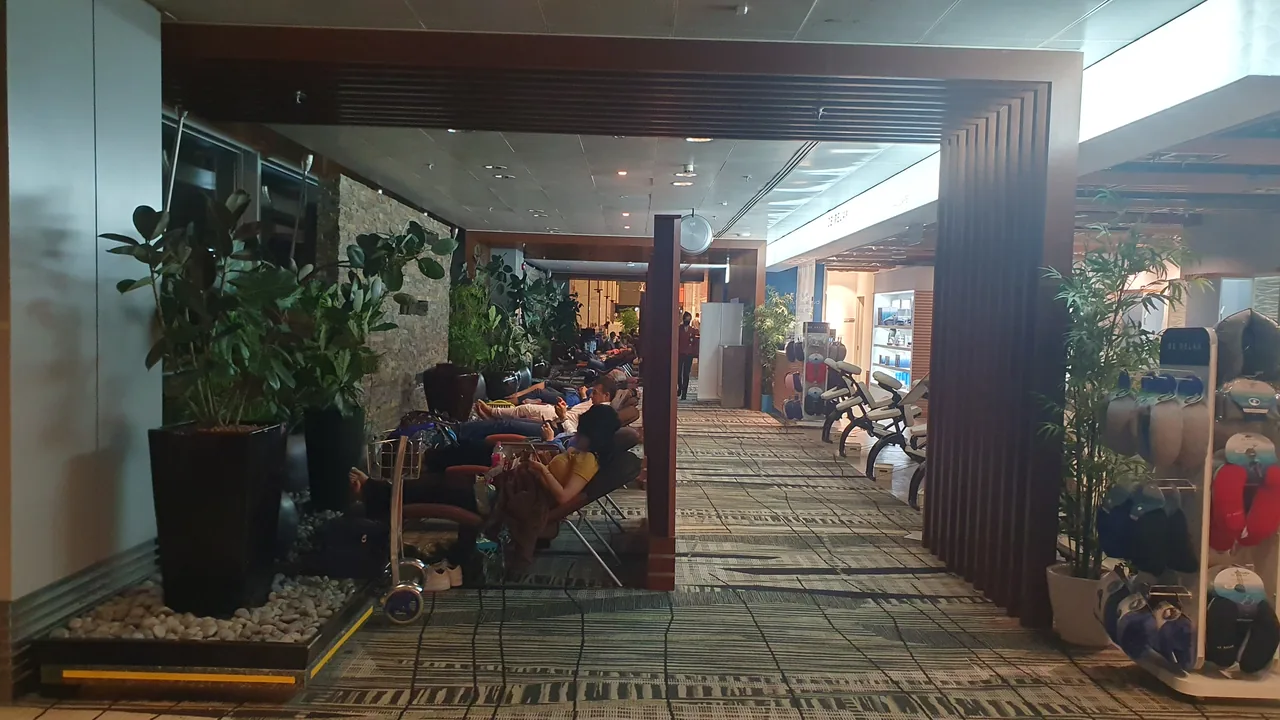
If you would rather not pay at all, every terminal at Changi has free snooze lounges with reclining chairs where you can rest without booking anything.
These are open, no-cost rest zones rather than private rooms, so there is no lock, no bed and no guaranteed quiet, but they cost nothing and need no reservation. The Terminal 3 snooze lounge is among the better-known ones, and similar rest zones exist across the other terminals too.
They suit a short doze on a long layover far better than a serious sleep, and they are the natural first stop if your connection is too short to justify either a lounge entry fee or a transit hotel block.
One realistic caveat: these seats are unreserved and strictly first-come, first-served, with no way to book or hold one ahead of time. During peak travel periods and on busy red-eye arrival waves, it is entirely possible to find a snooze lounge already full, so treat it as a good-odds free option rather than a guaranteed one, and have a backup plan (a pay-use lounge, or simply a quieter gate area) in mind if your flight lands in the middle of a rush.
16. Summary and What’s Next
Start with the zone: airside means Aerotel or an Ambassador Transit Hotel and no immigration, landside means YOTELAIR and clearing immigration first, and everything else follows from your layover length and budget.
| Before you book | Why it matters |
|---|---|
| Know your zone: airside or landside | Determines whether you can clear immigration |
| Match the hotel to your layover length | 4-hour minimum at YOTELAIR vs 6-hour-plus blocks elsewhere |
| Check your document if booking airside | Ambassador hotels need a valid ticket within 24 hours |
| Book ahead in peak season | As few as 66 rooms per property can sell out |
| Confirm the live rate at booking | Prices move with season, demand and platform |
With your transit hotel sorted, round out the rest of your time at the airport: compare the shared, pay-use option in our Changi lounge guide, plan the rest of a longer stopover with our layover guide, and get the practical basics right with our full Changi Airport guide. If you’re heading into the city afterwards, our Singapore transport guide covers the ride in, our eSIM guide gets you connected, and our Singapore on a budget guide and best time to visit guide help with everything beyond the airport. It all ties back to our complete Singapore travel guide.
🎡Things to Do52
🍜Food4
🏨Where to Stay10
🚇Getting Around4
🧭Travel Tips15
Frequently asked questions
Plan the rest of your layover with our complete Changi Airport layover guide