
The Merlion: Singapore’s Icon — and Is It Worth the Trip?
The half-lion, half-fish Merlion is Singapore’s national symbol — and its waterfront park frames the city’s most famous view. Here’s the full story: the legend, the history, all the Merlions, the best photos and how to visit.
- The Merlion — a mythical creature with a lion’s head and a fish’s body — is Singapore’s national icon, and Merlion Park on the Marina Bay waterfront is where the famous 8.6-metre statue stands, spouting water from its mouth.
- The lion’s head represents Singapura, the ‘Lion City,’ from the legend of Prince Sang Nila Utama; the fish body recalls Temasek, the ‘Sea Town,’ and the island’s humble origins as a fishing village.
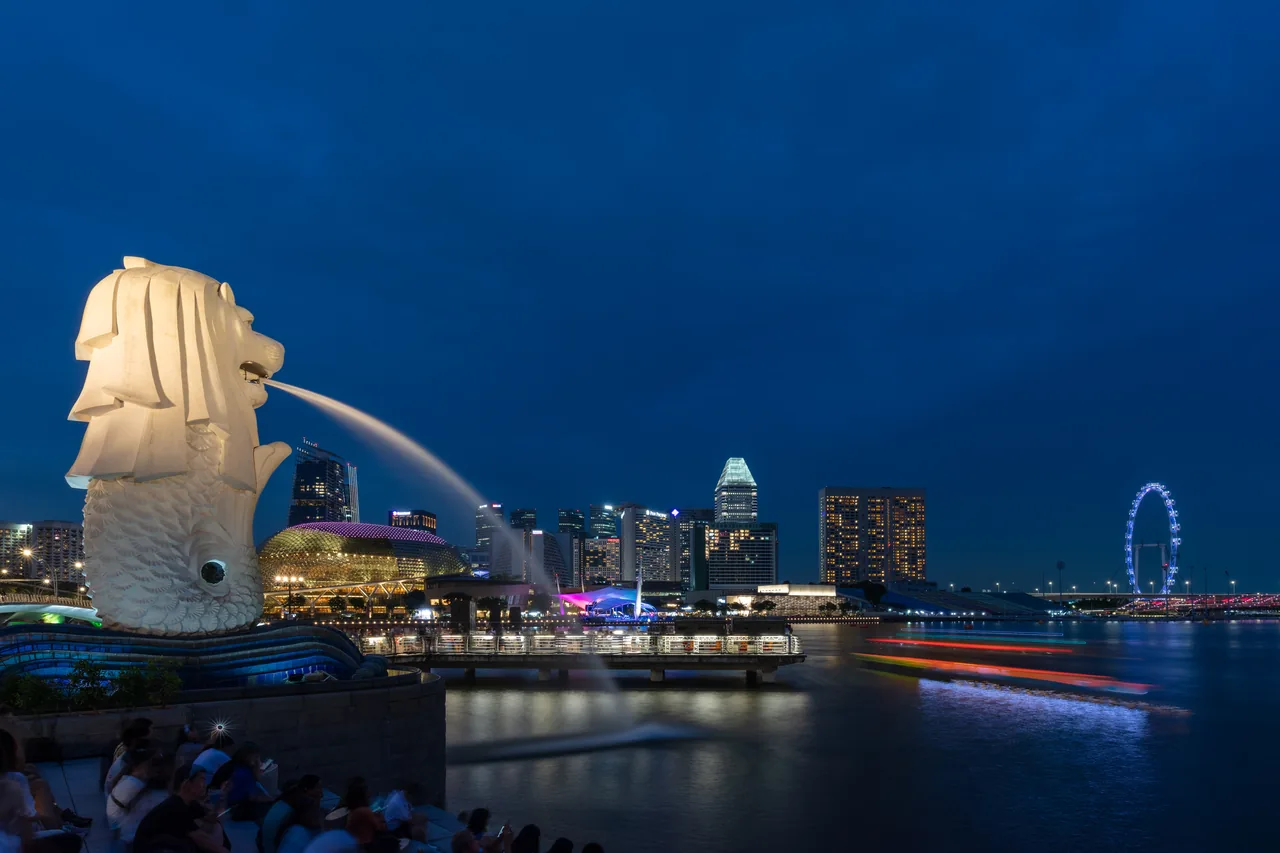
- It’s completely free and open 24 hours, with viewing decks that frame Singapore’s postcard panorama — Marina Bay SandsMap, the ArtScience MuseumMap, the EsplanadeMap and the bay all in one shot.
- The classic photo is a forced-perspective trick — ‘catching’ or ‘drinking’ the water spouting from the Merlion’s mouth — and the best light is at sunrise, sunset and the blue hour, when the bay lights up.
- It’s small (a quick visit), often crowded and best combined with the rest of Marina Bay; reach it on foot from Raffles Place, Esplanade or Bayfront MRT stations.
| Location | One Fullerton, Marina Bay waterfront |
|---|---|
| Opening hours | Open 24 hours, daily |
| Price | Free |
| Time needed | 15–30 minutes |
| Getting there | ~10-min walk from Raffles Place MRT |
| Best for | Photos & the Marina Bay skyline view |
| Best time | Sunrise or blue hour (fewer crowds) |
1. What is the Merlion?
2. The legend: Singapura, the Lion City
3. The symbolism: decoding the lion and the fish
4. Who designed the Merlion?
5. The statue’s story: 1972
6. The great 2002 move: relocating 70 tonnes
7. The statue up close: dimensions, water & the cub
8. The Merlions of Singapore: where to find them all
9. The lost giant: the 37-metre Sentosa Merlion
10. Merlion Park: location, hours & what to expect
11. The view: Singapore’s postcard panorama
12. Photography masterclass: the famous ‘mouth’ shot
13. Best time to visit
14. How to get there
15. Combine it with Marina Bay: the waterfront loop
16. The Merlion in Singaporean culture
17. Is the Merlion worth visiting?
18. Practical tips & nearby
No symbol says ‘Singapore’ like the Merlion — a mythical beast with the head of a lion and the body of a fish, forever spouting water over Marina Bay. It appears on souvenirs, in textbooks and across the city’s imagination, and the 8.6-metre statue at Merlion Park is the single most photographed spot in the country. Yet most visitors know surprisingly little about it: where the strange creature came from, what its two halves mean, why it was hauled 120 metres across the water in 2002, or how many Merlions actually exist (and the giant one that’s now gone). This guide tells the whole story — the legend of the Lion City, the symbolism decoded, the statue’s history, every Merlion in Singapore, a photography masterclass for the famous ‘mouth’ shot, the spectacular bay view, and exactly when and how to visit a landmark that costs nothing and never closes. Pair it with our complete Singapore travel guide and our Marina Bay Sands and Gardens by the Bay guides to plan a full day around the bay.
1. What is the Merlion?
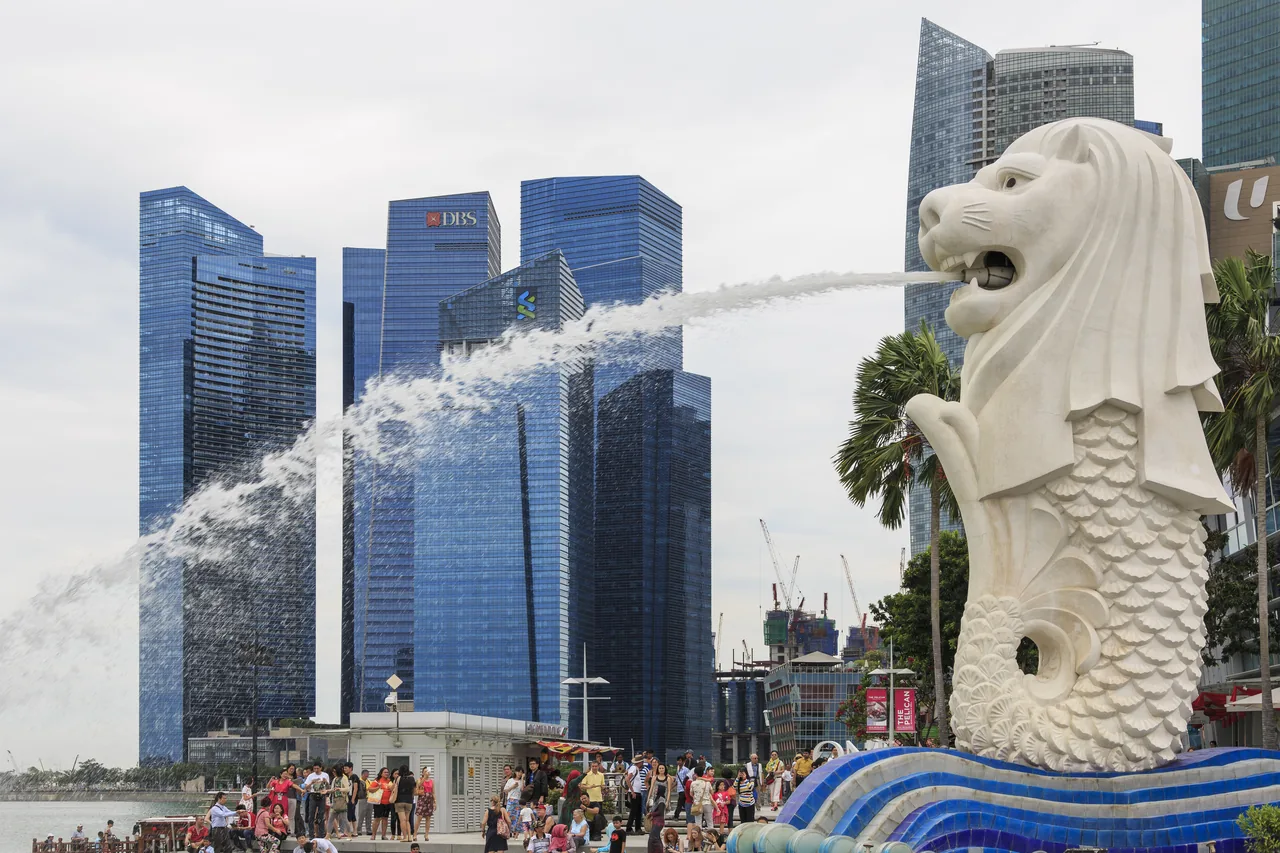
The Merlion is Singapore’s national symbol: a mythical creature with the head of a lion and the body and tail of a fish, most famously rendered as an 8.6-metre statue at Merlion Park that spouts water into Marina Bay.
Half-lion, half-fish, it is at once instantly recognisable and a little surreal — a beast that exists nowhere in nature, invented to capture Singapore’s identity in a single figure. The two halves are not random: the lion stands for the city’s name and the fish for its origins (more on that below). Since the 1960s the Merlion has appeared on the tourism board’s logo, on countless souvenirs, in school textbooks and across the national imagination, becoming the country’s de facto mascot. The statue at Merlion Park, on the Marina Bay waterfront, is where visitors come to see it in the flesh — and it is, by a wide margin, the most photographed spot in Singapore. To understand why a lion-fish, you have to start with a 14th-century legend.
2. The legend: Singapura, the Lion City
The lion in the Merlion comes from the legend of Sang Nila Utama, a 14th-century prince who, the story goes, landed on the island and spotted a lion — and named the place Singapura, Sanskrit for ‘Lion City.’
According to the Malay Annals, Sang Nila Utama was a prince of Srivijaya, from Palembang in Sumatra. While out at sea he was caught in a storm and landed on an island then known as Temasek. Exploring the shore, he is said to have glimpsed a magnificent creature — golden-bodied, swift and powerful — which his advisors told him was a lion. Taking it as an auspicious sign, he founded a city there and named it Singapura, from the Sanskrit singa (lion) and pura (city). Whether a lion ever truly roamed the island is doubtful — lions are not native to the region, and it may well have been a tiger — but the legend gave Singapore its enduring name and the lion at the heart of its symbol.
3. The symbolism: decoding the lion and the fish
The Merlion’s two halves each carry meaning: the lion’s head represents Singapura, the Lion City of legend, while the fish body and tail represent Temasek, the ‘Sea Town,’ and the island’s beginnings as a fishing village.
Before it was Singapura, the island was called Temasek, a Javanese word meaning ‘Sea Town.’ For centuries it was a modest fishing settlement and trading post, its fortunes bound to the water. The Merlion fuses these two identities: the proud lion’s head for the name and spirit of the Lion City, and the fish’s body for its humble maritime roots and its rise as a great port. In other words, the creature tells Singapore’s whole story in one image — from a fishing village on the sea to a modern city that still faces, and lives by, the water. That is why it spouts its jet of water out over Marina Bay: a symbol forever returning to the sea that made it.
4. Who designed the Merlion?
The Merlion was designed in 1964 by Alec Fraser-Brunner, a member of the Souvenir Committee and curator of the Van Kleef Aquarium, as the logo for Singapore’s tourism board — and it served as that emblem from 1964 to 1997.
When Singapore set out to build a tourism identity in the 1960s, it needed a memorable symbol. Fraser-Brunner, an Englishman and an authority on fish, drew the lion-fish that married the island’s legendary name to its seafaring origins. Adopted by the Singapore Tourism Board (then the STPB) on 26 March 1964, the Merlion logo represented the country’s tourism for over three decades before the board updated its branding in 1997. By then the creature had long outgrown its origins as a mere logo: it had become a beloved national icon in its own right, soon to be immortalised in stone and water on the waterfront.
5. The statue’s story: 1972
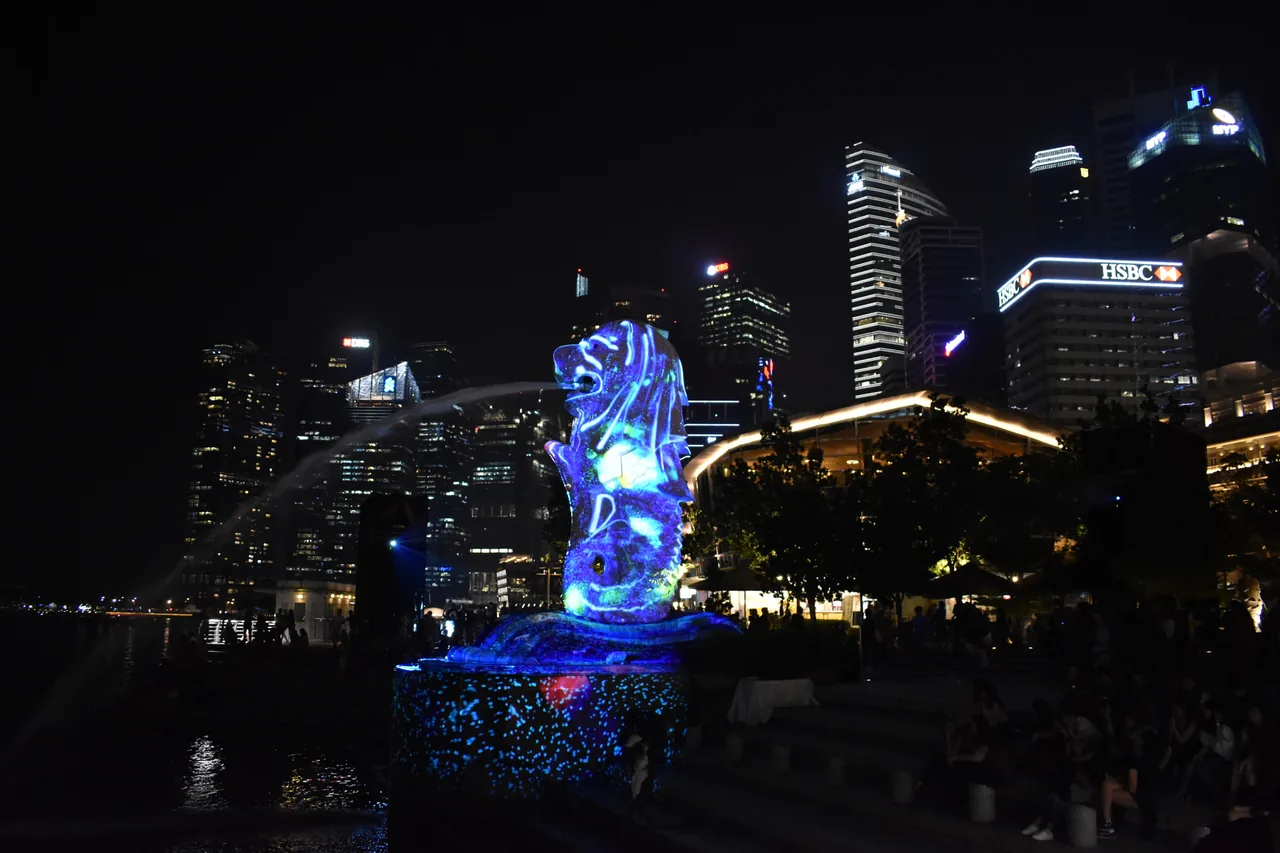
The Merlion statue was unveiled on 15 September 1972 by Prime Minister Lee Kuan Yew — an 8.6-metre, 70-tonne figure sculpted by Lim Nang Seng, originally standing at the mouth of the Singapore River.
To give the symbol a physical home, the tourism board commissioned a grand statue. Designed with input from artist Kwan Sai Kheong and sculpted by craftsman Lim Nang Seng, it was built from cement fondue with a skin of small porcelain plates, weighing some 70 tonnes. Prime Minister Lee Kuan Yew officiated its installation on 15 September 1972, at a site near the Singapore River’s mouth by the Anderson Bridge, where it greeted boats arriving in the harbour. From the start it did what it still does today — spout a continuous jet of water from its mouth — and it quickly became the country’s signature photo. For thirty years it stood at that original spot, until the city’s changing skyline forced a dramatic decision.
6. The great 2002 move: relocating 70 tonnes
In April 2002 the entire 70-tonne Merlion was carefully moved about 120 metres to its current home at Merlion Park, because the new Esplanade Bridge had blocked its view of the bay — a complex engineering feat that took several days.
By the early 2000s the construction of the Esplanade Bridge meant the Merlion, at its original riverside spot, was hidden from the waterfront — visitors could barely see it from the bay. So the authorities decided to relocate the statue (and its cub) to a purpose-built park nearby with an open view across Marina Bay. The move, from 23 to 25 April 2002, required a barge, two enormous cranes with a 5,000-tonne lifting capacity and a team of around 20 engineers, who lifted and shifted the fragile, porcelain-skinned giant without breaking it. In a neat piece of symmetry, Lee Kuan Yew returned on 15 September 2002 — exactly thirty years after he first unveiled it — to welcome the Merlion to its new home, where it has stood ever since.
7. The statue up close: dimensions, water & the cub
Up close, the Merlion is an 8.6-metre, 70-tonne statue of cement fondue clad in porcelain scales, endlessly pumping a jet of water from its mouth — and just behind it stands a often-overlooked smaller ‘Merlion cub.’
Standing on its plinth above the water, the main Merlion is bigger up close than photos suggest, its surface a mosaic of tiny porcelain plates that catch the light. The famous spout is created by a pump that recirculates water out through its mouth and into the bay around the clock, so the statue is always ‘flowing’ for photos. Directly behind it, many visitors walk straight past the Merlion cub — a charming 2-metre, 3-tonne miniature of the original, added as a companion piece. Seek it out: it’s a quieter photo, and a nice detail most people miss. Together, the parent-and-cub pairing has guarded this stretch of waterfront for decades.
8. The Merlions of Singapore: where to find them all
Beyond the famous statue, the Singapore Tourism Board recognises several official Merlions dotted around the island — so the one at Merlion Park is just the most famous of a small family.
If you want to spot more than one, here’s where the recognised Merlions stand:
| Merlion | Height | Where |
|---|---|---|
| Merlion Park (the original) | 8.6 m | One Fullerton, Marina Bay waterfront |
| The Merlion cub | 2 m | Right behind the main statue |
| Tourism Court | 3 m | Near Grange Road (tourism board area) |
| Mount Faber | 3 m | Faber Point, with harbour views |
| Ang Mo Kio | small (a pair) | In the residential heartlands |
| SentosaMap (demolished 2019) | 37 m | No longer exists |
For nearly everyone, the Merlion Park statue (and its cub) is the one to see. The Mount Faber Merlion is a fun bonus if you ride the cable car or walk the Southern Ridges, rewarding you with a panorama over the harbour.
9. The lost giant: the 37-metre Sentosa Merlion
The largest Merlion of all was a 37-metre giant on Sentosa that you could climb inside — but it was demolished in 2019, so it no longer exists.
Built in the 1990s, the Sentosa Merlion towered over the resort island at 37 metres, more than four times the height of the waterfront statue. Unlike the others, this one was a building you could enter: lifts and stairs took visitors up into viewing galleries, including one in the lion’s mouth, for panoramic views over Sentosa and the harbour. It closed for the last time on 20 October 2019 and was demolished to make way for the Sentosa-Brani revitalisation and the wider Greater Southern Waterfront redevelopment. So if you’ve seen older photos of a colossal Merlion you could go inside, that landmark is gone — the iconic statue to visit today is the 8.6-metre original at Merlion Park. For what’s on the island now, see our Sentosa Island guide.
10. Merlion Park: location, hours & what to expect
Merlion Park is a free, public waterfront park at One Fullerton on Marina Bay, open 24 hours a day — a compact space built around the statue, with viewing decks looking across the water.
The park sits right on the bayfront, beside the Esplanade Bridge, with the Merlion facing out over Marina Bay. There are no tickets and no opening hours — you can wander in at any time, day or night. It’s not large: a couple of viewing decks, some steps down toward the water, and the two statues. Most visitors spend 15 to 30 minutes here taking photos and soaking up the view. Set your expectations accordingly — this is a quick, iconic photo stop rather than a lengthy attraction — and plan to fold it into a longer Marina Bay walk (see below). Bring sun protection by day; there’s little shade on the open deck.
11. The view: Singapore’s postcard panorama
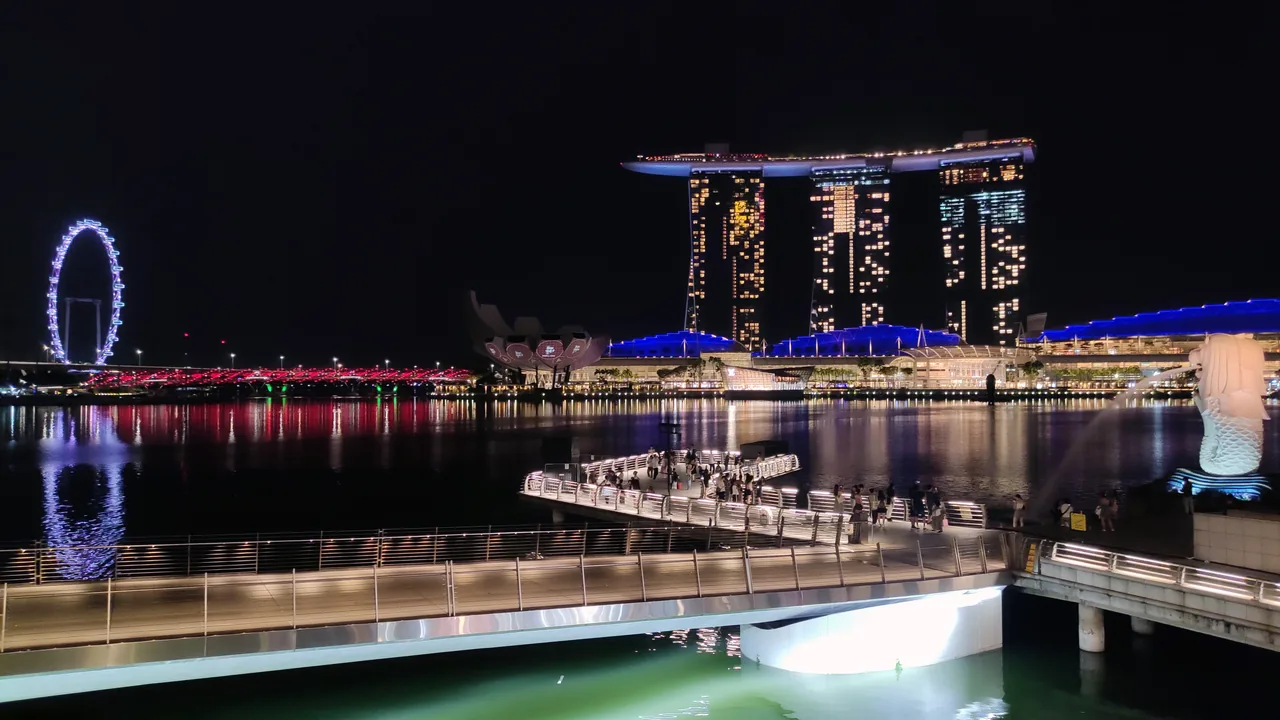
The real magic of Merlion Park is the view: from its decks you take in Singapore’s signature panorama — Marina Bay Sands, the lotus-shaped ArtScience Museum, the Esplanade, the Helix BridgeMap and the Singapore FlyerMap, all wrapped around the glittering bay.
Look across the water and the whole of modern Singapore lines up in one frame. Dominating the far shore is the three-towered Marina Bay Sands with its ship-like SkyPark; beside it, the ArtScience Museum opens like a white lotus; to the left stretch the spiky domes of the Esplanade theatres and the curving Helix Bridge; and the giant Singapore Flyer observation wheel turns in the distance. By day it’s a gleaming cityscape; by night it becomes a wall of light reflected in the bay. This is the shot on a thousand postcards — and standing at the Merlion, with the city arrayed before you, is the moment many visitors finally feel they’ve ‘arrived’ in Singapore.
12. Photography masterclass: the famous ‘mouth’ shot
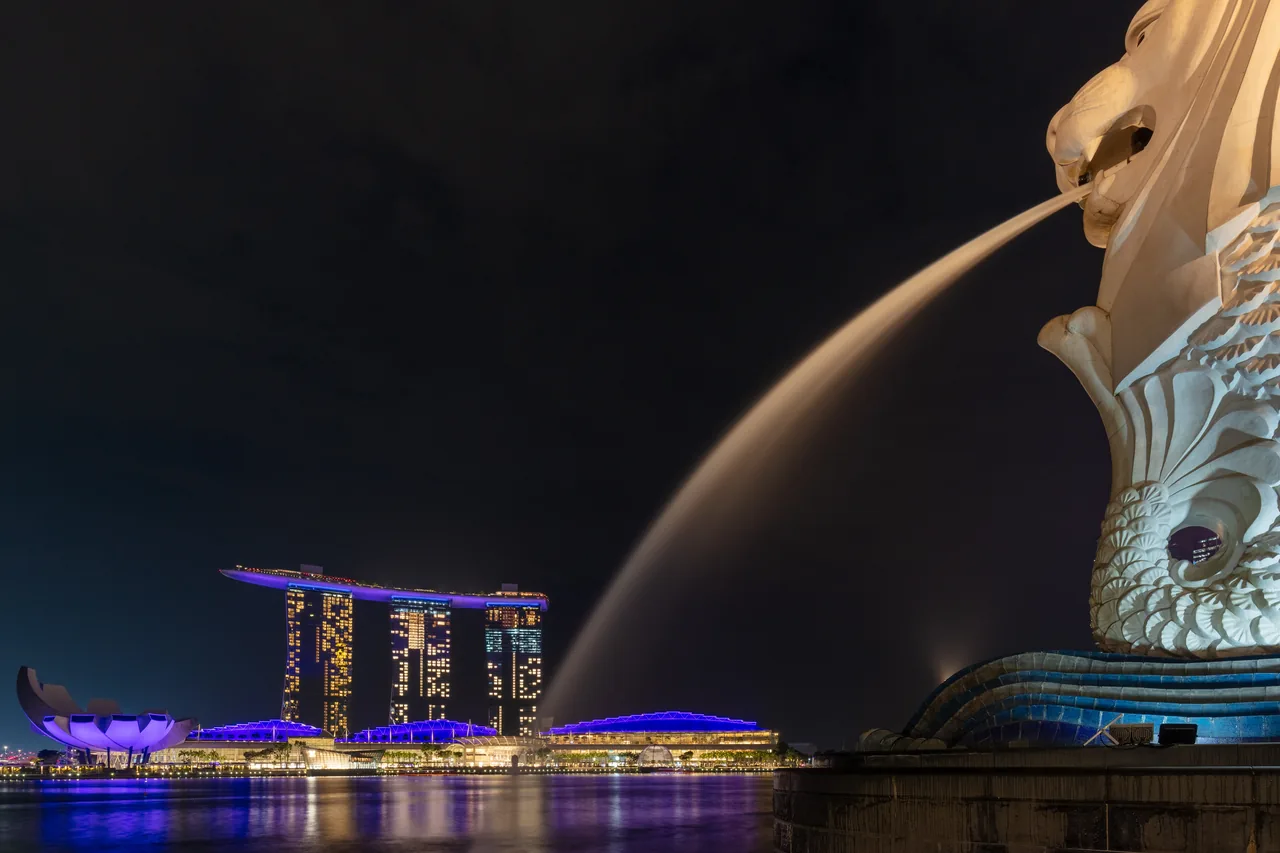
The classic Merlion photo is a forced-perspective trick — lining yourself up so the jet of water from the Merlion’s mouth seems to pour into your hand, your mouth or a cup — and a little technique makes it work.
Here’s how to nail it, plus the wider shots worth getting:
- The water trick: stand to the side along the lower deck and position yourself so, from your photographer’s viewpoint, the arc of water lines up with your open hand or mouth. Move a few centimetres at a time until it ‘connects.’
- Frame from a distance: have your friend step back so both you and the whole Merlion fit, and so both are in focus — a phone’s wide lens helps.
- The full panorama: shoot the Merlion off-centre with Marina Bay Sands and the skyline behind for the definitive Singapore frame.
- Light: sunrise and the blue hour after sunset give soft colour and lit-up buildings; midday sun is harsh and the crowds are thickest.
- Patience: it’s the country’s busiest photo spot, so expect to queue politely for the prime spot — early morning is your friend.
13. Best time to visit
Visit at sunrise or early morning for soft light and few people, or come for sunset and the blue hour, when Marina Bay Sands and the skyline light up and reflect in the water — night is spectacular too.
Because the park is free and open around the clock, you can choose your light. Sunrise and the hour after are magical and almost empty — the best time for clean photos. Sunset and blue hour deliver the postcard glow as the city switches on, though it’s busy. Night is dramatic, with everything illuminated, and lets you pair the Merlion with the free Spectra light-and-water show across the bay at Marina Bay Sands (nightly). Midday is the least flattering — hot, harshly lit and crowded. Whatever the hour, the weather is warm and humid year-round; for the broader picture of seasons, festivals and rain, see our best time to visit Singapore guide.
14. How to get there
Merlion Park is at One Fullerton on the Marina Bay waterfront, an easy walk from the Raffles Place, Esplanade and Bayfront MRT stations — and a short, scenic stroll from Marina Bay Sands and Clarke QuayMap.
The simplest route is by MRT:
- Raffles Place (closest): head toward the Singapore River and the Fullerton Hotel, then follow the waterfront — about a 10-minute walk.
- Esplanade or City Hall: walk to the Esplanade and across to the bayfront.
- Bayfront: walk over from the Marina Bay Sands / ArtScience side around the bay.
It also links naturally on foot to Marina Bay Sands, the Esplanade, the Fullerton Hotel and Clarke Quay along the bayside promenade, so you’ll often pass it as part of a longer walk. For fares, passes and the network, see our MRT & transport guide.
15. Combine it with Marina Bay: the waterfront loop
The Merlion is best enjoyed as the anchor of a walk around Marina Bay — a free, mostly flat loop that strings together the city’s headline sights along the waterfront promenade.
From Merlion Park you can walk the promenade right around the bay, taking in the Esplanade theatres, the Helix Bridge (a DNA-shaped pedestrian span), Marina Bay Sands and the ArtScience Museum, then on to Gardens by the Bay for its free nightly Supertree light show. Time it so you catch the free Spectra light-and-water show on the MBS waterfront (nightly), and finish with dinner or drinks at one of the bayside spots. In the other direction lie the historic Fullerton Hotel and the riverside bars of Clarke Quay. It’s one of the best — and cheapest — evenings in the city; for more free ideas, see our Singapore budget guide.
16. The Merlion in Singaporean culture
The Merlion is far more than a statue — it’s Singapore’s national personification, a souvenir-shop staple and a recurring figure in the country’s art, poetry and humour.
From fridge magnets and plush toys to chocolates and keyrings, the Merlion’s lion-fish silhouette is the face of Singapore tourism. But it also runs deeper in the culture: poets and artists have used it to explore national identity — Edwin Thumboo’s well-known poem ‘Ulysses by the Merlion’ meditates on the young nation through the figure — and locals are fond of gently teasing it (the perpetual spout has earned plenty of affectionate jokes about the creature being unwell). It has featured in countless artworks, including temporary installations that have reimagined it in playful ways. In 2022 the statue celebrated its 50th anniversary, a reminder of how thoroughly this invented beast has become a genuine, beloved emblem of the nation.
17. Is the Merlion worth visiting?
For first-time visitors, yes — it’s the definitive Singapore landmark and the free view across Marina Bay is genuinely spectacular — but go in with realistic expectations: the statue is modest in size, the park is small and it’s often crowded.
Some travellers arrive expecting a huge monument and a grand site, and come away feeling the Merlion is smaller than they pictured — a fair point. The way to enjoy it is to reframe what it is: not a half-day attraction, but a quick, iconic, free photo stop and the gateway to Singapore’s best waterfront. Spend 15–30 minutes here, get your photo, take in the panorama, and then let it lead you into a longer Marina Bay walk. Visit at sunrise or blue hour rather than the harsh, packed midday, and it goes from a tick-box stop to a highlight. As the symbol of the city, seeing it in person is something most visitors are glad they did.
18. Practical tips & nearby
A few practical pointers make a Merlion Park visit smoother — and it’s surrounded by some of the best of central Singapore.
- It’s free and 24/7 — no tickets, no queues to enter; choose your light.
- Go early or at blue hour for the best photos and the smallest crowds.
- Little shade: bring sun protection and water by day — it’s hot on the open deck.
- Don’t miss the cub just behind the main statue.
- Pair it with the Marina Bay loop and the free Spectra show at Marina Bay Sands.
- Nearby food: One Fullerton and the Fullerton Bay area have waterfront dining; Clarke Quay’s bars are a short walk away.
- With kids: the open waterfront and the water jet are a fun, free stop — see our Singapore with kids guide.
With your visit to the country’s icon planned, use our complete Singapore travel guide to map the rest, and dive into the Marina Bay Sands, Gardens by the Bay and best time to visit guides to build the perfect day around the bay.